

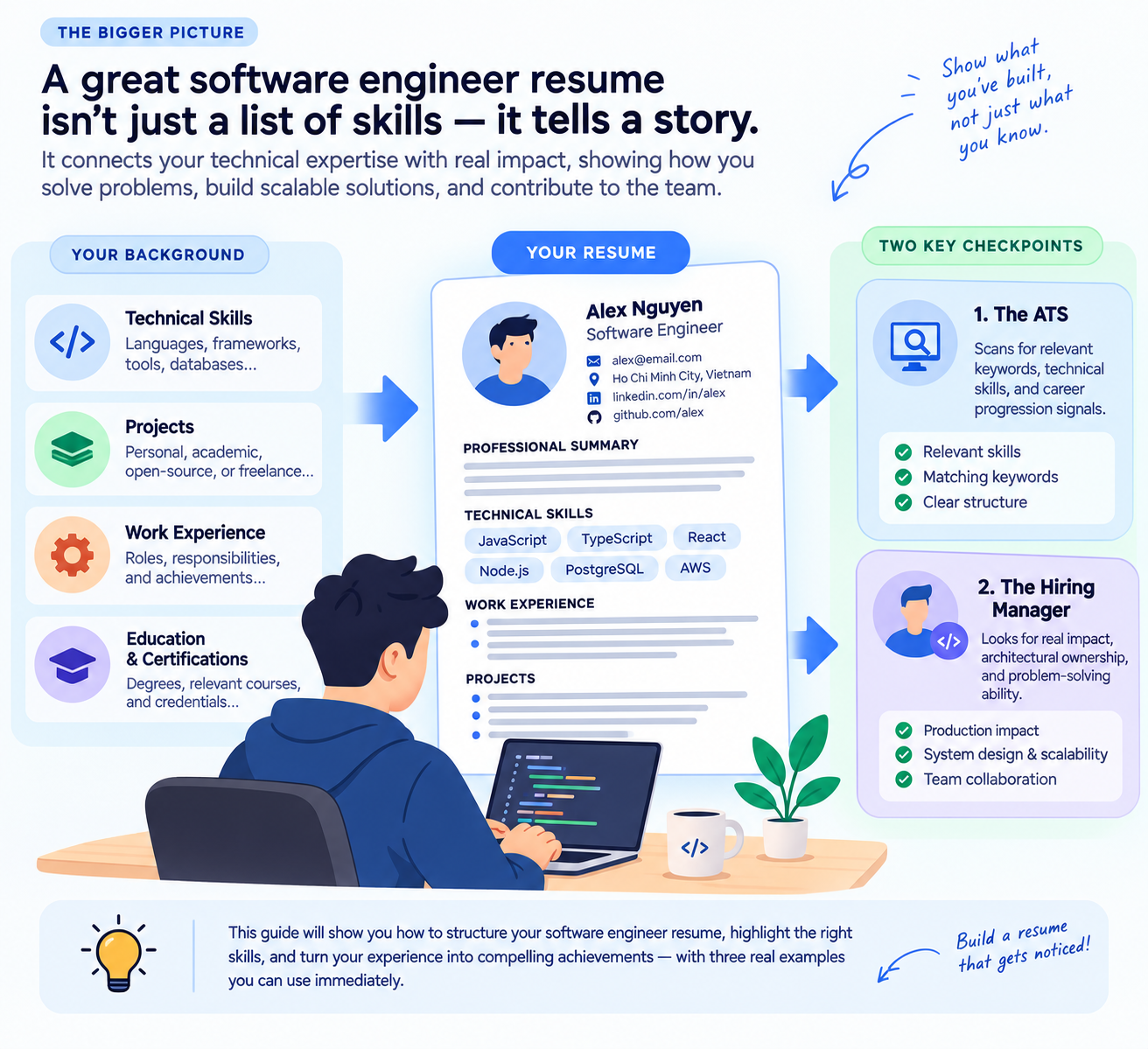
A software engineer’s resume is more than a record of programming languages and frameworks. It’s a snapshot of how you think, build, and solve problems. From debugging complex systems to shipping features that improve user experience, the strongest resumes reveal the engineering decisions behind the work—not just the technologies used.
But how do you communicate that value when you have limited space? The key is to connect your technical expertise with tangible contributions, whether you’re a recent graduate showcasing personal projects, a developer building production applications, or a senior engineer leading architectural decisions.
In this guide, you’ll learn how to structure your software engineer resume, highlight the skills employers look for, turn technical responsibilities into compelling achievements, and explore resume examples for different career stages.
Software engineering roles can vary widely. One company may need a frontend developer who creates responsive interfaces, while another is looking for a backend engineer who builds scalable APIs or a DevOps engineer who improves deployment workflows.
Hiring managers want to understand a few things:
What programming languages, frameworks, and tools can you use?
What applications, systems, or projects have you built?
How have you solved technical problems?
What measurable results have you achieved?
Can your experience and skills match the role?
Your resume should answer these questions without making recruiters dig through pages of unrelated information.
Whether you’re applying for a Junior Software Engineer, Full-Stack Developer, Backend Engineer, Frontend Developer, or Senior Software Engineer position, focus on the skills and achievements that matter most to that particular job.
Think of your resume as a technical portfolio in a compact format. Every section should help demonstrate your suitability for the role.
Include your full name, professional email address, phone number, location, and relevant professional links. Add your LinkedIn profile, GitHub account, or personal portfolio if they showcase your work.
Write two to four sentences introducing your specialization, strongest technical skills, relevant experience, and most important achievement.
Group your programming languages, frameworks, databases, cloud platforms, and development tools into clear categories.
Describe your responsibilities through specific contributions, technical decisions, and outcomes. Use numbers when you have reliable data.
Showcase relevant personal, academic, freelance, or open-source projects, especially if you have limited professional experience.
Include your degree, university, major, and graduation year where relevant. Students and recent graduates can also highlight relevant coursework.
Add relevant credentials, such as AWS, Microsoft Azure, Google Cloud, or Kubernetes certifications, if you hold them.
You don’t need to include every section in every resume. Prioritize the information that best supports your application.
Sending the same resume to every company may save time, but it can make your application less relevant.
Before writing, read the job description carefully. Identify the required technologies, responsibilities, experience level, and preferred qualifications.
For example, a frontend developer role might emphasize React, TypeScript, responsive design, and accessibility. A backend position may focus on API development, database optimization, distributed systems, and cloud infrastructure.
Use these requirements to decide which skills, projects, and achievements to highlight.
Example:
If a job description asks for experience with React, TypeScript, REST APIs, and automated testing, highlight relevant experience with those technologies near the top of your resume, provided you genuinely have those skills.
Applicant tracking systems (ATS) may help employers organize applications and identify relevant information. Using standard section headings and relevant terminology can make your resume easier for both software and human reviewers to understand.
You’re not changing your experience to fit the job. You’re making the most relevant parts easier to find.
Your professional summary is a short introduction to your technical background. It should tell recruiters who you are, what you specialize in, and what you can contribute.
Use this formula:
[Job title or experience] + [technical specialization] + [key skills] + [achievement or value]
Here’s how it works in practice.
Weak example:
“Hardworking software engineer looking for an opportunity to learn new technologies and grow professionally.”
This statement could describe almost any applicant. It doesn’t explain what you can do or what makes you qualified.
Better example — Entry-level software engineer:
“Entry-level Software Engineer with a foundation in JavaScript, React, Node.js, and PostgreSQL. Experienced in building and deploying full-stack projects, implementing REST APIs, and writing automated tests. Eager to contribute to user-focused applications while developing strong software engineering practices.”
Example — Mid-level software engineer:
“Full-Stack Software Engineer with 4+ years of experience developing web applications using React, TypeScript, Node.js, and PostgreSQL. Experienced in API optimization, automated testing, and CI/CD workflows, with a focus on building reliable, maintainable applications.”
Example — Senior software engineer:
“Senior Backend Engineer with 8+ years of experience designing distributed systems and cloud-native applications using Java, Spring Boot, Kafka, and Kubernetes. Experienced in technical leadership, system reliability, and performance optimization, with a track record of delivering scalable production systems.”
Use the example closest to your experience level as a starting point, then customize it with your actual skills and achievements. Avoid claiming expertise, years of experience, or results you cannot substantiate.
This is where many software engineer resumes fall short. Listing daily responsibilities tells recruiters what you were assigned to do, but not how well you did it.
Compare these examples.
Weak Resume Bullet | Stronger Resume Bullet |
|---|---|
Responsible for optimizing database queries and improving application performance. | Optimized PostgreSQL queries and introduced indexing strategies, reducing average report generation time by 35%. |
Developed frontend components using React. | Built 12 reusable React components for a shared design system, helping 3 development teams deliver interface updates more consistently. |
Worked on CI/CD pipelines and deployment automation. | Automated build and test workflows using GitHub Actions, reducing release preparation time from 40 minutes to 12 minutes. |
The stronger examples explain the action, the technical approach, and the result. The figures are illustrative; use your own verified results when writing your resume.
A useful framework for writing achievement-focused bullet points is:
Accomplished [X], as measured by [Y], by doing [Z].
X — Outcome: What did you improve, build, or deliver?
Y — Measurement: What evidence demonstrates the result?
Z — Action: What technologies, methods, or decisions helped you achieve it?
For example:
“Reduced API response time by 40% by implementing Redis caching and optimizing PostgreSQL queries.”
Not every achievement needs a percentage or revenue figure. You can also highlight the number of features delivered, services supported, tests written, users served, or manual steps eliminated.
If you don’t have access to exact metrics, describe the scope and technical contribution accurately rather than inventing numbers.
Your skills section should be easy to scan and relevant to the position. Instead of listing every tool you have encountered, group the technologies you can confidently use.
Examples include:
Programming languages: JavaScript, TypeScript, Python, Java, Go, C++
Frontend: React, Next.js, Angular, HTML, CSS
Backend: Node.js, Express, Spring Boot, Django, REST APIs
Databases: PostgreSQL, MySQL, MongoDB, Redis
Cloud and DevOps: AWS, Azure, Docker, Kubernetes, GitHub Actions
Testing and development practices: Jest, Cypress, unit testing, integration testing, CI/CD, Agile
Choose the categories and technologies that reflect your actual background. A frontend developer does not need the same skills section as a cloud infrastructure engineer.
Avoid rating yourself with arbitrary skill bars such as “Python: 90%.” Concrete experience and relevant projects provide better evidence of proficiency.
If you’re a student, recent graduate, career changer, or self-taught developer, projects can demonstrate practical skills even when your professional experience is limited.
For each project, include:
Project name: Give it a clear, descriptive title.
Tech stack: List the main languages, frameworks, and tools.
Purpose: Explain the problem your project solves.
Your contribution: Describe the features or technical challenges you handled.
Evidence: Add a GitHub repository, live demo, or portfolio link when available.
Example:
TaskFlow — Collaborative Project Management App
Tech stack: React, Node.js, PostgreSQL, Docker
Developed a task management application with project boards, task assignments, and status tracking.
Built REST APIs to manage project data and user permissions.
Implemented automated tests for core application features.
Published the source code on GitHub with setup instructions and documentation.
This example is suitable for a personal or academic project. If you have genuine usage statistics or performance benchmarks, include them where relevant.
Keep your GitHub profile organized and pin two or three strong repositories rather than linking to a collection of unfinished tutorials.
Below are three examples showing how to present your skills and experience at different career stages. Use them as inspiration, not as claims to copy without adapting.
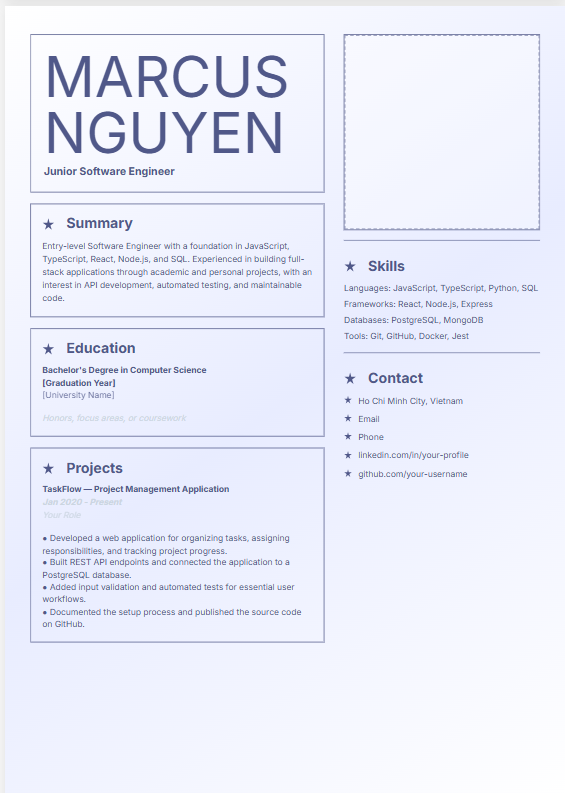
Why this works: It emphasizes relevant technical skills and practical projects instead of relying on professional experience the candidate may not yet have.
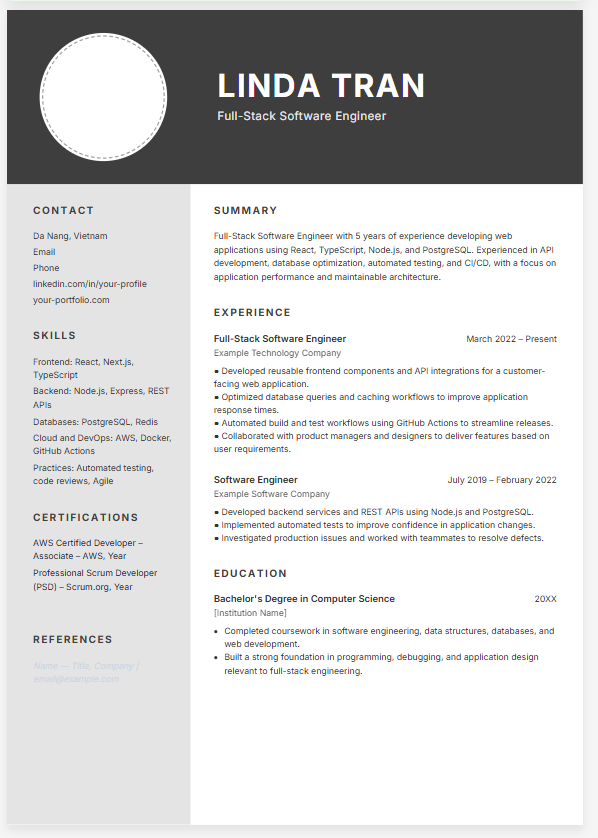
Why this works: It demonstrates a progression of responsibilities and gives recruiters a clear picture of the candidate’s technical capabilities. For a real application, replace generic descriptions with specific features, systems, and verified outcomes.
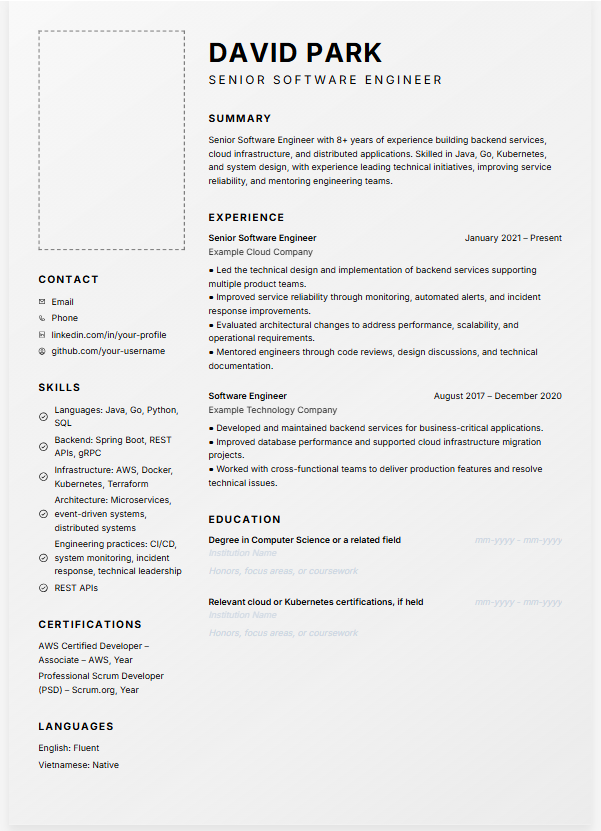
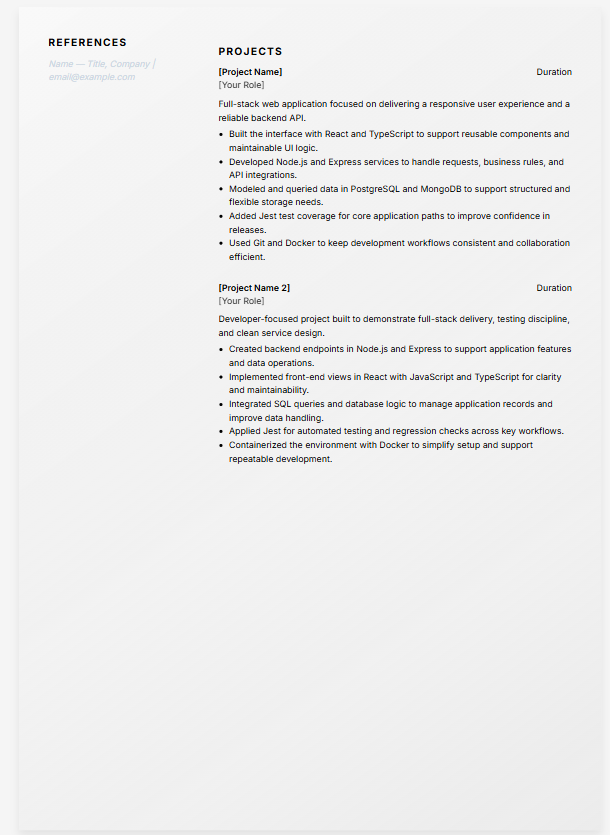
Why this works: It emphasizes technical ownership, system design, reliability, and leadership rather than focusing exclusively on individual coding tasks.
Note: These examples are illustrative templates. Replace placeholder information with your real employers, dates, projects, qualifications, and achievements.
1. Keep the layout simple. Use a clean, readable format with standard headings and consistent spacing. A single-column layout is a practical choice for straightforward reading and parsing.
2. Use keywords from the job description. Include relevant programming languages, frameworks, tools, and engineering practices when they accurately reflect your experience.
3. Quantify your achievements where possible. Metrics such as response time, test coverage, deployment duration, or the number of features delivered can make your contributions more concrete.
4. Customize each application. Adjust your summary, skills, and most relevant achievements to match the role you want.
5. Check every link and detail. Make sure your GitHub, LinkedIn, and portfolio links work. Follow the employer's instructions for PDF or Word documents, and proofread before submitting.
Even technically strong candidates can weaken their applications with avoidable mistakes.
Listing responsibilities instead of achievements: Explain what you contributed and what changed as a result.
Including every technology you've ever tried: Focus on the tools relevant to your target role and be ready to discuss them.
Ignoring personal projects: If you're early in your career, projects can provide important evidence of your practical skills.
Using an overly complicated design: Prioritize readable text over decorative graphics, skill bars, and complex layouts.
Leaving out project links: Provide working GitHub or demo links when they help verify your work.
Sending the same resume everywhere: Tailor the most relevant sections to each job description.
Exaggerating your achievements: Use accurate metrics and describe your contribution honestly.
Forgetting to proofread: Check spelling, grammar, dates, technical terminology, and contact information.
A strong software engineer resume is not a list of every technology you know. It is a focused explanation of what you can build, how you approach technical problems, and why your experience fits the role.
Focus on your technical skills, education, and relevant projects. Include academic assignments, internships, hackathons, freelance work, or open-source contributions that demonstrate practical ability. Explain what you built, which technologies you used, and how the application works.
One page is often sufficient for students, recent graduates, and candidates with limited experience. Experienced engineers may need two pages to communicate substantial technical contributions and leadership responsibilities. Prioritize relevant information over a strict page count.
Include programming languages, frameworks, databases, cloud platforms, testing tools, and engineering practices relevant to the job. For example, a full-stack developer might highlight JavaScript, TypeScript, React, Node.js, SQL, REST APIs, and automated testing.
Yes, if your GitHub profile contains relevant, well-documented projects or meaningful open-source contributions. Link to repositories that demonstrate your coding practices, technical decisions, and ability to build working software.
Use standard section headings, clear text, consistent formatting, and relevant keywords from the job description. Avoid relying on images or graphics to communicate essential information, and follow the employer's file-format requirements.
Yes. AI can help organize your experience, improve bullet points, identify relevant keywords, and refine your professional summary. However, review every suggestion carefully. Make sure your technical skills, responsibilities, and performance metrics are accurate and that you can explain each claim in an interview.
You know how to write a software engineer resume that highlights your technical skills, projects, and achievements. Now, put that knowledge into practice.
With Jobcadu's AI Resume Builder, you can create a professional resume, organize your experience, and refine your content with AI assistance. Choose from polished resume templates, customize your sections, and present your qualifications in a clear, recruiter-friendly format.
Whether you're applying for your first developer role or preparing for your next career move, let your resume show what you can do.
Start building your resume with Jobcadu today: https://jobcadu.com/vi/resume-builder
No sections detected in this article.


