

Here's something worth knowing about hiring: recruiters don't read your resume word by word. They scan it, often looking for a few key details before deciding whether to take a closer look.
And if you're applying for a Data Analyst role, your resume needs to do more than list the tools you've used. It needs to show that you can turn raw data into useful insights, solve business problems, and help teams make better decisions.
You don’t need experience at a big tech company or millions of rows of data to stand out. What matters is demonstrating your analytical skills, the tools you can use, how you solve problems, and how your insights can drive better business decisions.
Data analytics is a competitive field. Many applicants list the same technical skills, such as SQL, Excel, Python, and Tableau. Simply mentioning these tools won't necessarily make your resume stand out.
Hiring managers want to know what you can actually do with them.
They're looking for evidence of:
Technical skills: Can you write SQL queries, clean datasets, and build dashboards?
Analytical thinking: Can you identify patterns, investigate problems, and interpret trends?
Business understanding: Can you translate data into insights that support business decisions?
Communication: Can you explain complex findings in a way that non-technical teams understand?
Measurable impact: Have your analyses helped improve efficiency, reduce costs, or identify opportunities?
Whether you're applying for a Junior Data Analyst, Business Intelligence Analyst, Product Analyst, Marketing Analyst, or Senior Data Analyst position, your resume should answer these questions quickly.
Think of your resume as a dashboard. The most important information should be easy to find, understand, and act on.
Keep it simple and professional. Include:
Full name
Phone number
Professional email address
LinkedIn profile
Location
Portfolio or GitHub link, if available
For data analyst candidates, a portfolio can be particularly valuable. A GitHub repository, interactive dashboard, or data analysis project can demonstrate your skills beyond what's written on your resume.
Write two to four sentences explaining who you are, what you specialize in, and what you bring to the role.
Example:
Data Analyst with 3+ years of experience transforming business data into actionable insights. Proficient in SQL, Python, Excel, and Power BI, with experience in data cleaning, dashboard development, and KPI reporting. Skilled in identifying performance trends and communicating data-driven recommendations to support business decisions.
If you're a recent graduate, don't worry about having years of professional experience. You can highlight your technical skills, academic projects, internships, and analytical capabilities instead.
This is where you demonstrate how you've applied your analytical skills to real problems. Focus on projects, responsibilities, and outcomes that are relevant to the position.
We'll cover how to turn everyday tasks into stronger resume bullet points below.
Include the tools and capabilities relevant to the job description.
Technical skills: SQL, Python, Excel, Power BI, Tableau, data visualization, statistical analysis, data cleaning, and database management.
Soft skills: Critical thinking, problem-solving, communication, attention to detail, and cross-functional collaboration.
Only list skills you can confidently explain or demonstrate in an interview.
Include your degree, university, major, and graduation year.
If you're a recent graduate, relevant coursework in statistics, mathematics, economics, computer science, or business analytics can strengthen your application.
Certifications can help demonstrate your commitment to learning, particularly when you're transitioning into data analytics.
Relevant options include:
Microsoft Certified: Power BI Data Analyst Associate
Google Data Analytics Professional Certificate
Tableau certifications
Relevant SQL, Python, or data engineering courses
Choose certifications that align with the job you're targeting rather than collecting credentials without a clear purpose.
You don't need a full-time data analyst job to demonstrate your analytical ability.
You can include:
Sales performance dashboards
Customer segmentation analysis
E-commerce revenue analysis
Customer churn prediction
Financial or operational reporting
Public dataset analysis using SQL or Python
University or internship projects
For each project, explain the problem, tools used, analysis performed, and findings or outcomes. Include a link to your work when possible.
Sending the same resume to every employer can make your application less relevant.
Instead, read each job description as if it were a business problem you're trying to solve. Identify the tools, responsibilities, industry knowledge, and analytical capabilities the employer prioritizes.
For example, different roles may require different skill combinations:
Business Intelligence Analyst: SQL, Power BI, Tableau, dashboard development, KPI reporting
Marketing Data Analyst: SQL, Excel, Google Analytics, campaign performance, customer acquisition metrics
Product Analyst: SQL, product analytics, funnel analysis, retention, experimentation, A/B testing
Financial Data Analyst: Excel, SQL, financial modeling, forecasting, variance analysis
Junior Data Analyst: Excel, SQL fundamentals, data cleaning, visualization, analytical thinking
If a job description emphasizes Power BI and stakeholder reporting, make those capabilities easy to find. If it focuses on SQL and Python, highlight relevant projects and experience using those tools.
You're not inventing new qualifications. You're making the most relevant parts of your background easier to recognize.
A strong professional summary answers three questions:
Who are you?
What can you do?
How can you contribute to the business?
Use this simple formula:
[Job title/experience] + [specialization] + [key tools] + [relevant achievement or value]
Here are two examples.
For an experienced candidate:
Business Intelligence Analyst with 4 years of experience developing dashboards and analyzing operational performance. Proficient in SQL, Power BI, and Python, with a track record of reducing reporting time by 40% through automated reporting workflows.
For a recent graduate:
Aspiring Data Analyst with a background in business analytics and hands-on experience using SQL, Excel, and Python to clean datasets, explore trends, and create visual reports. Experienced in academic projects involving sales analysis and customer behavior, with a strong interest in translating data into practical business recommendations.
The key is to be specific without making your summary too long. If you mention an achievement, make sure you can explain how it was measured.
This is where many data analyst resumes fall short. Candidates describe what they were responsible for but leave out what their work accomplished.
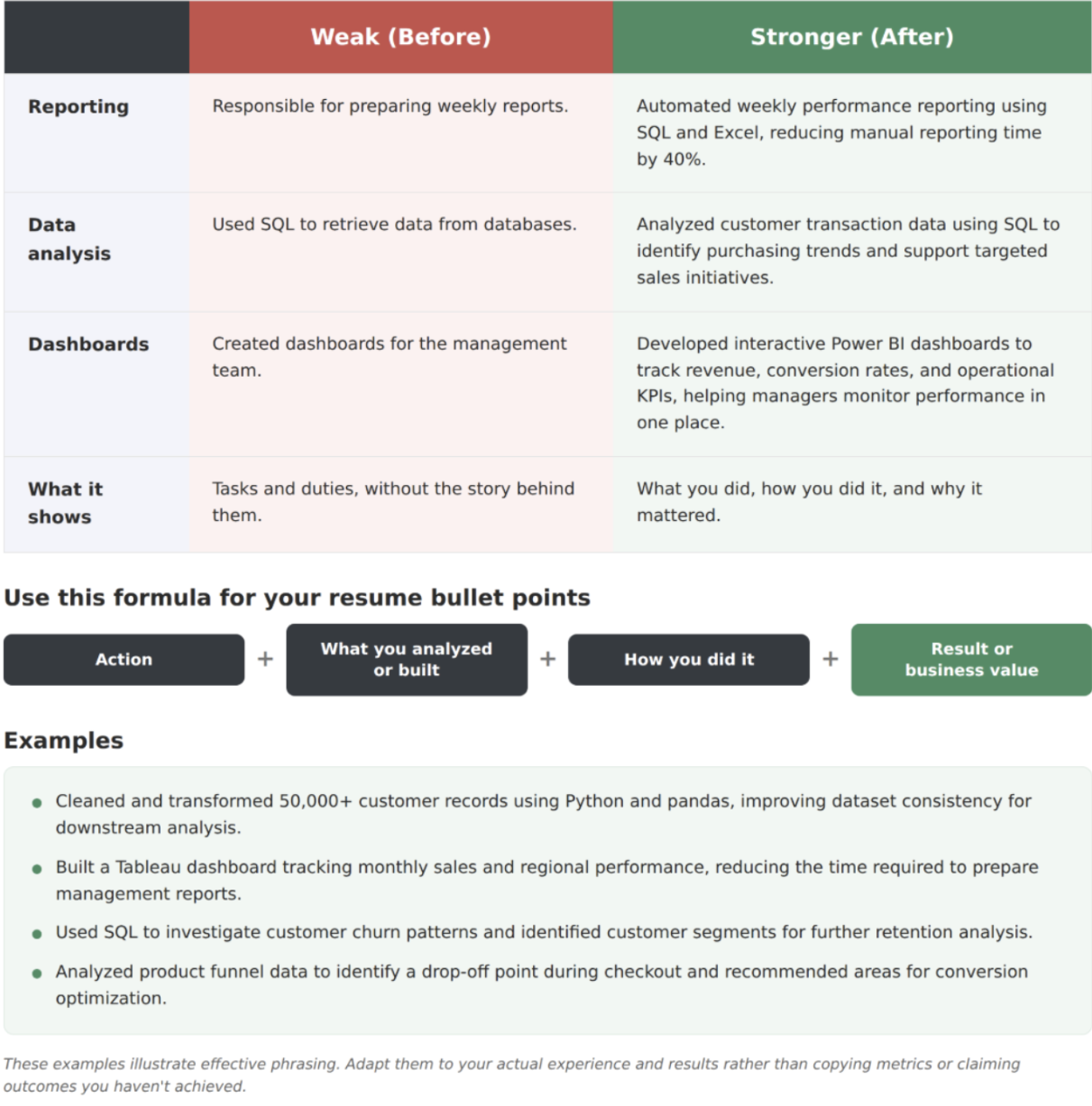
Numbers help recruiters understand the scale and impact of your work.
Consider including metrics such as:
Reduced manual reporting time by 40%.
Analyzed 100,000+ transaction records.
Automated 5 recurring reports.
Built dashboards tracking 12 business KPIs.
Reduced data processing time by 30%.
Identified a 15% decline in customer retention in a specific segment.
Improved data accuracy by 20%.
Not every project needs a percentage or a financial result. You can also quantify the number of datasets, dashboards, reports, business units, or stakeholders involved.
If you don't have access to business metrics, describe the scope of the analysis and the decisions your work was designed to support.
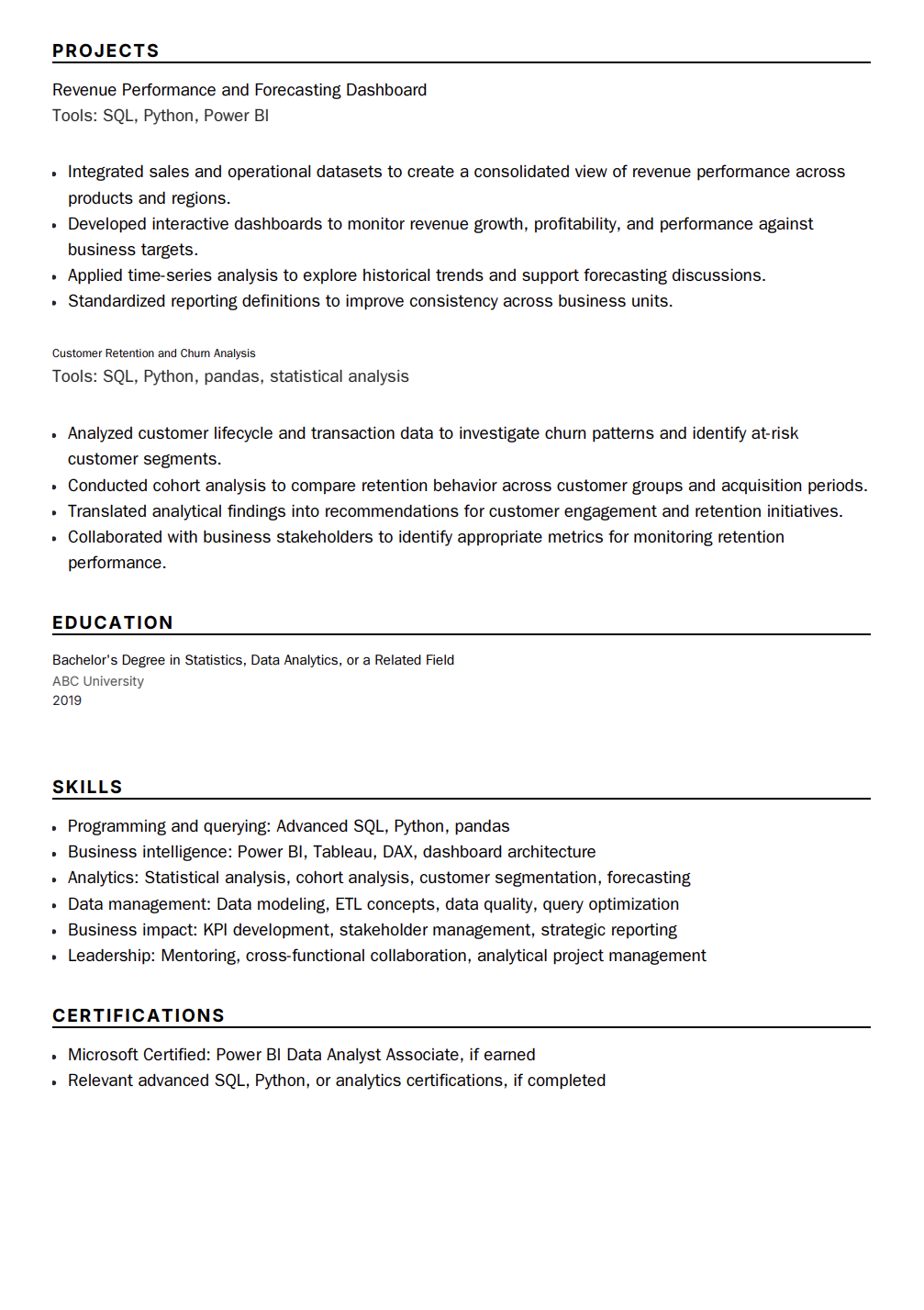
Here's an example of how a resume for an early-career Data Analyst could be structured.
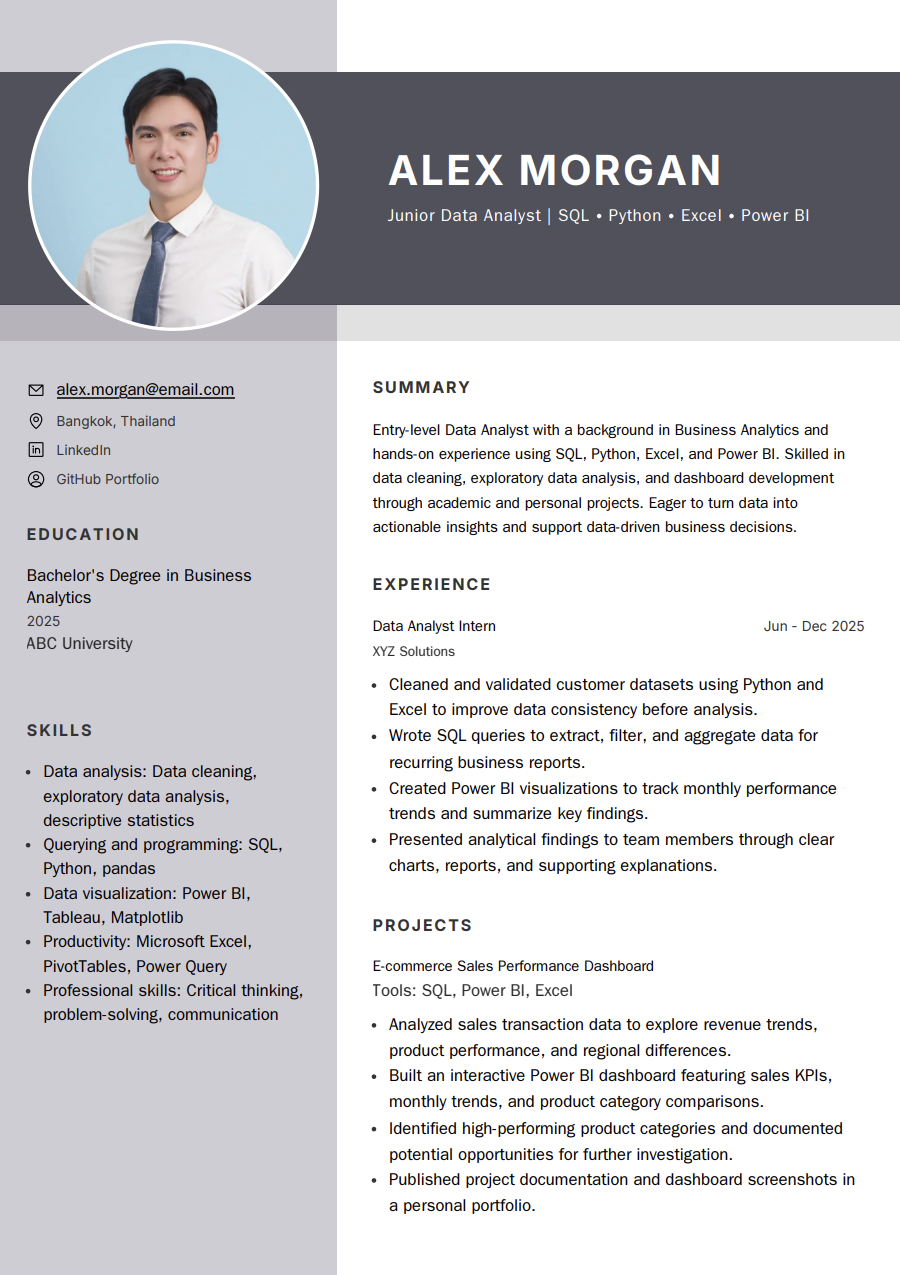
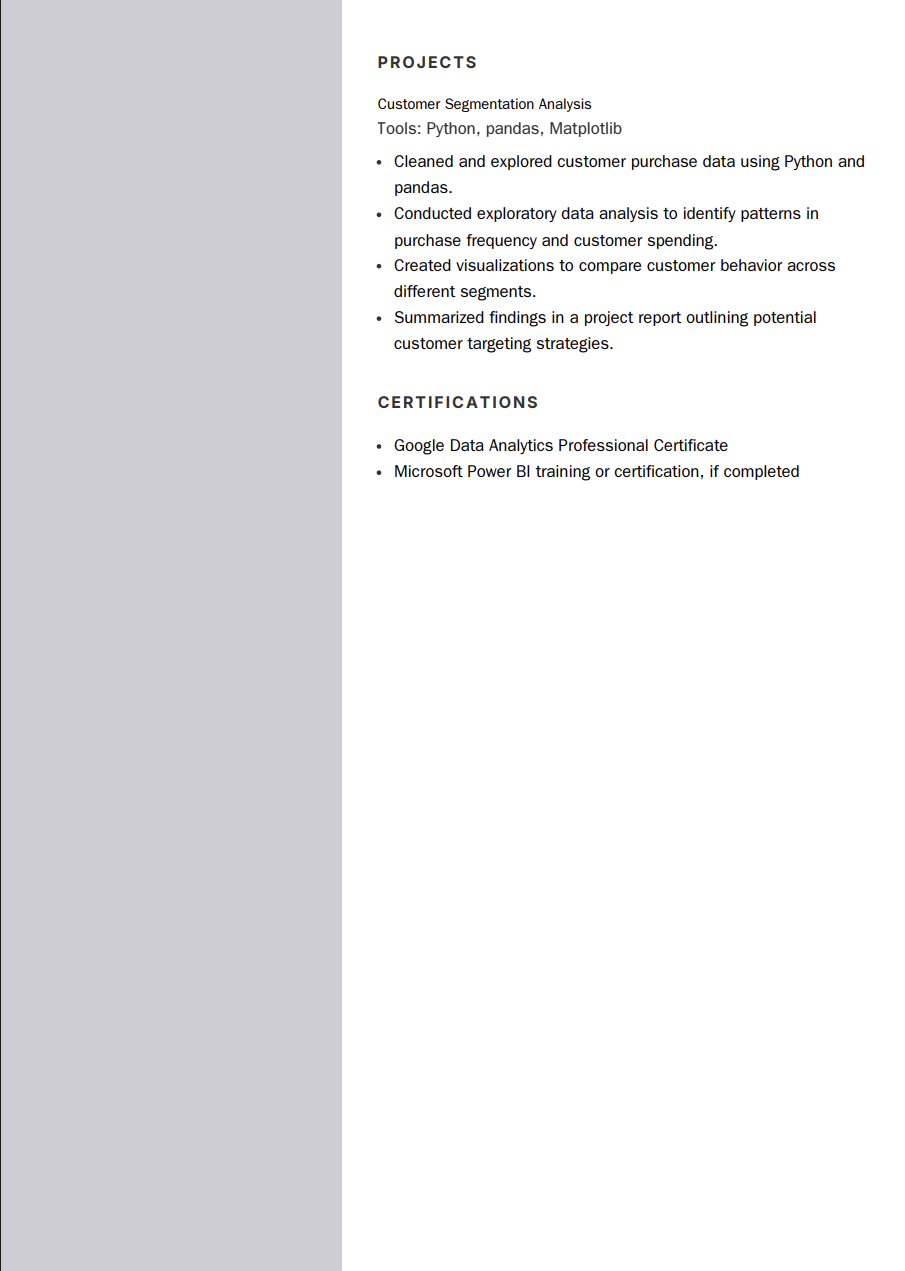
Why this resume works: It demonstrates practical skills through projects rather than relying on years of experience. This approach is especially useful for recent graduates, career changers, and candidates applying for their first full-time analytics role.
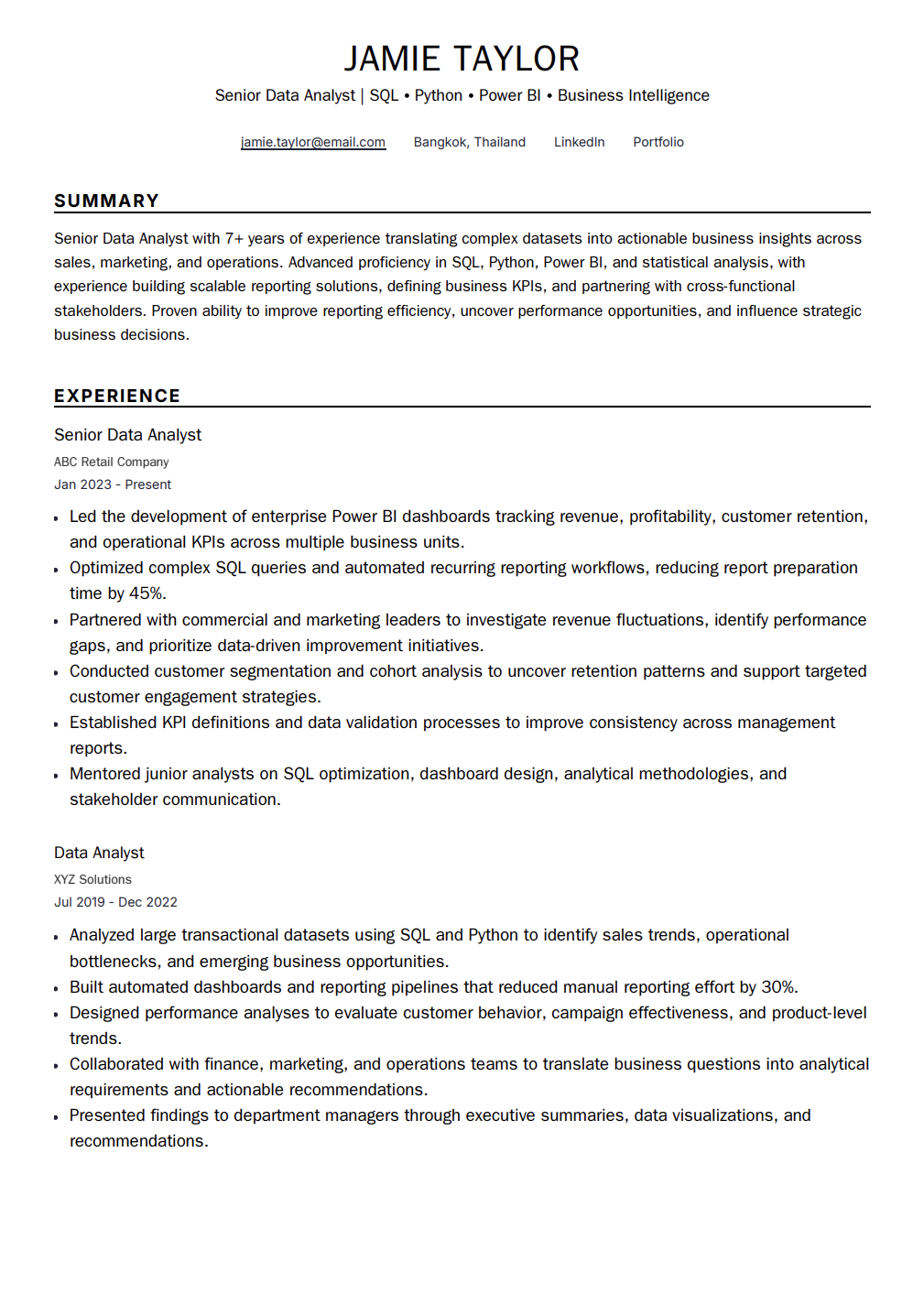
Why this resume works: It moves beyond listing technical tools to show how the candidate improves reporting processes, establishes reliable metrics, guides business decisions, and supports other analysts. These are important differentiators for senior-level positions.
Want a resume like this in minutes? Use Jobcadu’s Resume Builder to pick an ATS-friendly template, add your achievements, and download it, with no design skills needed.
Your skills section should reflect the position you're applying for, not every tool you've ever encountered.
Business Intelligence Analyst
SQL
Power BI
Tableau
Data modeling
Dashboard development
KPI reporting
DAX
Stakeholder reporting
Marketing Data Analyst
SQL
Excel
Google Analytics 4
Marketing performance analysis
Customer segmentation
Campaign attribution
Conversion rate analysis
Data visualization
Product Analyst
SQL
Python
Funnel analysis
Retention and cohort analysis
A/B testing
Product analytics tools
Experimentation
User behavior analysis
Financial Data Analyst
Excel
SQL
Financial reporting
Forecasting
Variance analysis
Financial modeling
Budget analysis
Data visualization
Junior Data Analyst
Excel
SQL
Python fundamentals
Data cleaning
Exploratory data analysis
Basic statistics
Power BI or Tableau
Reporting and documentation
You don't need to know every tool in a category. Prioritize the ones requested by the employer and the ones you can confidently use.
"Created dashboards" is vague.
"Developed a Power BI dashboard tracking 10 KPIs across three business units" gives the recruiter a much clearer picture of your work.
Focus on the scale, efficiency, accuracy, or decisions supported by your analysis.
Applicant tracking systems (ATS) may help employers organize and search applications. Relevant keywords also help recruiters quickly recognize your qualifications.
If a job posting mentions SQL, Python, Power BI, data visualization, and stakeholder communication, include those terms where they accurately describe your experience.
Avoid keyword stuffing. Your skills should be supported by examples whenever possible.
A visually impressive resume isn't necessarily easy for recruitment software to process.
For a straightforward, readable format:
Use standard headings such as Work Experience, Education, Skills, and Projects.
Choose a clean, readable font.
Use simple bullet points.
Avoid placing essential information inside images or decorative graphics.
Be careful with complex multi-column layouts, text boxes, and tables.
Export to the file format requested by the employer, usually PDF or DOCX.
A simple layout makes your experience easier for both recruiters and software to interpret.
You don't need to rewrite your entire resume every time.
Instead, adjust your professional summary, reorder relevant skills, highlight the most relevant projects, and refine your experience bullet points to match the position.
For example, a Marketing Analyst application should emphasize campaign performance, customer behavior, and conversion metrics. A Business Intelligence application should give more attention to dashboards, KPI tracking, and reporting workflows.
A GitHub repository filled with code isn't always enough to demonstrate your value.
For each project, explain:
The problem: What question were you trying to answer?
The data: Where did the data come from, and how did you prepare it?
The method: Which tools and analytical techniques did you use?
The findings: What patterns or insights did you discover?
The business relevance: How could the findings inform a decision?
You don't need an elaborate portfolio website. A well-documented project with clear visualizations and thoughtful conclusions can be a strong starting point.
Listing responsibilities without explaining their value.
Mentioning SQL, Python, or Power BI without showing how you used them.
Sending the same resume to every employer.
Including too many unrelated technical skills.
Leaving out relevant projects because you lack professional experience.
Claiming results or percentages you cannot substantiate.
Using a complicated design that makes information difficult to scan.
Forgetting to include a portfolio or project link when one is available.
Leaving typos, inconsistent dates, or unexplained technical abbreviations.
Ignoring ATS readability and relevant job-description keywords.
Remember, you don't need a perfect career history to build a strong Data Analyst resume. You need to make your current skills, analytical thinking, and potential contribution easy to understand.
A great Data Analyst resume isn't simply a list of tools and qualifications. It's evidence that you can work with data, ask the right questions, uncover meaningful patterns, and communicate findings that help people make better decisions.
Whether you're applying for your first analytics role or moving toward a more specialized position, focus on relevant skills, practical projects, clear explanations, and measurable achievements.
Don't let formatting slow down your job search. With Jobcadu's Resume Builder, you can create a professional, ATS-friendly resume in minutes.
Choose from 25+ polished templates, customize your sections, and showcase the technical skills, projects, and achievements that matter to recruiters.
[Start building your Data Analyst resume with Jobcadu's Resume Builder now →]
No sections detected in this article.


