

Here's a little secret about hiring: recruiters don't read your resume. They scan it. You often have about ten seconds to prove you're worth a second look.
And if you work in digital marketing, the bar is even higher. You're literally applying for a job that involves getting people's attention. A resume that's dull, cluttered, or full of vague claims sends the wrong message before anyone has met you.
The good news? Writing a strong digital marketing resume isn't about fancy design or big-name employers. It's about showing what you did, how you did it, and what changed because of it.
Digital marketing is crowded. Hiring managers see dozens of applicants with the same job titles, so titles alone won't set you apart. What they're really looking for is proof:
What experience do you have?
Which platforms and tools can you use?
What campaigns have you run?
How do you measure success?
What results did you deliver?
Whether you're aiming for Digital Marketing Executive, Social Media Specialist, Performance Marketer, SEO Specialist, or Digital Marketing Manager, your resume should answer those questions fast.
Think of your resume as a landing page. Every section needs a clear purpose.
1. Contact information:
Keep it clean: full name, phone number, a professional email, your LinkedIn profile, your location, and a portfolio link if you have one.
2. Professional summary: Two to four sentences that say who you are, what you're good at, and what you bring to the table.
Digital Marketing Specialist with 3+ years of experience managing social media, paid advertising, and content campaigns. Skilled in Meta Ads, Google Ads, SEO, and Google Analytics, with a track record of improving campaign performance and boosting online engagement.
3. Work experience: This is the heart of your resume. We'll dig into it below.
4. Skills: A mix of technical skills (SEO, Google Ads, analytics) and soft skills (communication, collaboration, creativity).
5. Education: Degree, university, major, and graduation year if it's relevant.
6. Certifications: Google Analytics, Google Ads, HubSpot, Meta Blueprint, and SEO certifications all add credibility.
7. Portfolio or projects: Especially valuable if you're just starting out. Campaign projects, social media accounts, SEO experiments, freelance gigs, and university projects all count.
One resume for every application is the fastest way to blend into the pile.
Instead, read the job description like a marketer reads a brief. Look for the title, required skills, tools, responsibilities, and desired experience. Then mirror what matters.
Say the role is all about performance marketing. Make sure your resume clearly shows things like Meta Ads, Google Ads, conversion optimization, ROAS, CPA, CTR, A/B testing, and campaign reporting.
You're not changing who you are. You're making it easy for the recruiter to see you're a match.
A great summary answers three quick questions: Who are you? What can you do? What value do you bring?
Use this simple formula:
[Job title/experience] + [specialization] + [key skills] + [measurable achievement]
Here's what it looks like in action:
Performance Marketing Specialist with 4 years of experience managing paid campaigns across Meta and Google Ads. Skilled in campaign optimization, audience targeting, A/B testing, and analytics, with a record of increasing ROAS by 35% through data-driven decisions.
Short, specific, and packed with proof.
This is where most resumes fall flat. They list duties instead of wins.
Use this formula for every bullet point:
Action + What you did + How you did it + Result
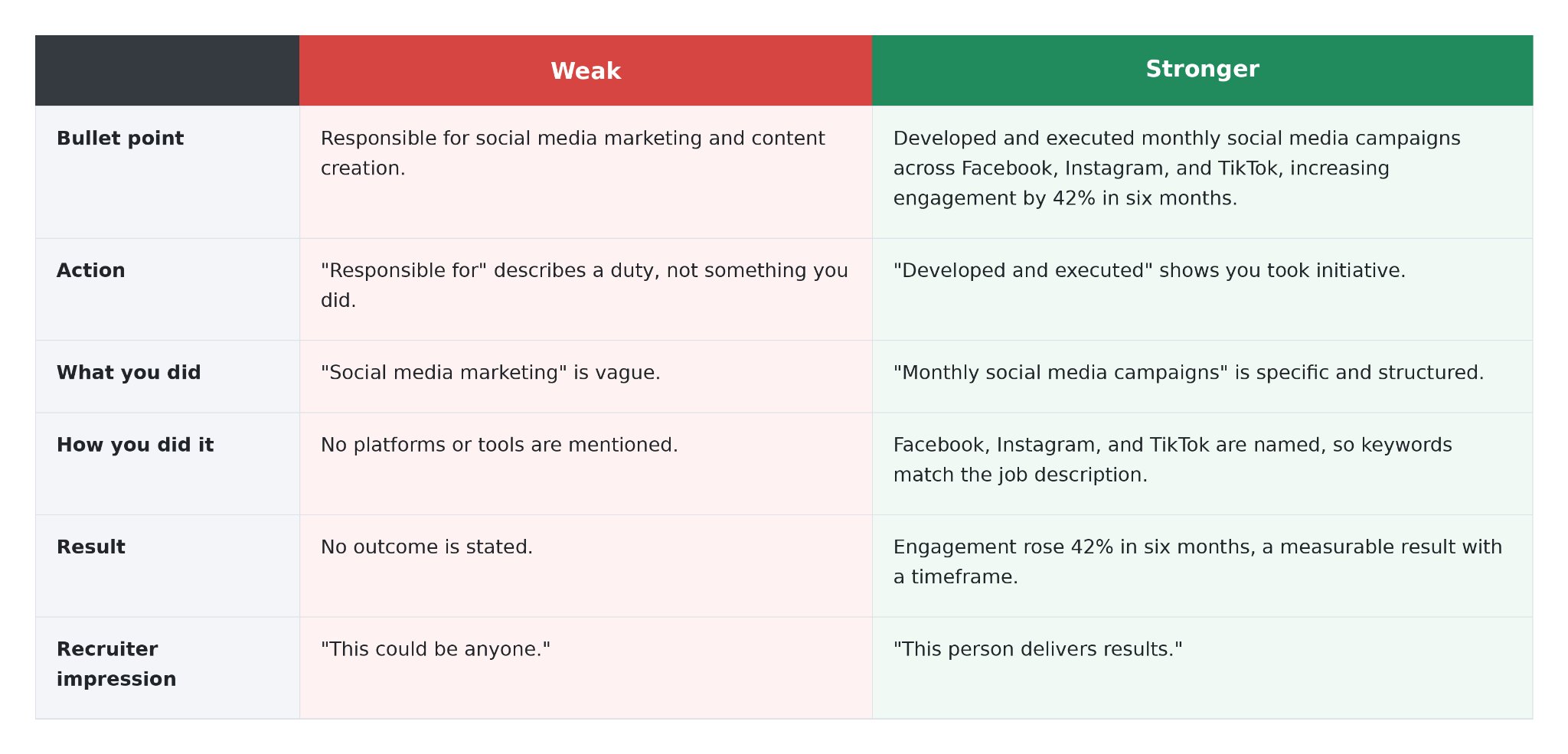 See the difference? The second one tells a story, and the story has a happy ending.
Add numbers wherever you can:
Increased website traffic by 35%
Improved CTR by 22%
Reduced CPA by 18%
Generated 500+ qualified leads
Grew social media followers by 40%
Managed a monthly ad budget of ฿200,000
Improved ROAS from 2.5x to 4.1x
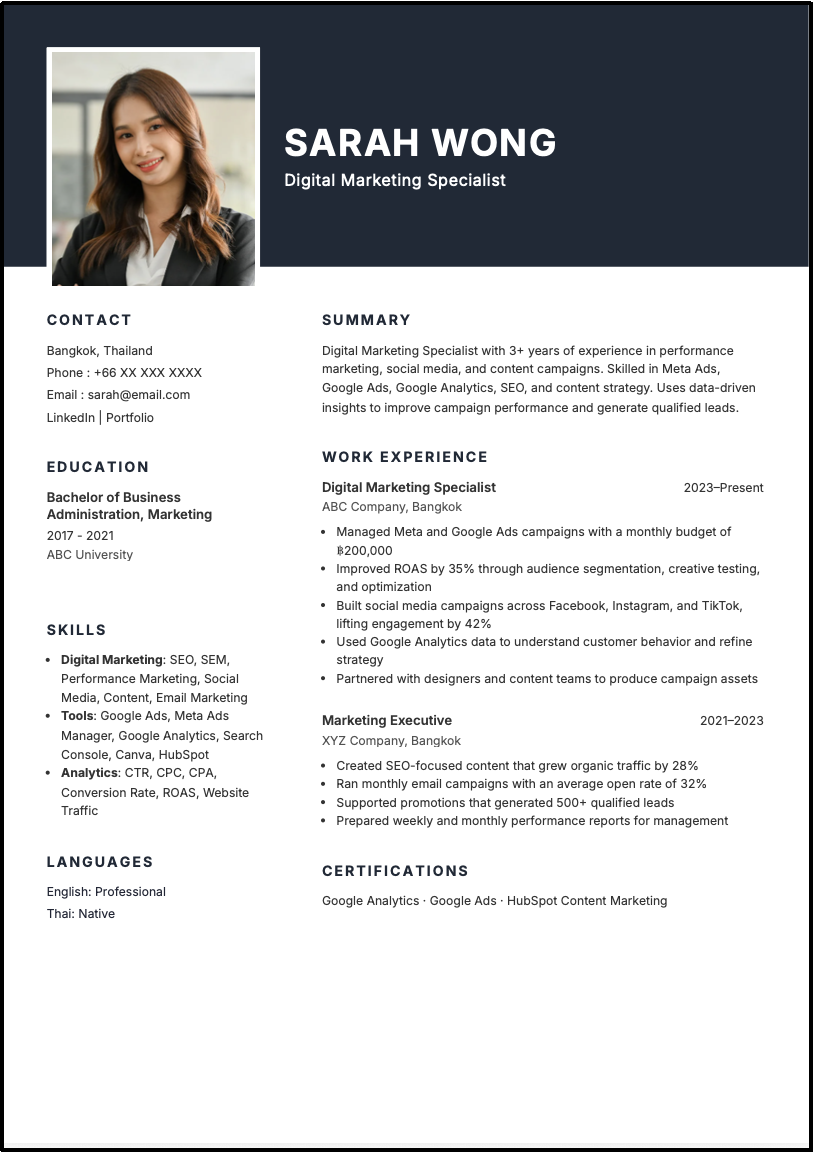
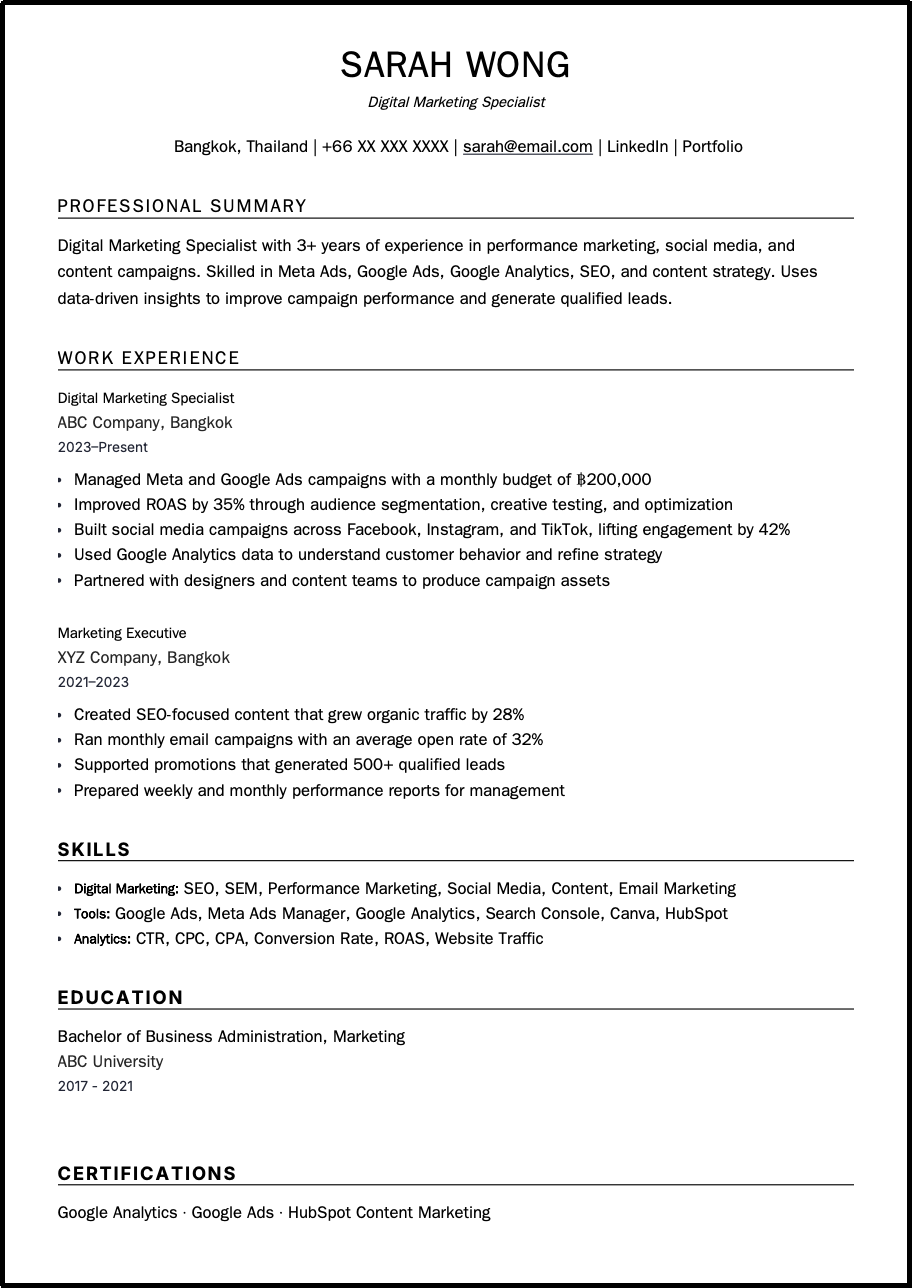
Want a resume like this in minutes? Use Jobcadu’s Resume Builder to pick an ATS-friendly template, add your achievements, and download it, with no design skills needed.
Your skills section should match the job, not just list everything you've ever touched.
Social media marketing: social media strategy, content creation, community management, social analytics, influencer marketing, Meta Business Suite, TikTok
Performance marketing: Meta Ads, Google Ads, PPC, conversion optimization, A/B testing, ROAS, CPA, CTR, CPC
SEO: keyword research, on-page SEO, technical SEO, link building, Google Search Console, SEO analytics, content optimization
Content marketing: content strategy, copywriting, SEO content, storytelling, content planning, email marketing, marketing campaigns
1. Quantify everything you can: "Increased social media performance" is forgettable. "Increased Instagram engagement by 45% in six months" is memorable.
2. Borrow keywords from the job description: Recruiters and ATS (applicant tracking systems) scan for specific terms. If the posting mentions SEO, Google Analytics, and Meta Ads, make sure those words appear in your resume, as long as you genuinely have those skills.
3. Keep it ATS-friendly: Skip the heavy graphics, icons, text inside images, and unusual fonts. Stick with clear headings, standard section names, simple formatting, and easy-to-read bullet points.
4. Customize for every application: Tweak your summary, skills, experience, keywords, and projects to fit each role. It takes ten extra minutes and can change your results completely.
5. Show your marketing mindset: Ask yourself: "If I were the recruiter, would I understand this person's value within 10 seconds?" If not, simplify and move your best achievements higher up.
Listing responsibilities with no results
Sending the same resume to every company
Stuffing in irrelevant skills
Writing a long personal statement
Forgetting to mention marketing tools
Leaving out measurable achievements
Choosing a complicated design over a readable one
Leaving typos and grammar errors (in a marketing resume, they hurt extra)
Including outdated or irrelevant information
Ignoring ATS optimization
A great digital marketing resume isn't a list of everything you've ever done. It's a sharp, honest pitch that shows recruiters what you can do, how you do it, and what results you can deliver.
Focus on relevant skills, measurable achievements, the tools you use, and the keywords from the job description. Whether you're chasing your first marketing role or stepping into a senior position, a clear, targeted resume helps you make a strong first impression, and that first impression is often the whole game.
Don't let formatting slow you down. With Jobcadu’s Resume Builder, you can create a professional, ATS-friendly resume in minutes. Choose from 25+ polished templates, customize every section, and spotlight the skills and achievements recruiters actually want to see.
[Start building your resume with Jobcadu’s Resume Builder now →]
No sections detected in this article.


