

Think of your resume as a pitch, and the person reading it as a buyer who has already seen a dozen similar offers today. Before they book a call, they want proof: the deals you sourced, the revenue you brought in, and the partnerships that are still paying off.
That’s what makes business development hard to write about. A title like “BD Executive” or “Partnerships Manager” means something different at every company, so it says very little on its own. And phrases like “built client relationships” or “identified new opportunities” read like a pipeline with no deal values attached.
A strong business development resume doesn’t need a famous employer or a clever layout. It needs to show which opportunities you found, how you turned them into signed deals, and what those deals were worth to the business.
Let’s build one.
Why your business development resume matters
Business development (BD) is a role with many shapes. One company's BD Executive is a hunter chasing new clients. Another is a partnerships builder, and a third is a market-expansion strategist. Because titles vary so much, hiring managers rely on your resume to see what you actually did.
They're looking for answers to these questions:
What kind of BD experience do you have: sales, partnerships, or expansion?
Which industries and client types have you worked with?
What tools and CRM systems can you use?
How do you build and manage a pipeline?
What revenue or growth did you deliver?
Whether you're applying as a Business Development Executive, Business Development Manager, Partnerships Manager, Account Executive, or Sales Development Representative, your resume should answer those questions quickly.
Think of your resume as a sales deck. Every section should have a job to do.
1. Contact information. Keep it clean: full name, phone number, professional email, LinkedIn profile (essential in BD), and your location.
2. Professional summary. Two to four sentences covering your experience, your focus area, and the value you bring.
Business Development Executive with 4+ years of experience in B2B lead generation, client acquisition, and strategic partnerships. Skilled in pipeline management, negotiation, and CRM tools, with a track record of generating new revenue and expanding key accounts.
3. Work experience. The heart of your resume. We'll dig into it below.
4. Skills. A balance of hard skills (CRM, lead generation, forecasting) and soft skills (negotiation, relationship building, communication).
5. Education. Degree, university, major, and graduation year if relevant.
6. Certifications. Salesforce, HubSpot Sales Software, Google Analytics, or negotiation and sales training programs all add credibility.
7. Key deals or projects. Especially useful if you're early in your career or changing fields. Include partnerships you initiated, market-entry research, pitch competitions, freelance sales work, or university projects.
Sending the same resume everywhere is the quickest way to blend in.
Read the job description like a client brief. Note the title, required skills, tools, target customers, and revenue expectations. Then reflect what matters most.
If the role focuses on new client acquisition, highlight outbound prospecting, cold outreach, pipeline building, conversion rates, deal size, and closed revenue. If it focuses on partnerships, highlight negotiation, stakeholder management, contract support, and co-marketing or joint ventures.
You're not changing who you are. You're making it easy for the recruiter to say, "This person fits."
A great summary answers three questions: Who are you? What can you do? What value do you bring?
Use this formula:
[Job title/experience] + [specialization] + [key skills] + [measurable achievement]
Here it is in action:
Business Development Manager with 6 years of experience growing B2B accounts in the SaaS and logistics sectors. Skilled in strategic partnerships, enterprise negotiation, and pipeline forecasting, with a record of generating ฿12M+ in new annual revenue.
This is where most BD resumes fall flat. They describe activity ("contacted clients," "attended meetings") instead of outcomes.
Use this formula for every bullet:
Action + What you did + How you did it + Result
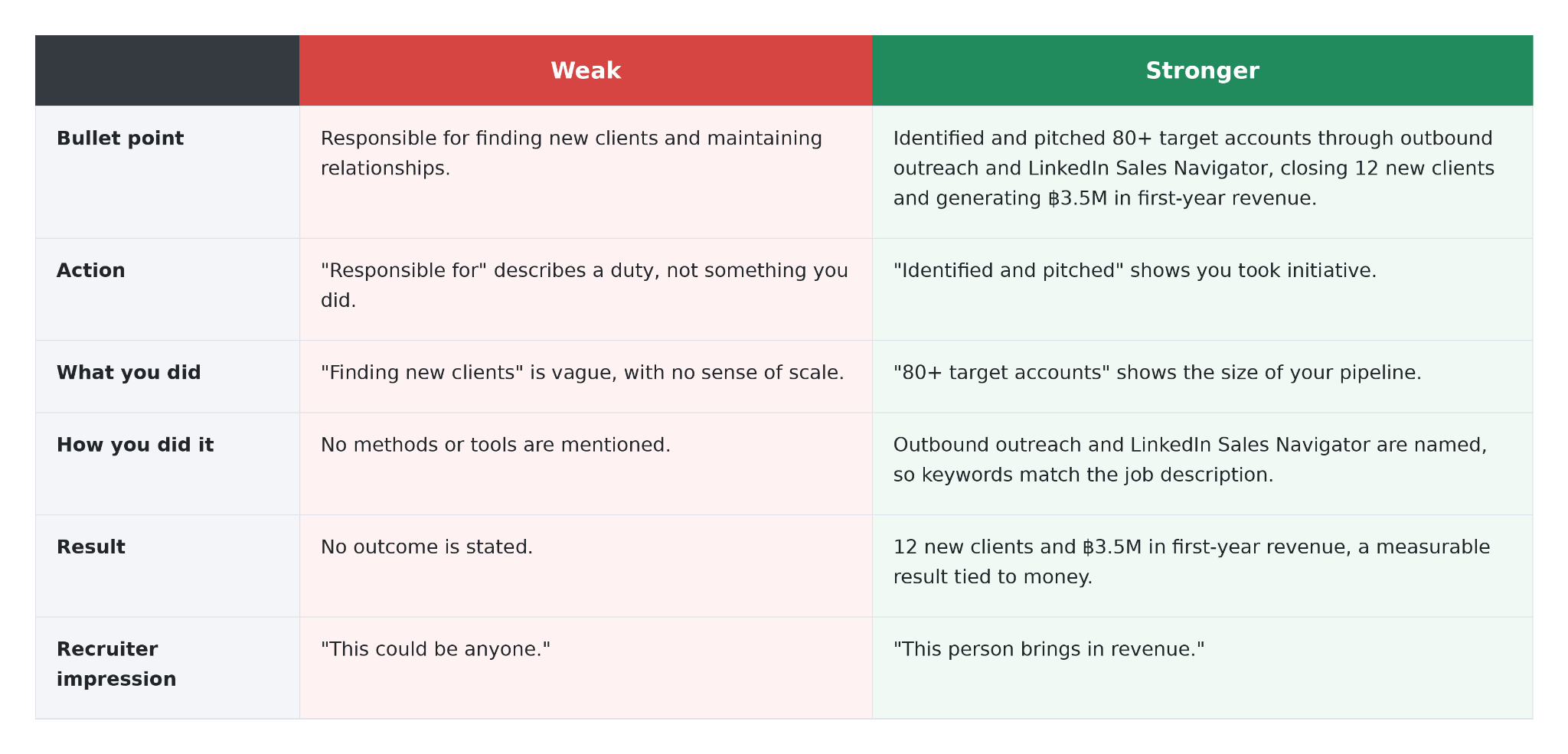 The second version shows a process and a payoff.
Add numbers wherever you can:
Generated ฿5M in new annual revenue
Built a sales pipeline worth ฿20M
Increased lead-to-deal conversion rate from 8% to 14%
Closed 15 new B2B accounts in 12 months
Signed 6 strategic partnerships across 3 markets
Shortened the average sales cycle by 20%
Achieved 120% of annual sales target
Grew revenue from key accounts by 30%
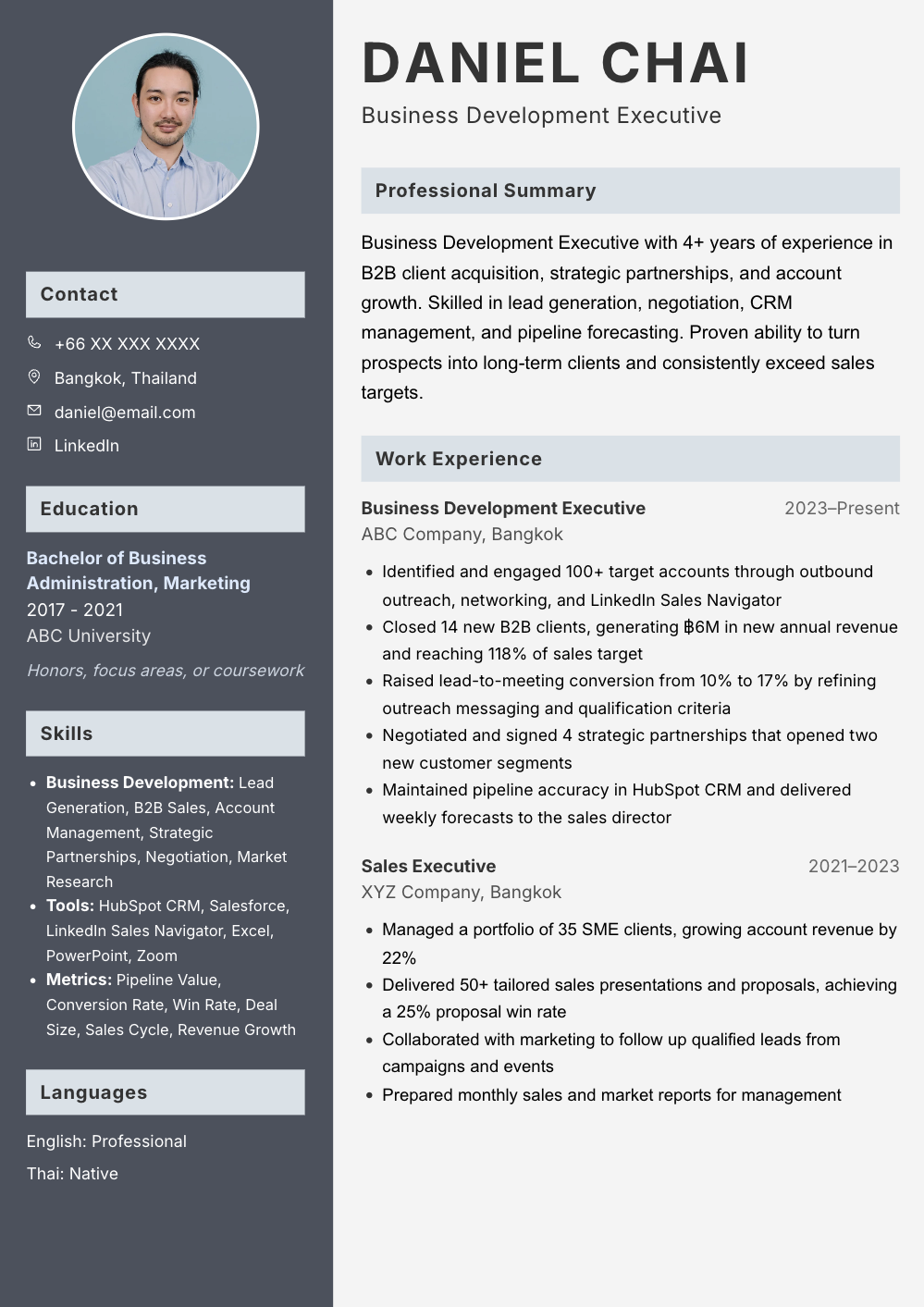
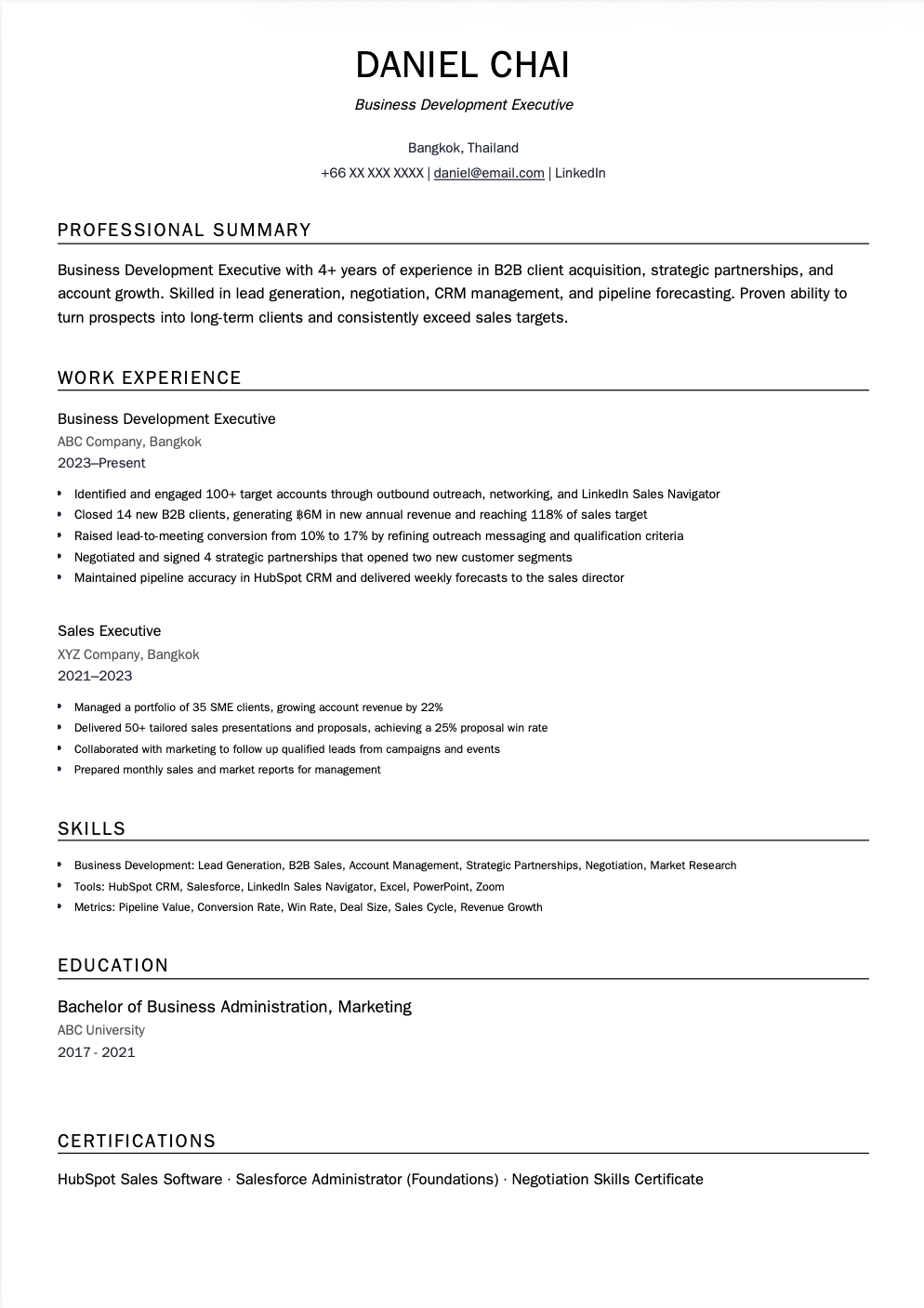
Want a resume like this in minutes? Use Jobcadu’s Resume Builder to pick an ATS-friendly template, add your achievements, and download it, with no design skills needed.
Match your skills section to the job instead of listing everything you've ever touched.
Client acquisition / B2B sales: lead generation, cold outreach, prospecting, sales presentations, pipeline management, closing deals, CRM (Salesforce, HubSpot), forecasting
Partnerships: relationship building, stakeholder management, negotiation, contract support, co-marketing, strategic alliances, partner onboarding
Market expansion / strategy: market research, competitor analysis, go-to-market strategy, business case development, new market entry, financial modeling basics
Account growth: account management, upselling and cross-selling, client retention, customer success collaboration, renewal management
Soft skills that matter in BD: communication, persuasion, resilience, active listening, adaptability, time management
1. Lead with revenue and growth: BD exists to create business value. Put your strongest numbers, such as revenue, pipeline, and deals closed, near the top of each role.
2. Borrow keywords from the job description: ATS (applicant tracking systems) and recruiters scan for specific terms. If the posting says "lead generation," "strategic partnerships," and "Salesforce," make sure those words appear, as long as you genuinely have those skills.
3. Keep it ATS-friendly: Skip heavy graphics, icons, text inside images, and unusual fonts. Use clear headings, standard section names, simple formatting, and easy-to-scan bullet points.
4. Customize for every application: Adjust your summary, skills, and top achievements to fit each role. A hunter role and a partnerships role need different spotlights.
5. Show your sales mindset
Ask yourself: "If I were the hiring manager, would I see this person's value within 10 seconds?" If not, simplify and move your best wins higher up.
Listing duties instead of results
Sending the same resume to every company
Using vague claims like "good at building relationships" without proof
Forgetting to mention your CRM and sales tools
Leaving out revenue, pipeline, or target-attainment numbers
Stuffing in irrelevant skills
Writing a long personal statement
Choosing a complicated design over a readable one
Leaving typos or grammar errors (in a role built on communication, they hurt extra)
Ignoring ATS optimization
A great business development resume isn't a diary of every meeting you've attended. It's a sharp, honest pitch that shows recruiters how you find opportunities, how you win them, and what they were worth.
Focus on measurable results, the tools you use, and the keywords from the job description. Whether you're stepping into your first BD role or aiming for a senior leadership position, a clear, targeted resume helps you make a strong first impression, and in business development, first impressions often decide who gets the meeting.
Don't let formatting slow you down. With Jobcadu’s Resume Builder, you can create a professional, ATS-friendly resume in minutes. Choose from 25+ polished templates, customize every section, and spotlight the skills and achievements recruiters actually want to see.
[Start building your resume with Jobcadu’s Resume Builder now →]
No sections detected in this article.


