

Here's something many job seekers overlook: recruiters aren't just looking for someone who can manage a project. They're looking for someone who can deliver results.
And when recruiters scan a Project Manager resume, they want to understand a few things quickly: Can you keep projects on track? Manage budgets and deadlines? Coordinate different teams? Handle unexpected problems without everything falling apart?
A resume that simply says "responsible for project planning and coordination" doesn't tell them much.
You don’t need a million-dollar project or a big-name company on your resume to stand out. What matters is how you demonstrate your ability to plan strategically, lead teams, manage challenges, and deliver measurable results. A strong Project Manager resume turns your experience into evidence of the value you bring to every project.
Project management is about more than creating schedules and checking off tasks. Employers need people who can bring structure to uncertainty, align stakeholders, manage risks, and keep teams moving toward a shared goal.
That's why hiring managers look for evidence of:
Project delivery: Can you deliver projects on time and within scope?
Planning and organization: Can you manage timelines, resources, budgets, and competing priorities?
Leadership and communication: Can you coordinate stakeholders and keep teams aligned?
Risk management: Can you identify potential problems and respond before they derail a project?
Measurable impact: Did your work improve efficiency, reduce costs, or help achieve business objectives?
Whether you're applying for a Junior Project Manager, Project Coordinator, IT Project Manager, Marketing Project Manager, or Senior Project Manager position, your resume should make these capabilities easy to identify.
Think of your resume as a project plan. Every section should have a clear purpose and help the recruiter understand your value.
Keep your contact details simple and professional. Include:
Full name
Phone number
Professional email address
LinkedIn profile
Location
Portfolio or project case studies, if relevant
For project managers working in technology, consulting, construction, or creative industries, a portfolio of selected projects can help demonstrate the scale and complexity of your experience. Avoid sharing confidential company information.
Write two to four sentences that explain your experience, specialization, key strengths, and the value you bring to a team.
Example:
Project Manager with 4+ years of experience coordinating cross-functional teams and delivering projects across marketing and business operations. Skilled in project planning, stakeholder management, risk assessment, and Agile methodologies, with a track record of improving delivery efficiency and maintaining project alignment with business goals.
If you're just starting your career, focus on transferable skills, internships, university projects, and experience coordinating people or deadlines.
This is the most important section for experienced candidates. Instead of listing everyday responsibilities, explain the projects you managed, the challenges you handled, and the outcomes you achieved.
We'll explore how to write stronger achievement-focused bullet points below.
Include a combination of technical skills and people skills that match the job description.
Technical skills: Project planning, budget tracking, resource allocation, risk management, Agile, Scrum, Waterfall, Jira, Asana, Microsoft Project, and reporting.
Soft skills: Leadership, communication, negotiation, problem-solving, conflict resolution, and stakeholder management.
Prioritize skills you have actually used and can discuss confidently in an interview.
Include your degree, university, major, and graduation year.
Relevant fields may include business administration, engineering, information technology, management, or communications. However, project managers come from many different backgrounds, so your degree doesn't necessarily need to be in project management.
Certifications can help demonstrate your knowledge of project management frameworks and practices.
Depending on your experience and career goals, relevant options include:
Project Management Professional (PMP)
Certified Associate in Project Management (CAPM)
Professional Scrum Master (PSM)
Certified ScrumMaster (CSM)
PRINCE2 certifications
Agile project management certifications
Check each certification's eligibility requirements before listing or pursuing it. Only include credentials you've actually earned, and distinguish completed certifications from courses in progress.
If you have limited professional experience, projects can help demonstrate your planning and coordination abilities.
Consider including:
University events or student organization initiatives
Product launches
Website or application development projects
Marketing campaigns
Process improvement initiatives
Volunteer projects
Cross-functional business projects
For each project, explain its objective, your role, the team or stakeholders involved, the tools you used, and the outcome.
One resume for every application can make your experience appear too general.
Project management roles vary significantly by industry. Read the job description carefully and identify the responsibilities, methodologies, tools, and types of projects the employer needs you to manage.
For example:
IT Project Manager: Software development lifecycles, Agile, Scrum, Jira, release planning, technical stakeholders
Marketing Project Manager: Campaign planning, creative workflows, content calendars, resource coordination, campaign delivery
Construction Project Manager: Scheduling, contractor coordination, procurement, site safety, cost control
Business Project Manager: Process improvement, stakeholder alignment, operational efficiency, change management
Junior Project Manager: Task tracking, meeting coordination, documentation, timeline management, risk escalation
If a position emphasizes Agile delivery and cross-functional collaboration, make your relevant experience easy to find. If the job focuses on budgets and vendor management, highlight your experience tracking costs and coordinating external partners.
You're not changing your background. You're showing how your existing experience matches the employer's needs.
A strong summary answers three questions:
Who are you?
What types of projects can you manage?
What value can you bring to the organization?
Use this formula:
[Job title/experience] + [project specialization] + [key skills/methodologies] + [measurable achievement or value]
Here are two examples.
For an experienced candidate:
Project Manager with 5 years of experience delivering digital transformation and operational improvement projects. Skilled in Agile delivery, stakeholder management, resource planning, and risk mitigation, with a track record of reducing project delivery time by 20% through improved workflows and cross-functional coordination.
For a recent graduate or entry-level candidate:
Aspiring Project Manager with a background in Business Administration and hands-on experience coordinating university initiatives and team projects. Skilled in task planning, timeline tracking, documentation, and stakeholder communication, with a strong interest in helping teams deliver projects efficiently and achieve shared goals.
Keep your summary concise and specific. If you include a percentage or achievement, make sure you can explain where it came from.
This is where many Project Manager resumes fall short. Candidates list responsibilities without showing how their work helped the team or organization.
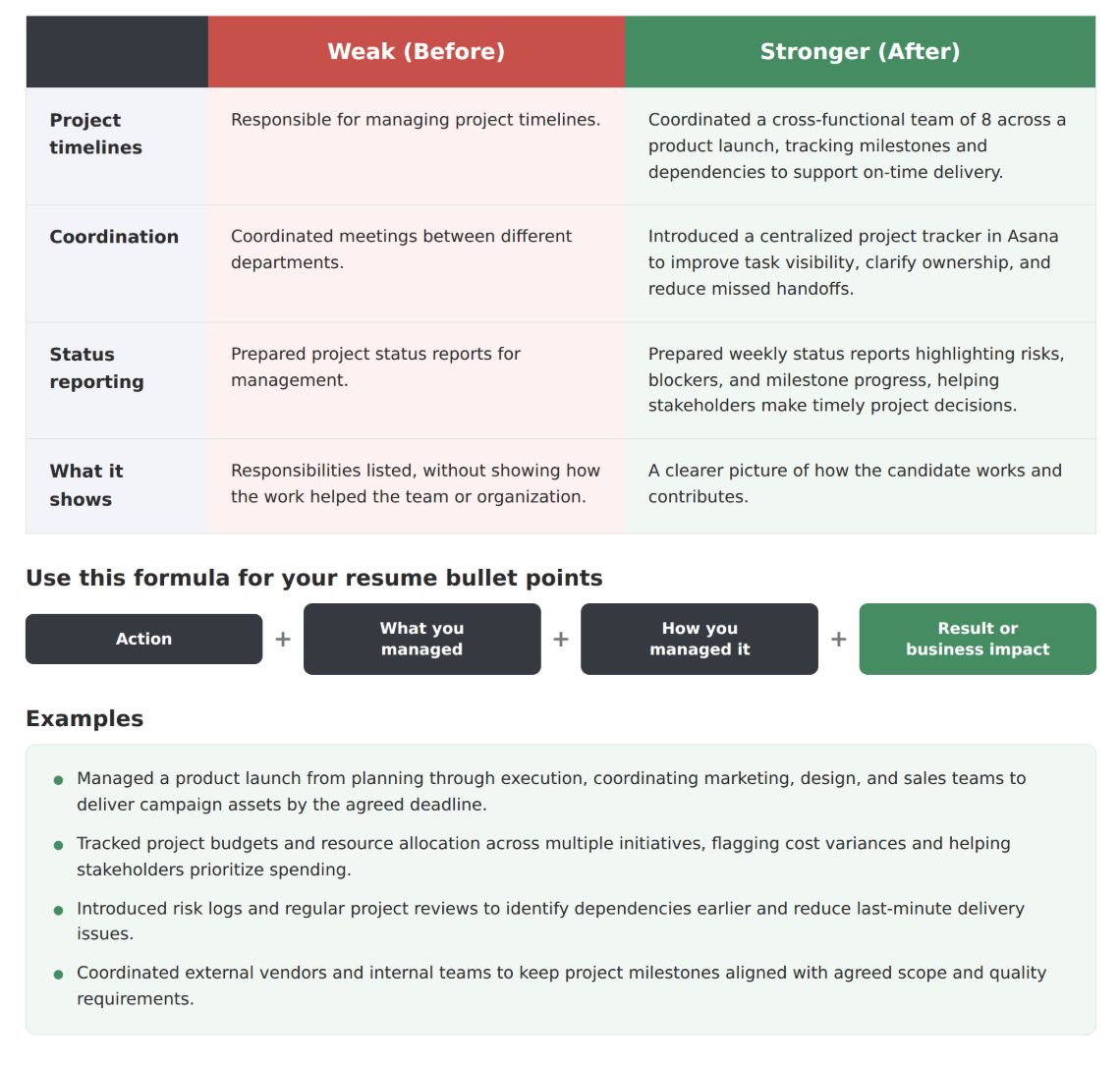
Metrics help recruiters understand the scale and impact of your work.
Consider including:
Delivered 12 projects within agreed timelines.
Coordinated a cross-functional team of 10.
Managed a project budget of ฿1.5 million.
Reduced project turnaround time by 25%.
Improved on-time task completion from 75% to 92%.
Coordinated 6 departments and 4 external vendors.
Reduced recurring reporting time by 30%.
You don't need a percentage in every bullet point. Project complexity, budget size, team size, number of stakeholders, and delivery scope can also demonstrate your experience.
Never invent metrics. If you cannot measure the impact precisely, explain the deliverable and why it mattered.
Your resume should reflect your career stage. A junior candidate needs to demonstrate organization, ownership, coordination, and potential. A senior candidate needs to show project delivery, leadership, risk management, and business impact.
Here are two examples you can use as a starting point.
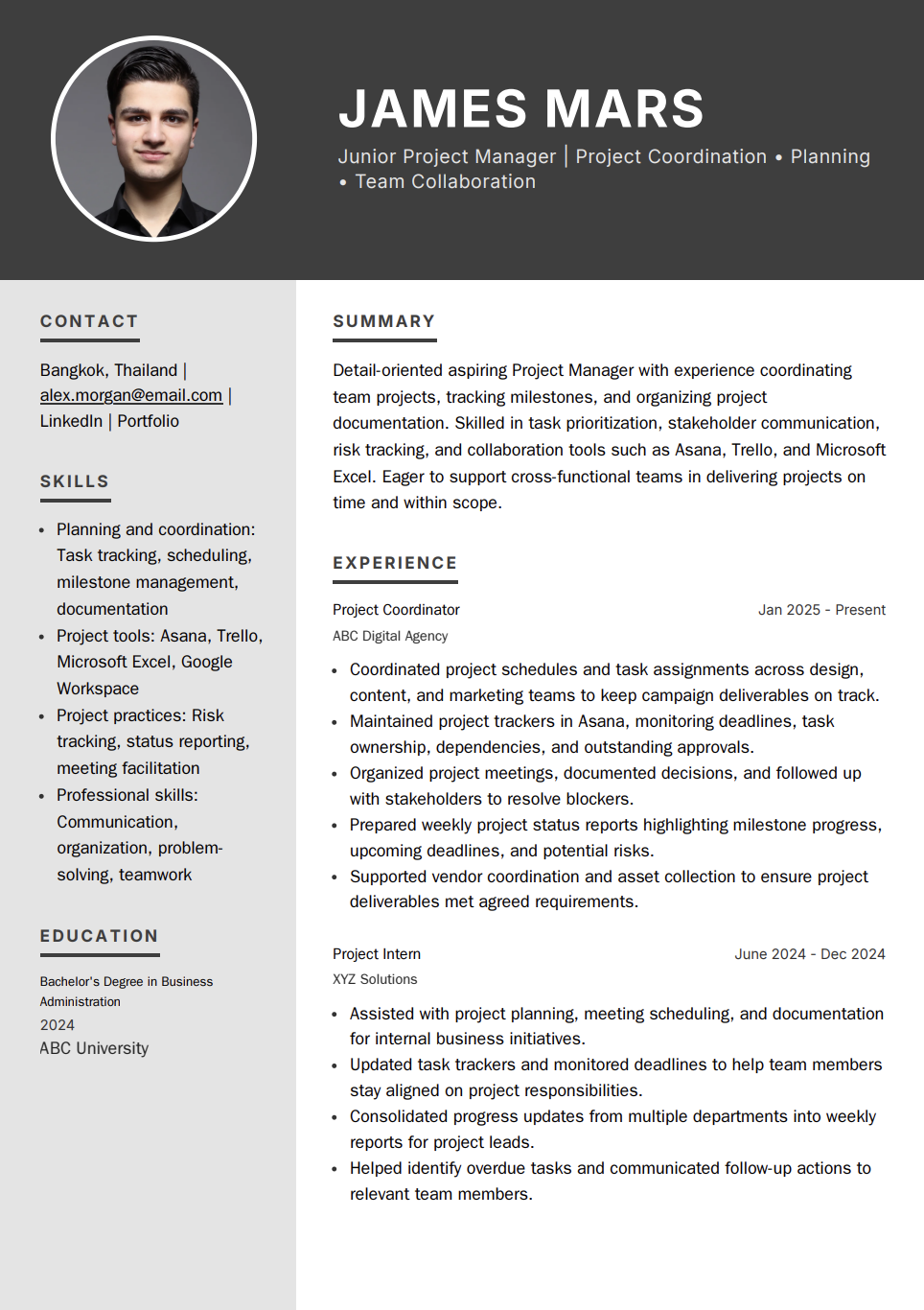
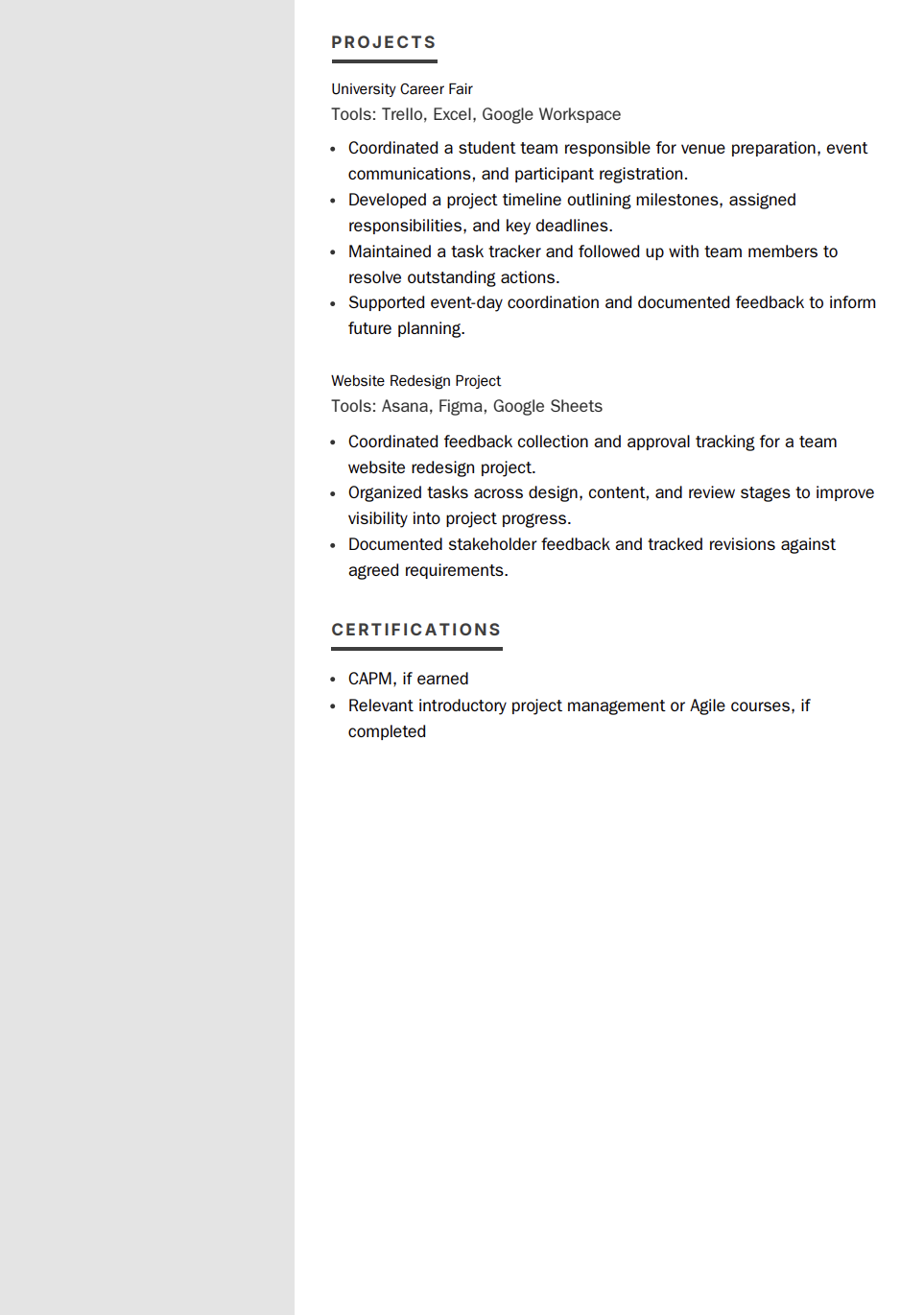
Why this resume works: It demonstrates practical project coordination, ownership, and communication skills without overstating the candidate's seniority. This structure is suitable for recent graduates, project coordinators, and professionals moving into project management.
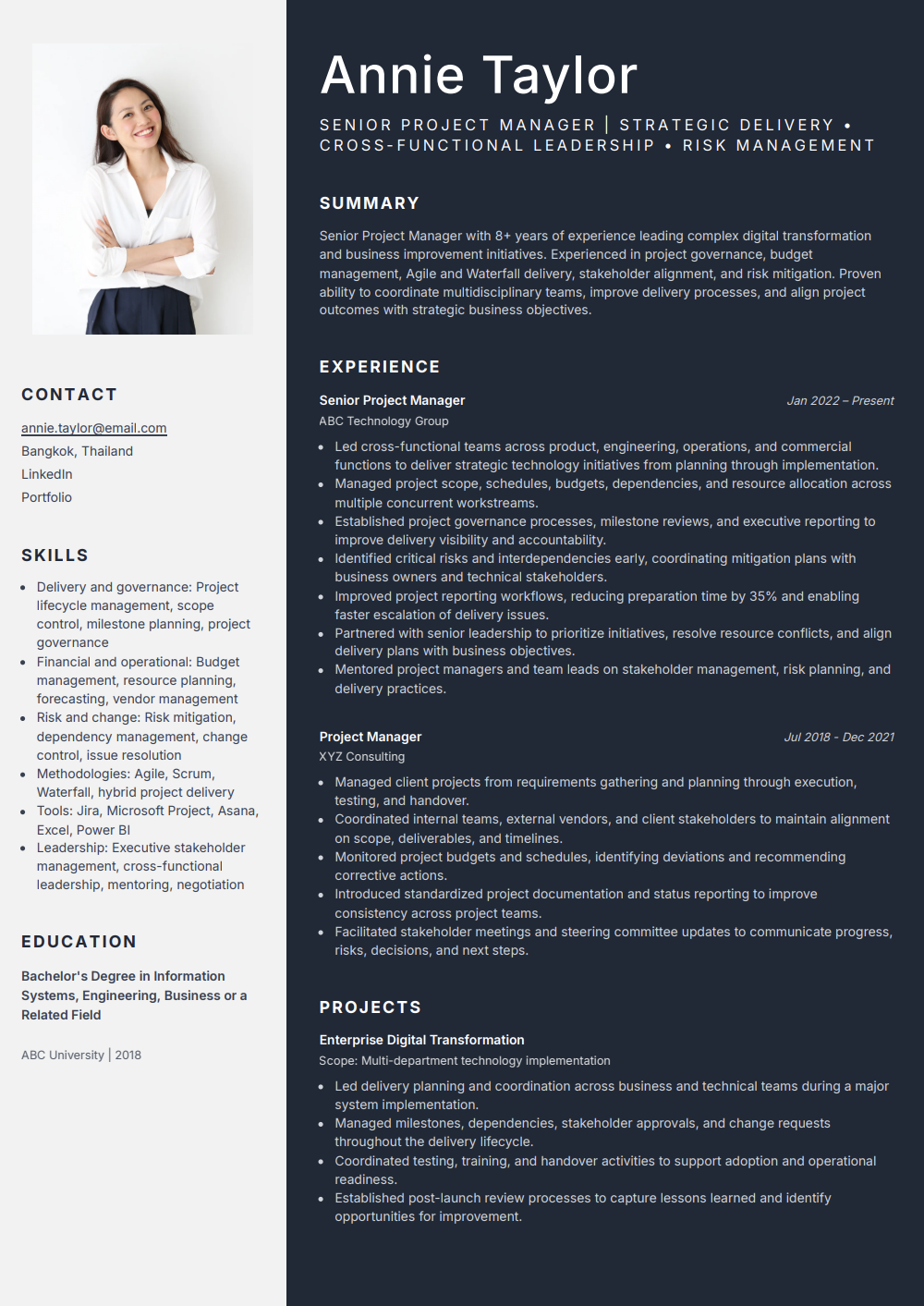
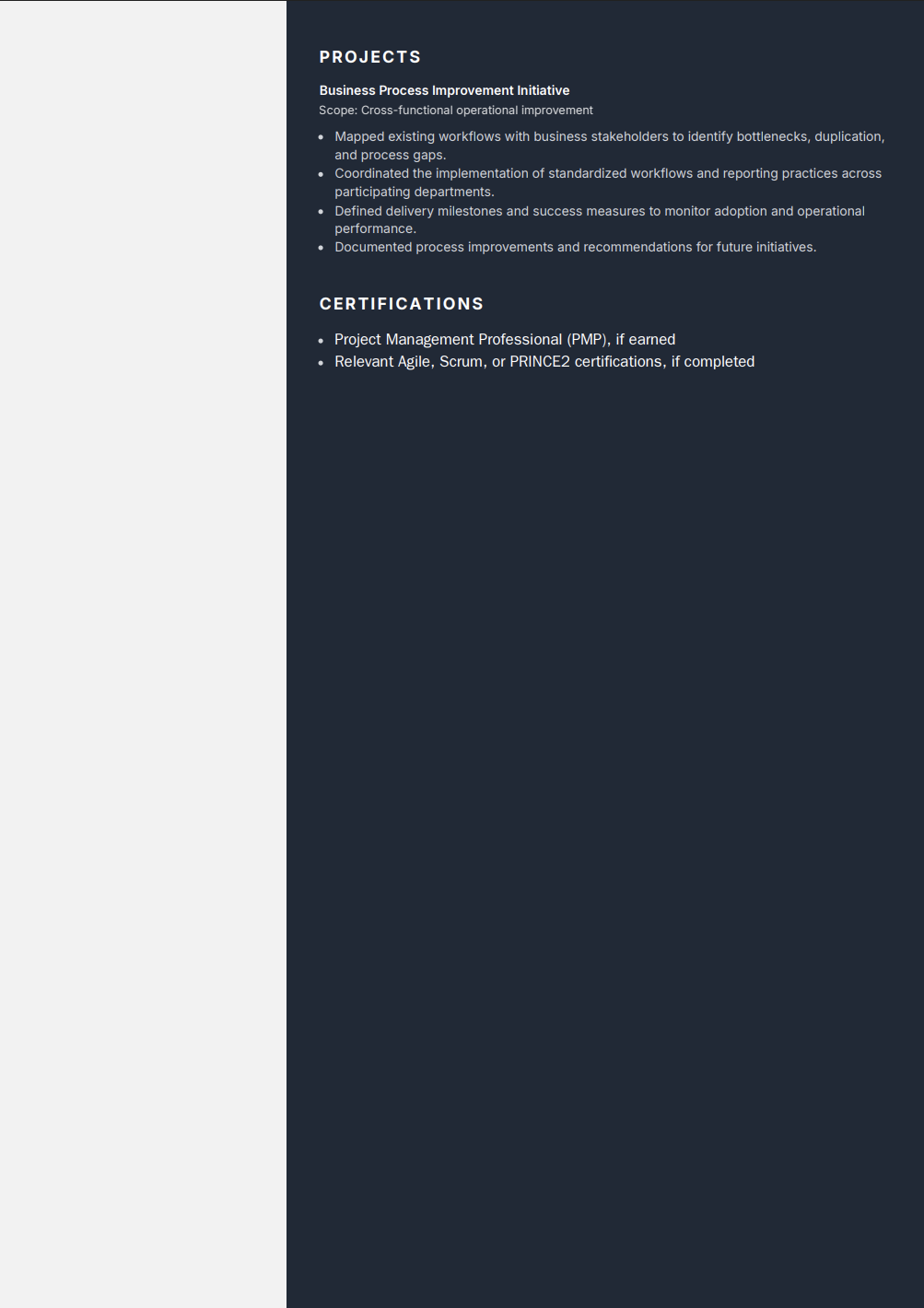
Why this resume works: It demonstrates more than task coordination. It emphasizes ownership of complex projects, governance, risk mitigation, executive communication, process improvement, and team leadership. These are important differentiators for senior project management roles.
Want a resume like this in minutes? Use Jobcadu’s Resume Builder to pick an ATS-friendly template, add your achievements, and download it, with no design skills needed.
Your skills section should match the type of project you want to manage. A software delivery role and a construction project role may require very different technical knowledge.
IT Project Manager
Agile and Scrum
Jira and Confluence
Software development lifecycle (SDLC)
Sprint and release planning
Risk and dependency management
Technical stakeholder coordination
Change management
Resource planning
Marketing Project Manager
Campaign planning
Content calendars
Creative workflow management
Resource allocation
Stakeholder and vendor coordination
Budget tracking
Asana, Trello, or Monday.com
Campaign reporting
Business Project Manager
Process improvement
Business requirements
Project governance
Change management
Risk assessment
KPI tracking
Cross-functional collaboration
Microsoft Project or similar tools
Construction Project Manager
Construction scheduling
Budget and cost control
Contractor management
Procurement coordination
Risk assessment
Quality and safety coordination
Resource planning
Construction project management software
Junior Project Manager
Task and timeline tracking
Meeting coordination
Documentation
Status reporting
Basic risk tracking
Team communication
Microsoft Excel
Asana, Trello, or similar tools
You don't need to list every skill in a category. Prioritize the skills requested by the employer and support them with relevant examples from your experience.
"Managed multiple projects" doesn't tell a recruiter much.
"Coordinated 6 cross-functional teams to deliver 10 project milestones within the agreed schedule" gives them a clearer picture of your responsibilities and scope.
Use credible numbers related to budgets, timelines, team size, project volume, efficiency, or delivery outcomes.
Applicant tracking systems (ATS) can help employers organize and search applications. Relevant keywords also make it easier for recruiters to identify your qualifications.
If the job description mentions Agile, stakeholder management, risk mitigation, Jira, and budget tracking, include those terms when they accurately reflect your experience.
Avoid keyword stuffing. Your experience should demonstrate how you've applied the skills.
A complex resume design can make important information harder to find or parse.
To improve readability:
Use standard headings such as Professional Summary, Work Experience, Skills, and Education.
Choose a clean, readable font.
Use straightforward bullet points.
Avoid placing essential details inside images, graphics, or elaborate text boxes.
Be cautious with complex columns and tables.
Follow the employer's requested file format.
Your resume should be easy to scan for both recruiters and recruitment software.
You don't need to rewrite your entire resume for every position.
Instead, tailor your summary, skills, selected achievements, and project examples to the role.
For an IT Project Manager position, emphasize technical delivery, release planning, and Agile practices. For a Marketing Project Manager role, highlight campaign execution, creative workflows, budgets, and vendor coordination.
Project management rarely goes exactly as planned. Recruiters want to know how you respond when deadlines change, resources become limited, or stakeholders disagree.
Whenever possible, include examples of how you:
Resolved delivery blockers.
Managed scope changes.
Escalated risks before they became major issues.
Reallocated resources to protect key milestones.
Improved communication between teams.
Helped stakeholders make timely decisions.
These examples show that you can adapt and deliver, not just maintain a project tracker.
Listing responsibilities without showing outcomes.
Using vague phrases such as "good leadership skills" without supporting examples.
Sending the same resume to every employer.
Listing project management tools you've never actually used.
Failing to explain project scope, complexity, or stakeholders.
Claiming budget savings or delivery improvements without evidence.
Overloading the resume with irrelevant projects.
Using a complicated design that makes the content difficult to scan.
Leaving typos, inconsistent dates, or unexplained abbreviations.
Ignoring ATS readability and relevant job-description keywords.
A great Project Manager resume isn't a list of meetings you've organized or tasks you've tracked. It's a clear demonstration of how you bring people together, manage uncertainty, make informed decisions, and deliver meaningful outcomes.
Whether you're applying for your first project management role or pursuing a senior leadership position, focus on relevant experience, credible achievements, and the skills that matter to your target role.
Don't let formatting slow down your job search. With Jobcadu's Resume Builder, you can create a professional, ATS-friendly resume in minutes.
Choose from 25+ polished templates, customize your sections, and highlight the project management skills, experience, and achievements that recruiters want to see.
[Start building your Project Manager resume with Jobcadu's Resume Builder now →]
No sections detected in this article.


