

An accountant's job is accuracy, so your resume is judged on it before anyone reads a word about your skills. A typo in a date, a vague bullet, or a cluttered layout tells a hiring manager something you never meant to say. A clean, specific resume says the opposite: this person is precise, organized, and understands what the numbers mean for the business.
But how do you show that in one or two pages? The key is to connect your technical knowledge (reconciliations, month-end close, tax filing, audit support) with results a finance manager can picture, whether you're a fresh graduate looking for a first role, a staff accountant moving up, or a senior accountant stepping into management.
In this guide, you'll learn how to structure your accountant resume, write a summary that gets noticed, turn daily tasks into measurable achievements, choose the right skills and certifications, and explore three resume examples for different career stages. When you're ready to put it into practice, Jobcadu's AI Resume Builder can help you organize your experience and refine your wording in minutes.
Accounting roles vary widely. One company needs an accounts payable specialist who clears invoices without errors. Another wants a tax accountant who keeps VAT and corporate income tax filings on time. An audit firm hires associates who can test controls, and a growing business needs a general accountant who can run the books and close the month.
Whatever the title, hiring managers want quick answers to a few questions:
Which accounting areas have you worked in (AP/AR, general ledger, tax, audit, reporting)?
Which standards and software can you use (VAS, IFRS, Excel, ERP, accounting packages)?
How accurate and reliable is your work?
What measurable results have you delivered, such as a faster close or fewer errors?
Do you hold, or are you working toward, a recognized qualification?
Your resume should answer these without making a recruiter dig. Whether you're applying for an Accounting Assistant, Staff Accountant, Tax Accountant, Senior Accountant, or Accounting Manager role, focus on the experience that matters most for that specific job.
Think of your resume as a financial statement of your career: compact, consistent, and easy to audit. Every section should help prove you're right for the role.
1. Contact information
Your full name, professional email, phone number, city, and your LinkedIn profile if it's up to date.
2. Professional summary
Two to four sentences covering your specialization, experience level, key skills, and strongest achievement.
3. Core skills
Group technical skills (reconciliation, financial reporting, tax, accounting software) so a recruiter can scan them in seconds.
4. Work experience
List roles in reverse-chronological order, with achievement-focused bullets rather than duty lists.
5. Education
Include your degree, university, and graduation year. Recent graduates can add relevant coursework, internships, and academic honors.
6. Certifications and licenses
List credentials such as CPA, ACCA, CMA, or CIA, or note "candidate" or "in progress" if you're still studying. Add software certificates if they're relevant.
7. Optional extras
Professional memberships, awards, volunteer treasurer roles, and languages. English proficiency is worth listing if you're targeting international firms or multinational companies.
You don't need every section on every resume. Recent graduates usually put Education and internships first, while experienced accountants lead with work history. Prioritize whatever best supports the job you want.
Sending the same resume everywhere saves time, but it makes each application less relevant.
Before you write, read the job posting closely and note the required tasks, tools, standards, and qualifications. A tax accountant posting may stress VAT, corporate income tax, and tax software. An audit role may focus on internal controls, sampling, and working papers. A general accountant role might emphasize the full cycle: AP/AR, bank reconciliation, month-end close, and financial statements.
Example: If the posting asks for IFRS reporting, month-end close, and ERP experience, move those items near the top of your resume and use the same wording, provided you genuinely have the experience.
Applicant tracking systems (ATS) may help employers sort applications by keywords, so standard headings and the terminology from the posting make your resume easier for both software and people to read. You're not changing your experience to fit the job. You're making the most relevant parts easy to find.
Your summary is a short pitch that tells the recruiter who you are, what you specialize in, and what you bring. Use this formula:
[Job title or experience level] + [accounting specialization] + [key skills or tools] + [achievement or value]
Weak example:
"Hardworking accountant looking for a challenging position at a reputable company."
This could describe almost any applicant. It names no skill, no result, and no specialty.
Entry-level accountant:
"Recent Accounting graduate with internship experience in accounts payable, bank reconciliations, and Excel-based financial analysis. Familiar with VAS, IFRS basics, and accounting software. Eager to support audit and reporting teams while working toward ACCA/CPA qualification."
Mid-level accountant:
"Detail-oriented General Accountant with 5+ years of experience in month-end close, general ledger management, and tax filings for mid-sized companies. Cut monthly close time from 8 to 5 working days by standardizing reconciliations in Excel and the ERP."
Senior accountant or accounting manager:
"Accounting Manager with 10+ years of experience leading financial reporting, audits, and tax compliance under VAS and IFRS. Led a team of 8 accountants and delivered on-time statutory reports with zero audit findings across three consecutive years."
Pick the example closest to your level and replace every detail with your own. Never claim years of experience, tools, or results you can't back up in an interview.
This is where most accountant resumes fall short. A list of duties tells a recruiter what you were assigned, not how well you did it. Compare:
Weak (duty) | Stronger (achievement) |
Responsible for accounts payable. | Processed 300+ vendor invoices per month with a 99.5% accuracy rate by tightening three-way matching checks. |
Prepared monthly financial reports. | Delivered monthly management reports to leadership within 4 working days of period end, down from 7, by automating data pulls in Excel. |
Handled bank reconciliations. | Reconciled 12 bank accounts monthly with no unresolved items older than 30 days. |
Helped with tax filings. | Prepared monthly VAT declarations and quarterly CIT filings on time for 24 consecutive periods with no penalties. |
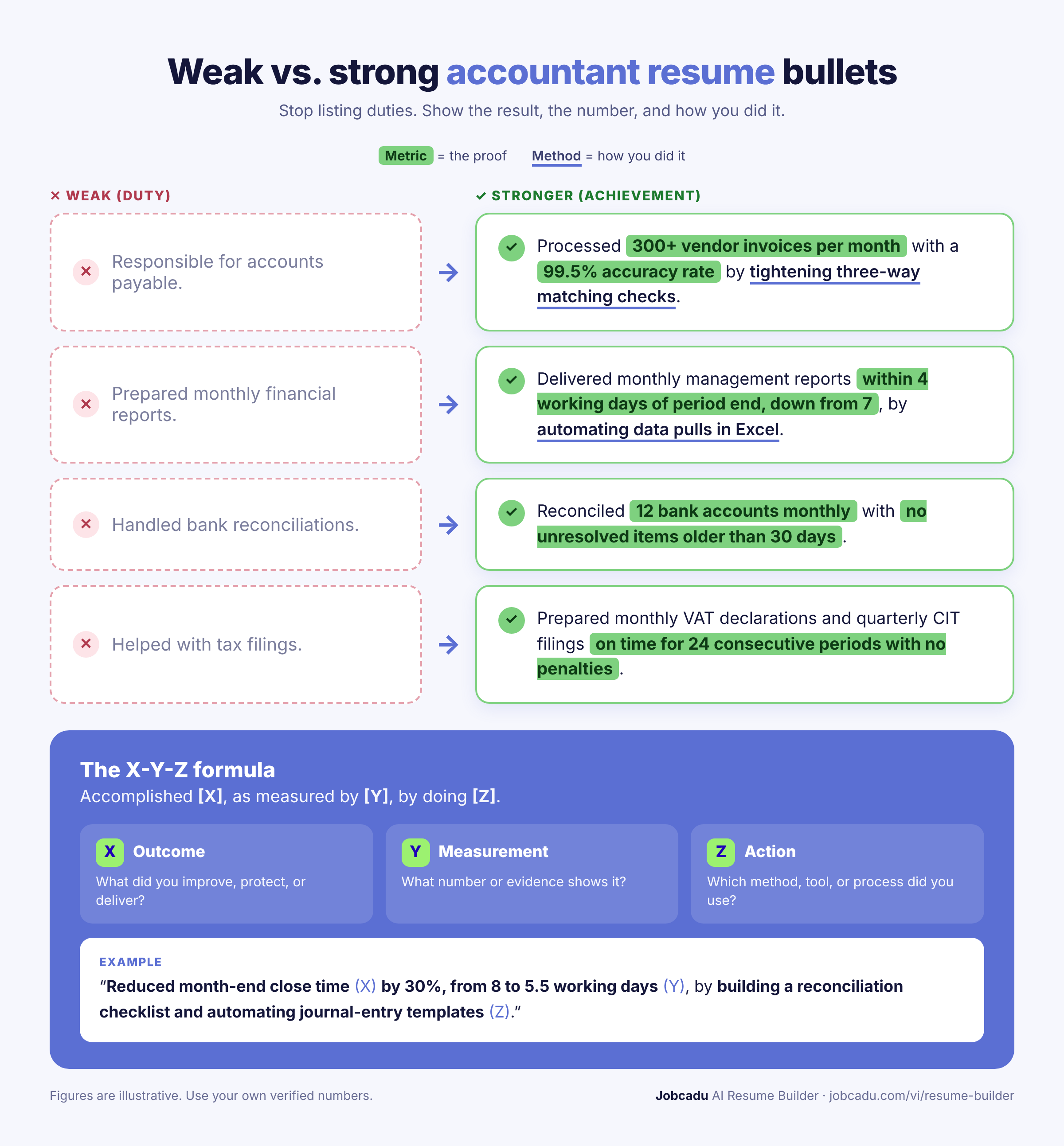
Not every win needs a percentage. You can also cite the number of entities, accounts, invoices, audits, or team members you supported, or the manual steps you eliminated. If you don't have exact data, describe the scope truthfully rather than inventing numbers. Start each bullet with a strong action verb such as reconciled, streamlined, reduced, prepared, audited, implemented, or led.
Keep your skills section easy to scan and relevant to the job. Group hard skills and add soft skills through your bullets and summary.
Accounting core: General ledger, AP/AR, bank and balance sheet reconciliation, month-end and year-end close, financial statement preparation
Tax and compliance: VAT, corporate income tax, personal income tax, e-invoicing, VAS, IFRS, internal controls
Analysis and planning: Budgeting, forecasting, variance analysis, cost accounting
Software: Advanced Excel (pivot tables, VLOOKUP/XLOOKUP), ERP systems (SAP, Oracle, NetSuite), accounting packages (QuickBooks, MISA, FAST), Power BI or similar tools
Workplace skills: Attention to detail, time management, communication, critical thinking, ethical judgment, teamwork
Choose only what reflects your real background, and match the wording of the job description. Skip arbitrary skill bars like "Excel: 90%"; specific experience is stronger evidence.
Credentials signal commitment and technical depth, so make them easy to spot:
ACCA (full or partly qualified, with the number of papers passed)
CPA (Vietnam CPA, CPA Australia, or U.S. CPA, stating which one)
CMA, CIA, or CFA, depending on your target role
Software or short courses, such as an advanced Excel or bookkeeping certificate
If you're still studying, write "ACCA Affiliate (9 of 13 papers passed)" or "CPA candidate." That is honest and still shows direction.
Below are three accountant resume examples for different career stages. All names, employers, and figures are fictional. Use them as inspiration, then adapt them to your real experience.
_page-0001 (1).jpg "Linh Tran (1)_page-0001 (1).jpg")
Why this works: With little professional history, it leads with education, a real internship, and specific numbers. It also shows a clear qualification plan.
_page-0001.jpg "Hoang Nam (1)_page-0001.jpg")
Why this works: It shows progression, ties every bullet to a result, and mirrors the language a hiring manager would use in a job posting. For your own version, replace the sample details with your real systems, entities, and verified outcomes.
_page-0001.jpg "Hoang Nam (2)_page-0001.jpg")
Why this works: It emphasizes ownership, team scale, control improvements, and business impact rather than routine tasks, which is what managers are hired to deliver.
Note: These examples are illustrative templates. Replace placeholder details with your real employers, dates, qualifications, and results.
1. Keep the layout simple. Use a clean single-column layout, standard headings (Summary, Experience, Education, Skills), a readable font like Calibri or Arial at 10–12 pt, and consistent spacing and dates.
2. Use keywords from the job description. Include the standards, software, and tasks the posting names, when they truly reflect your experience.
3. Quantify your achievements. Close time, error rates, invoices processed, accounts reconciled, savings found, and team size make your contribution concrete.
4. Keep it to one page if you can. One page suits students and professionals with under about 10 years of experience. Senior candidates may need two. Relevance matters more than a strict page count.
5. Check every detail. Accountants are expected to be precise, so proofread names, dates, numbers, and contact details, and save the file in the format the employer asks for (usually PDF).
Even strong candidates weaken their applications with avoidable errors.
Listing duties instead of achievements: Say what changed because of your work.
Burying certifications: Put ACCA, CPA, or CMA status where a recruiter will see it, including "in progress" qualifications.
Using an overly complicated design: Skip graphics, icons, and multi-column layouts that can confuse ATS parsing.
Listing every tool you've ever opened: Keep software relevant and be ready to discuss each one in an interview.
Sending the same resume everywhere: Tailor the summary and skills for each role.
Using vague words: "Hardworking" and "team player" tell a recruiter nothing; numbers and examples do.
Exaggerating results: Use accurate figures and describe your contribution honestly.
Skipping the proofread: One typo in a number or date can undermine a resume built on accuracy.
Knowing the rules is one thing. Applying them to a blank page is another. Jobcadu's AI Resume Builder is designed to make that step faster:
Organize your experience into clear, recruiter-friendly sections.
Refine your wording with AI suggestions that turn routine duties into achievement-focused bullets.
Choose a clean template that stays readable for both people and applicant tracking systems.
Customize for each job by adjusting your summary and skills in minutes.
AI is a starting point, not a substitute for your own judgment. Review every suggestion and keep only claims you can explain with confidence in an interview.
Lead with education, relevant coursework, internships, and academic projects. Include related roles such as bookkeeping, part-time cashier or finance work, or volunteer treasurer positions. Explain which tasks you handled, which tools you used, and any measurable results.
One page is usually enough for students, graduates, and professionals with under about 10 years of experience. Senior accountants and managers may need two pages. Prioritize relevant information over a fixed page count.
Include technical skills such as reconciliation, financial reporting, tax compliance, and budgeting, plus software like Excel, an ERP, or an accounting package. Add workplace skills like attention to detail, communication, and time management through your bullets. Mirror the wording of the job posting.
Yes, if you state your status honestly. Write "ACCA Affiliate (9 of 13 papers passed)" or "CPA candidate." It shows commitment without overstating your qualification.
Use standard headings, a simple single-column layout, clear fonts, and relevant keywords from the job description. Avoid putting important information only inside images, text boxes, or graphics, and follow the employer's file-format instructions.
Yes. AI can help organize your experience, strengthen bullet points, suggest relevant keywords, and refine your summary. Always review the output carefully. Make sure every skill, number, and responsibility is accurate and that you can explain it in an interview.
You now know how to write an accountant resume that highlights your accuracy, technical skills, and results. Now put it into practice.
With Jobcadu's AI Resume Builder, you can create a professional resume, organize your experience, and refine your content with AI assistance. Choose a polished template, customize each section, and present your qualifications in a clear, recruiter-friendly format.
Whether you're applying for your first accounting job or your next step up the ladder, let your resume show what you can do.
Start building your accountant resume with Jobcadu today: https://jobcadu.com/vi/resume-builder
No sections detected in this article.


