

You've spent hours choosing the perfect font, adjusting the colors, and making sure every element looks just right. Maybe you've even stayed up late finishing a portfolio project you're genuinely proud of. But now comes the part that many designers find less exciting: writing your resume.
You might be wondering, How do I fit my creativity, design skills, and experience into just a page or two? And if you're applying for your first design job, you might be asking yourself, What should I write when I don't have much professional experience yet?
Here's the thing: being a great graphic designer isn't just about creating beautiful visuals. It's also about showing people the thinking and value behind your work.
Recruiters want to understand how you turn ideas into designs, communicate a brand's message, solve creative problems, and contribute to a team's goals. Your portfolio shows them what you can create, while your resume helps them understand the skills and experience behind it.
Whether you're a fresh graduate building your first resume or an experienced designer ready for your next career move, you don't need a list of impressive clients or award-winning projects to get started. You need a resume that tells your story, highlights your strengths, and shows why you're a good fit for the role.
In this article, we'll walk through how to write a Graphic Designer resume, showcase your skills and achievements, choose the right keywords, and create a resume that helps your work get the attention it deserves.
Graphic design is about more than making things look good. Employers need designers who can communicate ideas visually, maintain brand consistency, understand creative briefs, and produce designs that serve a specific purpose.
Depending on the role, you may be responsible for social media content, advertising campaigns, brand identity, packaging, editorial layouts, presentations, or digital marketing materials.
Hiring managers often look for evidence of:
Visual communication: Can you communicate messages clearly through design?
Creative problem-solving: Can you turn a brief or business challenge into an effective visual solution?
Design fundamentals: Do you understand typography, color theory, composition, layout, and visual hierarchy?
Brand consistency: Can you maintain a consistent visual identity across different channels and materials?
Technical proficiency: Can you use relevant design software and prepare files correctly for digital or print production?
Collaboration: Can you understand feedback, communicate design decisions, and work with marketing teams, copywriters, clients, and other stakeholders?
Measurable impact: Did your work contribute to improved engagement, campaign performance, production efficiency, brand recognition, or another meaningful outcome?
Whether you're applying for a Junior Graphic Designer, Graphic Designer, Brand Designer, Marketing Designer, Packaging Designer, or Senior Graphic Designer position, your resume should make these capabilities easy to identify.
Your portfolio demonstrates the quality of your work. Your resume explains how your experience, skills, and achievements make you a strong candidate for the role.
Think of your resume as a design project in itself. It should communicate information clearly, establish a visual hierarchy, and help recruiters find the most important details without unnecessary effort.
Here are the essential sections to include.
Keep your contact information simple and professional.
Include:
Full name
Phone number
Professional email address
LinkedIn profile
Location
Portfolio website or selected design projects
Your portfolio is especially important for graphic design positions. While your resume summarizes your experience and capabilities, your portfolio provides visual evidence of your design skills.
Make sure your portfolio link works and that recruiters can access your work easily. Organize your projects so visitors can quickly understand what you designed, the purpose of each project, and your specific contribution.
If a project contains confidential company information, use approved, anonymized, or publicly shareable examples instead.
Write two to four sentences that explain your experience, design specialization, key skills, and the value you can bring to a creative team.
Avoid generic statements such as "creative and passionate designer." Instead, identify the type of design work you do, the tools you use, and the problems you can help solve.
Example: Graphic Designer with 3+ Years of Experience
Graphic Designer with 3+ years of experience creating visual assets for digital marketing campaigns, social media, and brand communications. Proficient in Adobe Photoshop, Illustrator, and InDesign, with strengths in visual storytelling, typography, and brand consistency. Experienced in collaborating with marketing teams to develop creative materials that communicate campaign messages effectively and align with brand guidelines.
Example: Entry-Level Graphic Designer
Aspiring Graphic Designer with a foundation in visual communication, typography, layout design, and digital illustration. Experienced in developing creative concepts through university projects, personal design work, and digital content creation. Proficient in Adobe Illustrator and Photoshop, with a strong interest in brand identity and digital marketing design.
If you're starting your career, focus on relevant projects, internships, coursework, and transferable skills instead of trying to sound like an experienced designer.
Your work experience section should demonstrate more than the number of graphics you've produced.
Explain the type of creative challenges you handled, the decisions you made, the projects you supported, and the results you helped achieve.
Instead of writing:
Responsible for creating social media graphics.
Designed promotional materials for marketing campaigns.
Worked with the marketing team on creative projects.
Try describing your contribution more specifically:
Designed social media graphics and campaign visuals across multiple platforms, maintaining brand consistency and adapting creative assets to different audience needs.
Developed promotional materials for seasonal campaigns, translating marketing briefs into clear visual concepts and supporting timely campaign delivery.
Created reusable design templates for recurring social media content, helping streamline production and maintain a consistent visual identity.
Collaborated with marketing and content teams to refine creative concepts, incorporate feedback, and deliver assets aligned with campaign objectives.
If you have reliable performance data, you can make your achievements even stronger.
For example:
Redesigned social media templates, contributing to a 20% increase in average engagement over three months.
Produced 40+ creative assets for a product launch across social media, email, and website channels.
Developed a reusable template library that reduced the time required to create recurring campaign materials.
These are illustrative examples, not guaranteed outcomes. Use numbers only when they accurately reflect your experience and can be explained during an interview.
If you don't have access to campaign metrics, describe the scope of your work, the creative challenge you addressed, and how your contribution supported the team.
Your skills section should include a combination of design fundamentals, creative software, production knowledge, and collaboration skills relevant to the job description.
Design skills:
Typography
Color theory
Layout and composition
Visual hierarchy
Brand identity
Visual storytelling
Illustration
Image editing and retouching
Creative concept development
Design adaptation across platforms
Digital and marketing design:
Social media graphics
Digital advertising creatives
Website and landing page visuals
Email marketing graphics
Presentation design
Infographics
Campaign key visuals
Content marketing assets
Print and production skills:
Editorial layout
Packaging design
Print-ready file preparation
Prepress fundamentals
Image resolution and color modes
Print production coordination
Include these skills only when they match your experience and the position you're applying for.
Design software:
Adobe Photoshop
Adobe Illustrator
Adobe InDesign
Figma
Canva
Adobe After Effects
Adobe Premiere Pro
You don't need to list every design tool available. Prioritize the tools requested in the job description and those you can confidently demonstrate.
Collaboration skills:
Creative briefing
Design presentation
Feedback and revision management
Cross-functional collaboration
Time management
Attention to detail
Creative problem-solving
Stakeholder communication
Whenever possible, support your skills with examples from your work experience or portfolio.
Include your degree, university, major, and graduation year.
Relevant educational backgrounds may include:
Graphic Design
Visual Communication Design
Communication Arts
Digital Media
Fine Arts
Advertising
Multimedia Design
Other related disciplines
However, a specific degree isn't the only path into graphic design. Employers may also consider your practical skills, relevant projects, work experience, and portfolio.
If you're a recent graduate, you can include relevant coursework or university projects that demonstrate your understanding of design fundamentals.
Courses and certifications can demonstrate your commitment to learning, especially if you're entering the field or developing a new design specialization.
Relevant learning areas may include:
Graphic design fundamentals
Typography and layout
Brand identity design
Adobe Photoshop and Illustrator
Adobe InDesign and editorial design
Digital marketing design
Motion graphics
Illustration
Packaging design
Design for social media
AI-assisted creative workflows
Include certifications you've actually earned and courses relevant to your target position. If a course is still in progress, label it accordingly.
Completing a course alone doesn't prove professional competence. Whenever possible, connect what you've learned to a practical project or portfolio piece.
If you have limited professional experience, projects can demonstrate your design thinking and technical abilities.
Consider including:
University design projects
Brand identity concepts
Social media campaign designs
Advertising creatives
Packaging concepts
Editorial layouts
Infographics
Posters and promotional materials
Personal illustration projects
Volunteer or nonprofit design work
Freelance projects
Conceptual redesigns of existing visual materials
For each project, explain:
The objective: What message, problem, or audience need was the design intended to address?
Your role: Which parts of the project did you create yourself?
The process: How did you develop the concept, explore visual directions, and refine the design?
The tools: Which software or techniques did you use?
The outcome: What did you deliver, what problem did it address, or what did you learn?
For example, instead of presenting a collection of social media graphics without context, explain that you developed a visual direction for a campaign targeting university students, created a set of platform-specific assets, and established reusable templates to maintain consistency.
A strong portfolio doesn't simply display attractive designs. It helps recruiters understand the thinking behind your creative decisions.
If you're presenting a personal or conceptual project, be transparent about its scope. Don't describe hypothetical campaign results as actual business achievements.
Sending the same resume to every employer can make your experience appear too general.
Graphic design positions often overlap, but the responsibilities can differ significantly. A social media designer may spend most of their time creating digital content, while a brand designer may focus on visual identity systems and brand guidelines.
Read the job description carefully. Identify the design skills, software, industry experience, and deliverables the employer values most.
Here are examples of what different graphic design roles may prioritize.
Layout and composition
Typography and color theory
Digital and print design
Adobe Creative Suite
Creative concept development
Brand consistency
File preparation and production
Social media graphics and content assets
Campaign key visuals
Platform-specific design adaptation
Visual storytelling
Digital advertising creatives
Template development
Collaboration with marketing and content teams
Brand identity development
Logo design
Typography and color systems
Brand guidelines
Visual identity systems
Creative direction
Consistency across brand touchpoints
Campaign creative development
Digital advertising assets
Landing page and email visuals
Promotional materials
Conversion-focused creative testing
Collaboration with marketing teams
Campaign performance evaluation
Packaging layout and visual design
Typography and information hierarchy
Print production and prepress
Dielines and packaging specifications
Material and format considerations
Brand consistency
Collaboration with production teams
Creative concept development
Visual direction and design quality
Brand consistency across channels
Complex creative project management
Stakeholder communication
Design review and mentoring
Workflow improvement
Creative strategy and business alignment
If the job description emphasizes social media and campaign design, make those projects easy to find. If it focuses on brand identity, highlight your experience with logos, visual systems, and brand guidelines.
You're not changing your background. You're showing how your existing experience matches the employer's needs.
Your professional summary is often one of the first sections recruiters read. Use it to communicate your design specialization and relevant strengths quickly.
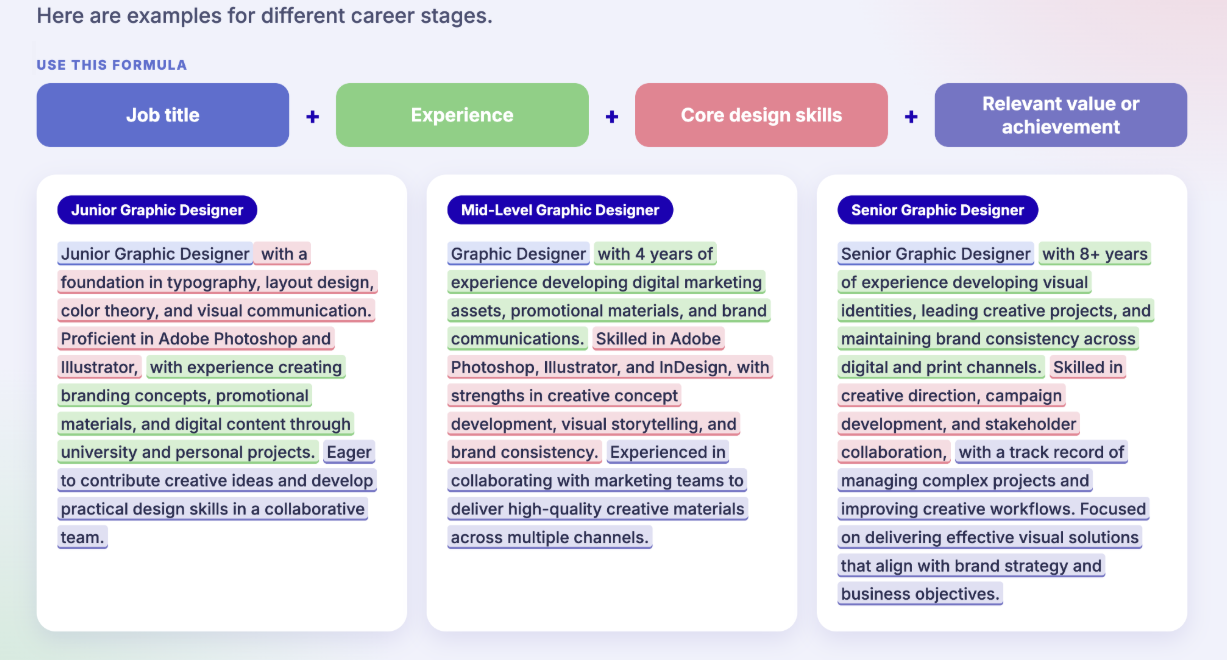
Keep your summary concise and specific. Avoid vague descriptions such as "creative, passionate, and hardworking" unless you support them with relevant experience or skills.
If you include a metric, make sure you can explain how it was measured and what your contribution was.
One of the most common weaknesses in a Graphic Designer resume is describing the designs created without explaining why they were needed or what they accomplished.
Recruiters want to understand not only what you designed, but also how you approached the brief, solved creative problems, and contributed to the team's goals.
Compare these examples.
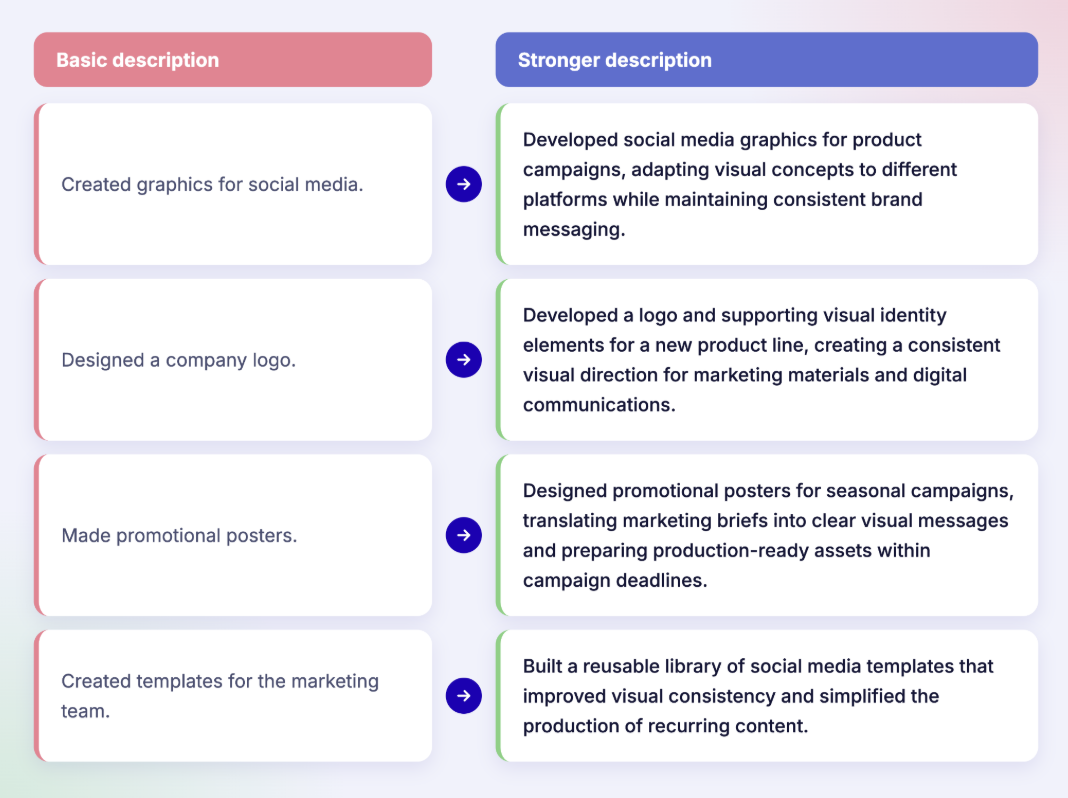
Graphic design involves more than producing the final visual. Your resume can demonstrate your experience by highlighting the process behind your work.
Understand the brief: Identify the objective, audience, key message, and design requirements.
Research: Explore the brand, audience, competitors, and relevant visual references.
Develop concepts: Create initial directions, sketches, mood boards, or visual approaches.
Design: Apply typography, color, composition, and visual hierarchy to develop the creative assets.
Review: Present the design, explain your decisions, and gather feedback from relevant stakeholders.
Refine: Revise the design based on feedback, brand requirements, and technical constraints.
Deliver: Prepare final files in the required formats and coordinate handoff or production.
You don't need to include every stage in every resume bullet. Focus on the parts that demonstrate your capabilities and match the position.
Metrics help recruiters understand the scale and scope of your work.
Depending on your role, useful examples may include:
Produced 50+ creative assets for a multi-channel marketing campaign.
Designed 20 social media templates for recurring content production.
Developed a visual identity system covering five brand touchpoints.
Created campaign materials for three product launches.
Prepared 30+ print-ready assets for promotional and event materials.
Reduced the time needed to produce recurring social media graphics by 25% through reusable templates.
Contributed to a campaign that achieved a 15% increase in engagement after the creative assets were updated.
These are illustrative examples, not industry benchmarks or guaranteed outcomes. Use them only if they accurately reflect your own work and available evidence.
You don't need a percentage in every bullet point. The number of assets produced, campaigns supported, formats delivered, or templates developed can also demonstrate the scope of your experience.
Never invent metrics or claim that your design directly caused an improvement without evidence. If you don't have access to campaign analytics, explain what you created, what problem it addressed, and how it supported the team.
Your resume should reflect your career stage.
A junior candidate needs to demonstrate design fundamentals, practical projects, curiosity, and the ability to learn. An experienced designer needs to show ownership, creative decision-making, collaboration, and the value of their work.
Here are two examples to use as starting points. The names and details are fictional.
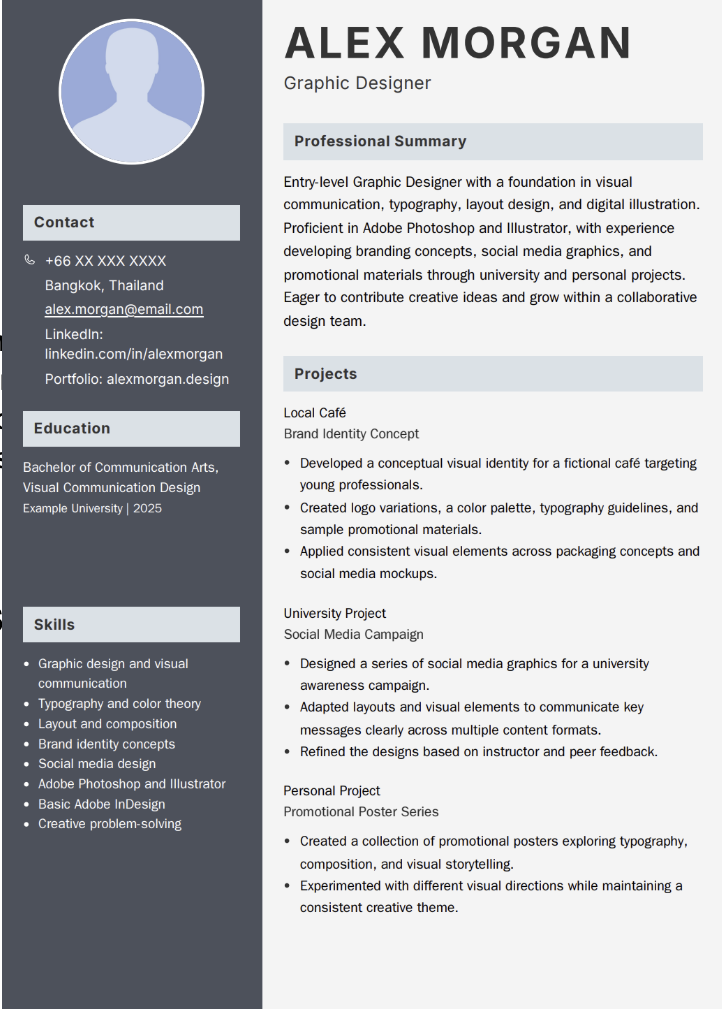
Why this resume works: It demonstrates practical design skills and creative thinking without overstating professional experience. University projects and personal work provide evidence of the candidate's potential, while the portfolio allows recruiters to evaluate the quality of the designs.
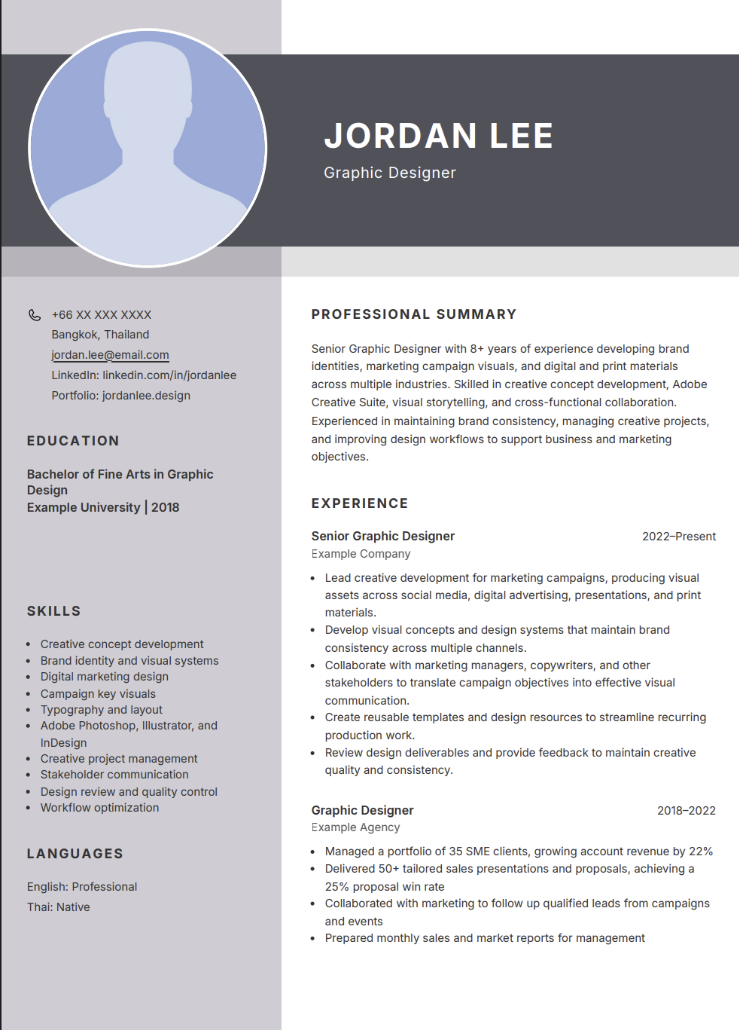
Why this resume works: It demonstrates more than the ability to produce attractive visuals. It highlights creative ownership, brand consistency, cross-functional collaboration, project management, and the ability to support broader business objectives.
The strongest version of this resume would include credible achievements and relevant metrics wherever available.
Want a resume like these? Use Jobcadu's Resume Builder to create a professional, ATS-friendly resume, organize your design experience, and highlight the skills relevant to your target role.
Your skills section should reflect the type of design work you want to do. A brand-focused role and a digital marketing design role may require different strengths.
Typography and color theory
Layout and composition
Visual hierarchy
Adobe Photoshop and Illustrator
Adobe InDesign
Brand consistency
Digital and print design
Creative concept development
Social media graphics
Campaign key visuals
Platform-specific creative adaptation
Digital advertising design
Visual storytelling
Template development
Content collaboration
Adobe Photoshop and Illustrator
Brand identity development
Logo design
Visual identity systems
Typography and color systems
Brand guidelines
Creative direction
Brand consistency
Concept presentation
Campaign creative development
Digital advertising assets
Email marketing graphics
Landing page visuals
Promotional materials
Visual communication
Creative testing and iteration
Marketing team collaboration
Packaging layout
Brand application
Typography and information hierarchy
Dielines and production specifications
Print-ready file preparation
Prepress fundamentals
Packaging mockups
Production coordination
Creative direction
Brand strategy and consistency
Complex creative problem-solving
Design review and mentoring
Stakeholder management
Creative project management
Workflow optimization
Business-aligned design decisions
You don't need to list every skill in a category. Prioritize the skills requested by the employer and support them with relevant examples from your resume or portfolio.
"Designed social media graphics" tells recruiters what you created, but not why it mattered.
"Developed a series of campaign visuals to communicate a product launch message consistently across social media channels" provides more context.
Whenever possible, connect your design decisions to campaign objectives, brand consistency, production efficiency, audience feedback, or measurable outcomes.
Applicant tracking systems (ATS) help employers organize and search job applications. Relevant keywords can also make it easier for recruiters to identify your qualifications.
If the job description mentions Adobe Illustrator, Photoshop, brand identity, typography, social media design, or print production, include those terms when they accurately reflect your experience.
Use terminology that matches the role. A brand design position may prioritize visual identity and brand guidelines, while a marketing design role may emphasize campaign creatives and digital advertising.
Avoid keyword stuffing. Your resume should show how you've applied the skills, not simply repeat a list of software and design terms.
A visually impressive resume isn't necessarily easy for recruitment software to read.
To improve readability:
Use standard headings such as Professional Summary, Work Experience, Skills, and Education.
Choose a clean, readable font.
Use straightforward bullet points.
Keep essential information in selectable text rather than images.
Be cautious with complex columns, tables, and decorative elements.
Follow the employer's requested file format.
Make your contact details and portfolio link easy to find.
Your resume and portfolio serve different purposes. Keep your resume easy to scan, then use your portfolio to demonstrate your visual creativity and detailed design process.
You don't need to rewrite your entire resume for every job application.
Instead, tailor your professional summary, skills, selected achievements, and project examples to the position.
For a Social Media Designer role, emphasize digital content, campaign assets, and platform-specific creative work.
For a Brand Designer role, highlight visual identity, logo development, and brand guidelines.
For a Marketing Designer role, demonstrate your experience supporting campaigns, creating digital advertising assets, and collaborating with marketing teams.
Your goal is to make your most relevant experience easy to find.
A Graphic Designer resume is stronger when your portfolio supports the claims you make.
If your resume mentions brand identity development, include a project showing the visual system and how it was applied. If you highlight social media campaign design, show relevant assets and explain the purpose of the campaign.
Make sure your portfolio is easy to navigate, your contribution to each project is clear, and your case studies distinguish your own work from that of your team.
You don't need dozens of projects. A few relevant, well-presented projects can be more useful than a large collection of designs without context.
Even talented designers can weaken their applications by making avoidable resume mistakes.
Watch out for these common problems:
Listing responsibilities without explaining your contribution. Describe the purpose and value of your work instead of simply listing the materials you created.
Focusing only on aesthetics. Show that you understand the brief, audience, brand, and intended message.
Using the same resume for every position. Tailor relevant skills and projects to each job description.
Listing software you don't know how to use. Include only tools you can confidently discuss and demonstrate.
Forgetting your portfolio link. Make it easy for recruiters to review your work.
Including broken or inaccessible portfolio links. Test your links and check that your selected projects can be viewed.
Presenting conceptual projects as commercial work. Clearly label personal, academic, and hypothetical projects.
Claiming results without supporting evidence. Don't invent engagement figures or attribute business improvements to your designs without reliable information.
Using an overly complex resume layout. Decorative elements can make information harder to scan or parse.
Including too many unrelated projects. Prioritize work that demonstrates the skills required for your target position.
A great Graphic Designer resume isn't simply a list of designs you've created or tools you've used. It's a clear demonstration of how you communicate ideas visually, solve creative problems, maintain brand consistency, and contribute to meaningful outcomes.
Whether you're applying for your first design role or pursuing a senior creative position, focus on relevant skills, credible achievements, and the thinking behind your work.
Don't let resume formatting distract recruiters from your creative abilities.
With Jobcadu's Resume Builder, you can create a professional, ATS-friendly resume using polished templates, organize your design experience, and highlight the skills and achievements that matter to your target role.
Build a resume that communicates your value clearly, then let your portfolio bring your creativity to life.
Start building your Graphic Designer resume with Jobcadu's Resume Builder today →
No sections detected in this article.


