

You have a strong resume. Your skills match the job description. Your experience looks relevant.
But you're still competing with dozens or even hundreds of other applicants.
So how can you make your application more memorable?
One way is through a cover letter.

A cover letter gives you an opportunity to communicate something your resume cannot always show clearly: why you want this specific role, why your experience is relevant, and what you could bring to the company.
A cover letter won't guarantee that you get an interview. In fact, some employers may not require one at all. However, when used strategically, a well-written cover letter can strengthen your job application by adding context, demonstrating motivation, and connecting your experience directly to the employer's needs.
In this guide, you'll learn what a cover letter is, when you should use one, what to include, how to tailor it to a job description, common mistakes to avoid, and practical cover letter examples.
A cover letter is a short document submitted alongside your resume when applying for a job.
While your resume summarizes your professional background, a cover letter gives you space to explain the story behind your application.
It can answer questions such as:
Why are you interested in this position?
Why do you want to work for this company?
Which parts of your experience are most relevant?
What can you contribute to the organization?
Is there anything about your career background that needs additional context?
A cover letter is usually one page and should be customized for the position you're applying for.
The short answer is: it can help, but there is no guarantee.
A cover letter isn't a magic document that automatically moves your application to the top of a recruiter's list.
Its effectiveness depends on the employer, the role, the application process, and the quality of the letter itself.
A generic cover letter that says you're "hardworking, passionate, and motivated" may add very little value.
A targeted cover letter that connects your experience to the company's specific needs can provide useful context that your resume doesn't communicate on its own.
This is the most obvious situation.
If the job description asks applicants to submit a cover letter, you should treat it as part of the application requirements.
Failing to provide one could make your application look incomplete.
More importantly, the employer may be using the cover letter to evaluate how well candidates communicate, how seriously they considered the opportunity, and whether their motivation aligns with the role.
Career changers often face a problem:
Your resume shows where you've been, but it doesn't necessarily explain where you're going.
For example, imagine you're moving from sales into digital marketing.
Your resume might contain valuable transferable skills such as:
Customer research
Communication
Data analysis
Relationship management
Campaign support
Presentation skills
A cover letter gives you an opportunity to explain the connection.

Sometimes your experience is relevant, but the connection isn't immediately obvious.
Perhaps you've worked in another industry but performed many of the same responsibilities.
For example:
A hotel operations manager applying for a customer success role may have experience in:
Customer relationship management
Complaint resolution
Team leadership
Service improvement
Performance monitoring
A cover letter can help translate those experiences into language relevant to the new position.
Career paths aren't always perfectly straight.
You may have:
Changed industries
Taken time away from work
Worked freelance
Started a business
Returned to employment after a break
Relocated to another country
Moved between different functions
A cover letter can provide context without forcing your resume to explain everything.
The goal isn't to make excuses. It's to control the narrative and explain why your background still makes sense for the position.
When many candidates have similar qualifications, relevance and motivation can become important differentiators.
If your resume shows that you meet the requirements, your cover letter can help explain:
"Here's why this particular opportunity matters to me, and here's why my experience is particularly relevant."
There's a major difference between:
"I am interested in working for your company."
and:
"I've followed the company's expansion into Southeast Asia and was particularly interested in the recent launch of your digital customer platform. My experience managing customer-facing digital projects would allow me to contribute to that growth."
The second statement demonstrates research and gives the employer a specific reason to believe you're genuinely interested.
Your resume might say:
Increased website traffic by 35%.
That's useful.
But your cover letter can provide context:
"When I joined the team, organic traffic had remained relatively flat for several months. I analyzed the site's highest-performing content, identified gaps in our keyword strategy, and worked with the content team to restructure our publishing plan. Within six months, organic traffic increased by 35%."
The cover letter isn't repeating the achievement. It's explaining the story behind the achievement.
A strong cover letter can perform several different functions.
Recruiters don't just want to know that you want a job. They want to understand why you want this job.
Compare these two openings:
Generic:
I am interested in this position because it matches my skills and experience.
Specific:
With three years of experience developing social media campaigns for consumer brands, I was particularly interested in this Marketing Executive position because of your company's focus on building digital communities across Southeast Asia.
One of the most valuable functions of a cover letter is connecting the dots for the recruiter.
For example:
Job requirement: Manage social media campaigns.
Your experience: Managed social media campaigns that increased engagement by 42%.
Cover letter:
In my previous role, I managed social media campaigns across Instagram, TikTok, and Facebook, using performance data to optimize content and audience targeting. These campaigns contributed to a 42% increase in engagement over six months.
Now the recruiter can clearly see the connection.
A resume needs to be concise. That means it doesn't always have room to explain the full context behind every achievement.
Suppose your resume says:
Reduced customer response time by 30%.
Your cover letter could explain:
What problem existed?
What did you change?
How did you approach it?
What was the result?
Why was the result important?
For example:
In my previous customer service role, I noticed that response times were increasing as customer inquiries grew. I helped redesign the team's ticket prioritization process and introduced response-time tracking, reducing average response time by 30% while maintaining customer satisfaction levels.
A cover letter can be particularly useful when your resume doesn't tell an immediately obvious story.
For example, if you're moving from finance into technology, you can explain the motivation behind the transition and highlight transferable skills.
Instead of writing:
I have decided to change careers because I want to try something new.
You could write:
After several years working with financial data and process improvement, I became increasingly interested in how technology can improve business decision-making. I began developing my skills in data analytics and completed several projects using SQL and Python, leading me to pursue a career in business intelligence.
This transforms a potentially confusing career change into a logical progression.
A cover letter can also demonstrate how you communicate in writing.
A strong letter can show:
Clear communication
Professionalism
Attention to detail
Ability to organize information
Understanding of the company
Genuine interest in the role
Start by clearly identifying:
The position you're applying for
Where you found the opportunity
Why the position interests you
For example:
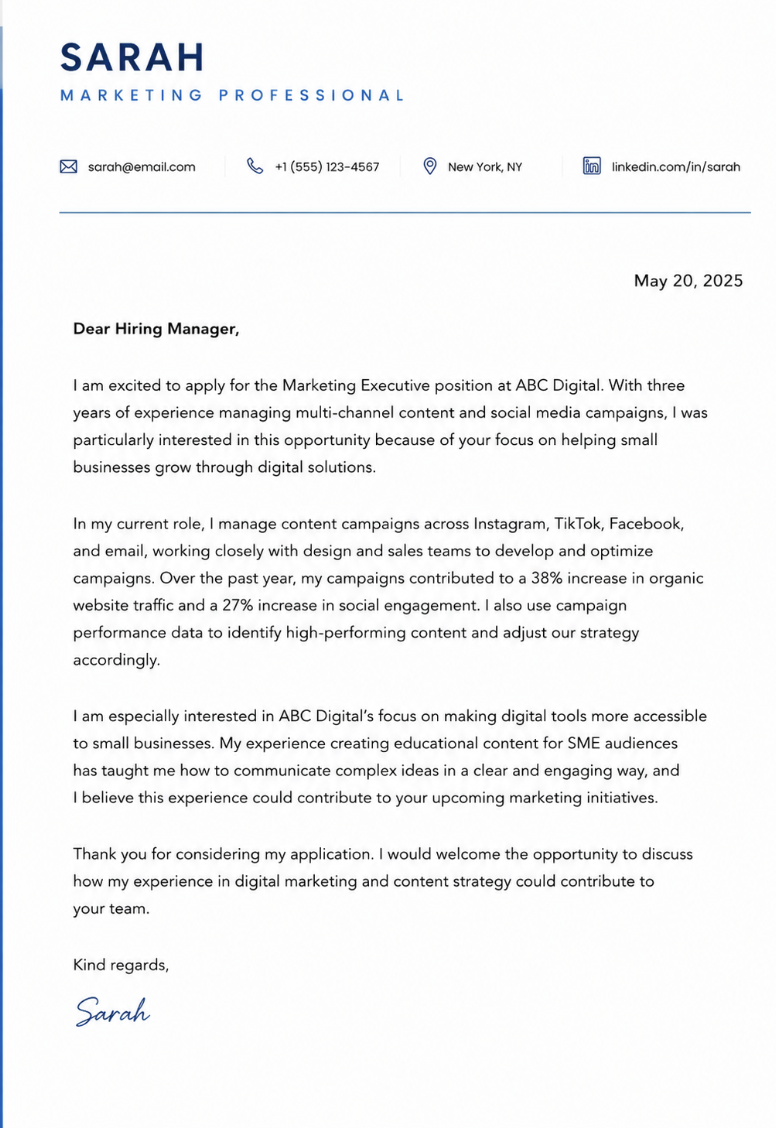
With five years of experience managing B2B marketing campaigns and a background in SaaS, I was excited to see your opening for a Senior Marketing Executive.
The next section should connect your skills, experience, and achievements to the job.
For example:
In my current role, I manage content campaigns across multiple digital channels and use performance data to optimize our strategy. Over the past year, these initiatives helped increase organic traffic by 38% and social engagement by 27%.
Show that you've researched the organization.
You might mention:
A company initiative
A product
The company's mission
Its industry position
A recent development
Its approach to customers
Something specific about the role
For example:
I am particularly interested in joining your team because of your focus on expanding digital services for small businesses. Having worked on products serving SME customers, I understand the importance of making complex solutions simple and accessible.

For example:
With experience managing multi-channel campaigns and analyzing performance data, I could contribute to the team's goal of expanding digital acquisition while helping improve campaign efficiency.
Your closing doesn't need to be complicated.
Thank the recruiter or hiring manager for considering your application and express your interest in discussing the position.
For example:
Thank you for considering my application. I would welcome the opportunity to discuss how my experience in digital marketing and campaign management could contribute to your team.
Then use a professional closing such as:
Kind regards,
[Your Name]
For most job applications, aim for approximately 250–400 words and no more than one page. The exact length isn't a strict rule, but recruiters generally don't need another version of your resume.
A useful cover letter should be: Relevant + Specific + Concise + Easy to Scan
A shorter, focused letter is often more effective than a long document filled with general statements.
Stronger Cover Letter Exampleซ
Highlight evidence from:
Internships
University projects
Academic achievements
Student organizations
Volunteer work
Freelance projects
Relevant coursework
Certifications
Extracurricular activities
For example:
During my final-year marketing project, I worked with a four-person team to develop a digital campaign for a local business. I conducted audience research, developed the content strategy, and presented our campaign recommendations to the business owner.

Career changers should focus heavily on transferable skills.
Don't spend the entire letter explaining why you dislike your previous career.
Instead, explain:
What you've accomplished.
Which skills transfer.
Why are you making the change?
What you've done to prepare.
Why the new role makes sense.
For example:
My eight years in retail management have given me extensive experience in team leadership, customer analytics, and operational planning. Over the past year, I have expanded my technical skills through data analytics courses and independent projects, and I am now looking to apply my operational experience and analytical capabilities in a business analyst role.
Experienced candidates should focus less on listing responsibilities and more on business impact.
Highlight:
Leadership
Revenue growth
Cost savings
Process improvement
Team performance
Strategic initiatives
Major projects
Industry expertise
For exampler:
I led a 20-person team across three functions and redesigned the team's performance management process, contributing to a 15% improvement in project delivery times.

If you're applying for another position within your current company, your advantage is that you already understand the organization.
Highlight:
Your knowledge of the company
Existing achievements
Internal relationships
Understanding of the team's goals
Relevant projects
Why you're ready for the next role
For example:
During my three years with the company, I've had the opportunity to work closely with the product and sales teams and develop a strong understanding of our customer journey. I believe this experience would allow me to transition effectively into the Product Marketing Manager position.
Before submitting your application, take a few minutes to review your cover letter.
Did I mention the specific position?
Did I explain why I'm interested in the role?
Did I explain why I'm interested in the company?
Did I connect my experience to the job requirements?
Did I include specific achievements or evidence?
Did I explain what I can contribute?
Did I avoid simply repeating my resume?
Did I customize the letter for this employer?
Is it approximately 250–400 words?
Is it no more than one page?
Is it easy to read?
Did I remove unnecessary information?
Did I check spelling and grammar?
Are all facts and achievements accurate?
Does the letter sound natural and authentic?
Your resume puts your qualifications in front of recruiters. Your cover letter gives you another opportunity to explain why those qualifications make you relevant to the role.
But creating a strong application from scratch can take time—especially when you're applying to multiple positions.
With Jobcadu's Resume Builder, you can create a professional, ATS-friendly resume and present your experience in a clear, structured format.
Use your resume to showcase your qualifications, then tailor your cover letter to explain the connection between your experience, the job, and the employer's needs.
No sections detected in this article.


.jpg&w=3840&q=75)
