
Posted on February 2, 2026
Growth
Tags:
%2520(1).jpg&w=3840&q=85)
The world of work is changing so rapidly that it is beyond imagination. AI technology, which was once just an experiment in the lab, has now become a tool that is actually used in daily work. Figures from the World Economic Forum (WEF) reveal that businesses using AI for at least one function have increased from 55% in 2022 to 88% today.
But the crucial question everyone faces is How will AI impact the future of work?
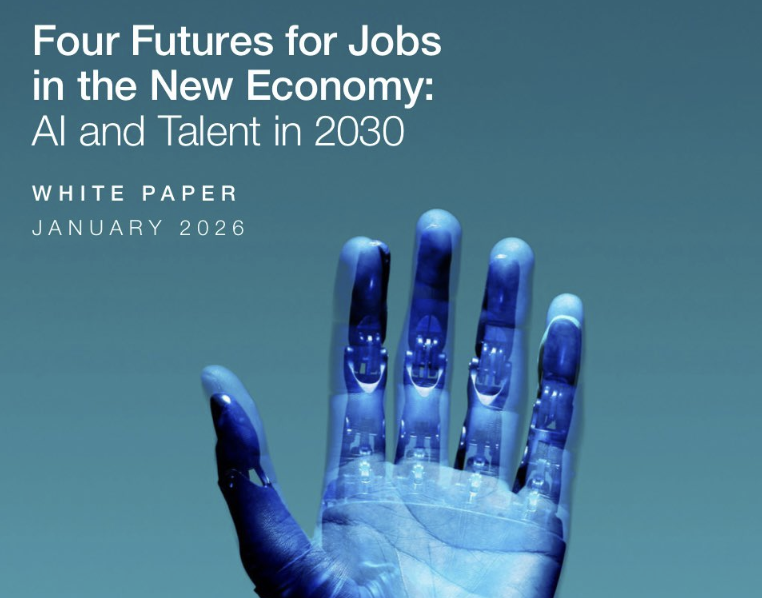
The report Four Futures for Jobs in the New Economy: AI and Talent in 2030 from the World Economic Forum, published in early 2026, does not attempt to predict the future definitively but offers a framework through “scenarios” to help society, organizations, and workers envision possible crossroads of the future. The report clearly indicates that AI itself is not the only variable determining the fate of jobs, but equally important is the level of readiness of the workforce and the human capital development system.
 Two Key Axes Defining the Future
WEF has analyzed the future of work through a framework that looks at two main dimensions.
Exponential: AI is developing rapidly beyond expectations, continuously gaining complex capabilities and able to perform tasks that require creativity and decision-making.
Incremental: AI is gradually developing but does not undergo major transformations, focusing on improving and expanding existing capabilities.
Widespread: Most people have the necessary AI skills, and education and training systems adapt timely, allowing effective collaboration with AI.
Limited: Only a small portion has the necessary skills, education systems still use outdated models, and most people cannot adapt in time.
When these two axes are combined, four possible scenarios for the world of work in 2030 emerge.
AI Leap + Many People Ready
This is a future that seems like a dream for many. AI develops so quickly that it can transform entire industries, but importantly, people are also ready to take advantage of these AIs.
Key Characteristics:
Unprecedented productivity surge: The production of goods and services increases massively, with global GDP growing by nearly double digits.
Many jobs disappear, but new jobs emerge quickly: People are not left unemployed in large numbers because they can adapt to new jobs in time, especially jobs that require managing multiple AIs simultaneously (Agent Orchestrators).
Massive investments: Investment in AI exceeds $1.3 trillion during 2025-2030.
Wages for AI-skilled individuals nearly double: From an expected increase of 56%.
Challenges:
Laws and welfare systems lag behind: Changes happen too quickly, and governments cannot keep up.
Increased inequality: Between those with AI skills and those without.
Ethical questions: How to control AI when it becomes highly capable?
Energy and environmental burdens: The extensive use of AI requires massive amounts of energy.
Real-life example: Imagine an architect who no longer designs buildings themselves but becomes a director of multiple AIs working together to design, with the architect defining the vision, checking quality, and coordinating between the AIs managing each part.
 Scenario 2: The Age of Displacement
 AI Leap + People Not Ready
This is the most concerning scenario. AI develops rapidly, but most people cannot adapt, resulting in significant unemployment.
Key Characteristics:
Soaring unemployment rates: AI and automation replace human jobs faster than people can learn new skills.
More than 50% of jobs replaced by AI: In some industries, up to 90%.
Businesses rush to automate without options: To address the shortage of skilled workers.
Consumer confidence at historic lows: Below 44 points.
Company profits increase: But most fall to just a few large technology companies.
Severe impacts:
Divided society: The highest inequality in history.
Welfare systems fail: Governments lack funds to care for the large number of unemployed.
Trust in institutions declines: Fake news from AI spreads rapidly.
System risks: Over-reliance on AI creates new vulnerabilities.
Real-life example: Many accountants were laid off because AI can perform accounting tasks better and faster, but they lack new skills to move on to other jobs, leading to competition for low-wage service jobs, which further reduces wages in the service sector.
 Situation 3: Co-Pilot Economy
 AI advances gradually + people are ready
The most balanced and livable future sees AI developing continuously but not making leaps, while people are ready to use AI as a tool to assist in their work.
Key characteristics:
AI is an assistant, not a replacement People use AI to help with routine, repetitive tasks, while they focus on work that requires creativity and decision-making.
Productivity increases continuously at more than 1.5% per year than before.
More than 40% of skills change more than expected, but people can learn in time.
AI can reduce the time spent on certain tasks by up to 80% such as paperwork and basic analysis.
Investor and consumer confidence is high because they see tangible results.
New opportunities:
Job mobility is easier People can switch careers more easily because AI assists.
Increase in entrepreneurs and freelancers AI makes starting a business easier.
Remote work and flexibility increase creating opportunities for people in rural areas and groups that have been marginalized.
Challenges:
Inequality still exists between those who have access to AI and those who do not.
Increase in fake information AI can generate content well, making it harder to distinguish between real and false information.
Regulations vary by country creating complexity for multinational businesses.
Real-life example: Marketers use AI to help analyze data and create initial campaigns, but the marketers themselves use their understanding of consumer psychology and creativity to refine and improve the campaigns. The results are better than doing it with just humans or just AI.
 Situation 4: Stalled Progress
 AI advances gradually + people are not ready
The most disappointing future sees AI developing continuously but not yielding clear results, while people are not ready to use it to its fullest potential.
Key characteristics:
Productivity increases unevenly Some companies and countries benefit, while most do not.
Businesses use AI superficially only automating repetitive tasks without seriously changing work methods.
Decreased competitiveness Companies lacking AI skills fall behind.
Wages decrease but skilled workers have increased bargaining power.
"AI bubble" bursts Investors are disappointed with returns that do not meet expectations.
Impact:
Stagnant economy does not grow as it should, but it is not in crisis.
Hope turns into disappointment People lose motivation and do not believe AI can change their lives.
Inequality increases gradually both domestically and internationally.
Vicious cycle: Unprepared → ineffective use → no investment → even less prepared.
Real-life example: A company purchases AI thinking it will make work faster, but employees do not know how to use it. The results are not as good as expected, leading the company to start thinking that AI is not worth it, so they do not invest in training people. Ultimately, they remain stuck in the same cycle while competitors who invest seriously advance further.
Main risks:
Overconfidence, laws lagging behind, and recklessness in AI development.
Insufficient power supply, rising material costs, environmental impacts.
Increased complexity makes it hard to control; winning businesses will dominate everything.
Golden opportunities:
Soaring productivity, reduced costs, increased innovation.
Geographical boundaries disappear, making it easier to access markets and talent.
Personalized education and healthcare, improved quality of life.
Strategies to implement:
Redesign businesses around AI from the start.
Invest in data, infrastructure, and resilience
Have AI leadership and governance
Collaborate with all parties, including government and employees
Main Risks:
Over-reliance on AI without human oversight, leading to serious errors
Lack of personnel in key positions, especially in designing and controlling AI
Power concentrated in a few tech companies and governments
Society and economy collapsing due to massive unemployment
Opportunities Available:
Lean, agile AI-native businesses
Transparency and accountability become competitive advantages
Opportunities to redesign entire work and education systems
Strategies to Implement:
Prepare for reduced consumption, plan investments carefully
Avoid reliance on a single AI; have alternatives
Maintain human roles in critical decision-making
Work with governments and stakeholders on automation systems
Main Risks:
Over-reliance on AI diminishing human decision-making, increasing chances of errors
AI bubble bursts, investors flee the market
Some countries or industries impose too many or too few regulations
Competition over AI and talent
Golden Opportunities:
Faster innovation across multiple industries
AI enables ordinary people to accomplish more, focusing on high-value tasks
Stronger and more resilient supply chains
Strategies to Implement:
Invest long-term in AI leadership
Create a culture of human-AI collaboration, defining tasks that humans must do themselves
Expand training and continuously develop employee skills
Main Risks:
Over-investing in AI while returns are low
Countries preventing talented individuals from moving out
Stagnant economy, divided society, and demoralized people
Desire for short-term profits, reluctance to implement serious changes
Opportunities Available:
Slower AI development allows time to establish better regulations
Specialized AI solutions and local innovations grow
Safe experimentation with lower risks
Strategies to Implement:
Strengthen financial stability, focus on core markets
Train people with skills relevant to real jobs, adaptable
Invest in data systems and AI to enhance efficiency
Build partnerships to fill gaps
According to a survey of over 10,000 senior executives worldwide:
54.3% believe AI will replace many jobs
44.6% expect AI to increase business profits
37.0% think AI will make products and services more accessible
30.0% believe AI will lower product prices
24.0% expect AI to create many new jobs
23.6% are concerned that AI will lead to more centralized businesses (markets dominated by a few companies)
21.4% are worried that AI will increase discrimination against certain groups
Only 12.1% believe AI will increase wages
 Strategies Every Business Should Implement Starting Today
Regardless of what the future holds in the four scenarios above, WEF recommends a "No-Regret" strategy, or strategies that are safe to implement, as follows:
How to do it:
Start with a small pilot project that can control risks
Choose low-risk tasks first, such as documentation or simple reporting tasks
Learn from failures, but at a low cost
Once you find what works, expand to other areas
 2. Align Technology and Talent Strategies
How to do it:
Investing in AI and developing people must go hand in hand
It's not just about buying tools; you must train people to use them
Create a learning system tailored to each person's actual work (Personalized Learning)
How to do it:
Design workflows where humans and AI assist each other
Clearly define which tasks are suitable for humans and which are suitable for AI
Foster a culture where people are not afraid of AI but see it as a tool to enhance their work
How to do it:
AI is only as good as the data used to train it; accurate, up-to-date, and complete data is essential
Establish standards for data storage, security, and usage
Build trust through transparency in data usage
How to do it:
Use AI to analyze what skills will be needed in the future
Collaborate with universities and training institutions to produce skilled individuals
Create a learning and internal mobility system within the organization
How to do it:
Instill curiosity, agility, and experimentation
Create an environment where failure is acceptable but must be learned from
Involve everyone in decision-making regarding AI usage
Be transparent about ethics and accountability
 7. Prepare for Different Implications
How to do it:
Understand that different jobs will be affected differently
Repetitive tasks and documentation may be replaced first
Jobs requiring creativity, empathy, and complex decision-making will still need humans
Prepare contingency plans for both scenarios
How to do it:
Allow older generations to learn from younger generations who are familiar with technology
Allow younger generations to learn experiences and wisdom from older generations
Create mixed teams that leverage the strengths of each age group
How to do it:
Collaborate with others who have expertise that we lack
Share knowledge with competitors in the same industry (on certain topics)
Work with universities, startups, software vendors, and investors
Build a network for knowledge exchange
LinkedIn reports that the demand for AI Literacy skills will increase 70% between 2024-2025, which means:
Skills have a short lifespan; what you learn today may be outdated in a few years
Continuous learning is not optional, but a necessity
Organizations must invest in continuously upskilling employees
 In conclusion: AI is not taking jobs from everyone, but it will eliminate those who cannot adapt.
The future of work in 2030 is not determined solely by AI, but depends on:
The speed of AI development - Will it be a leap or gradual?
People's readiness - Will we be able to adapt?
Supercharged Progress: Fast AI + Ready people = A drastically changed world with opportunities but also challenges
Age of Displacement: Fast AI + Unprepared people = Unemployment crisis and societal division
Co-Pilot Economy: Slow AI + Ready people = Working together, achieving the best balance
Stalled Progress: Slow AI + Unprepared people = Stagnation, disappointment, no progress
Start small, experiment quickly, scale what works
Align AI strategy with people development
Create a culture of human-AI collaboration
Invest in data and infrastructure
Anticipate skill demands and prepare people in advance
Build trust within the organization
Prepare for varying impacts on different jobs
Encourage different generations to work together and learn from each other
Build partnerships and exchange knowledge
Ultimately, AI may completely change the nature of work, but the most critical variable remains the human ability to learn, adapt, and steer technology in alignment with societal values.
Prepare for the future of work with Jobcadu, discover the courses and skills you need to avoid being left behind by AI.


