
Posted on November 24, 2025
Growth
Tags:

In an age overflowing with information, organizing your thoughts isn’t just a “nice-to-have” skill, it's essential for studying, working, and planning your life. One of the most popular tools worldwide is Mind Mapping, a technique that helps you see the big picture, connect ideas quickly, and plan more effectively.
Jobcadu will walk you through everything you need to know about Mind Mapping from the basics and how to create one, to its benefits, examples, and beginner-friendly tools.
A Mind Map is a visual diagram that organizes information starting from a central idea, branching into subtopics like the structure of a honeycomb or tree branches. It helps you see relationships and patterns more clearly than a traditional list.
Mind Mapping became globally popular thanks to Tony Buzan, an English author and psychologist. He observed that the human brain thinks in “radiant patterns,” branching outward like a web. When we combine images, colors, lines, and keywords, our brain remembers far better than with long linear text — forming the foundation of the Mind Mapping technique used today.

Mind Mapping turns complex information into an easy-to-see visual structure. It can be used for studying, meetings, work planning, brainstorming, and even designing business strategies.
Radiant thinking structure: Expand from the central topic into branches
Use keywords: Short, punchy terms that deliver instant understanding
Add colors, symbols, and images: Improve memory retention and spark creativity
Clear hierarchy: Main topics → subtopics → details
 Benefits of Mind Mapping
Mind Mapping offers advantages for students, professionals, and executives alike:
Clarifies thoughts and organizes ideas
Boosts memory and review efficiency
Makes brainstorming faster and more creative
Creates structured work plans with clear priorities
Helps teams understand ideas better through visualization
Saves time by placing all information in one structured view
Work planning
Studying and summarizing lessons
Project management
Business strategy design
Writing and content planning
Life planning and goal setting
Book summaries
Brainstorming marketing campaigns
Step 1: Choose your central topic
Step 2: Add main branches
Step 3: Expand into sub-branches
Step 4: Use colors, symbols, or images
Step 5: Review the flow and structure
Step 6: Apply it — write content, plan projects, or prepare meetings
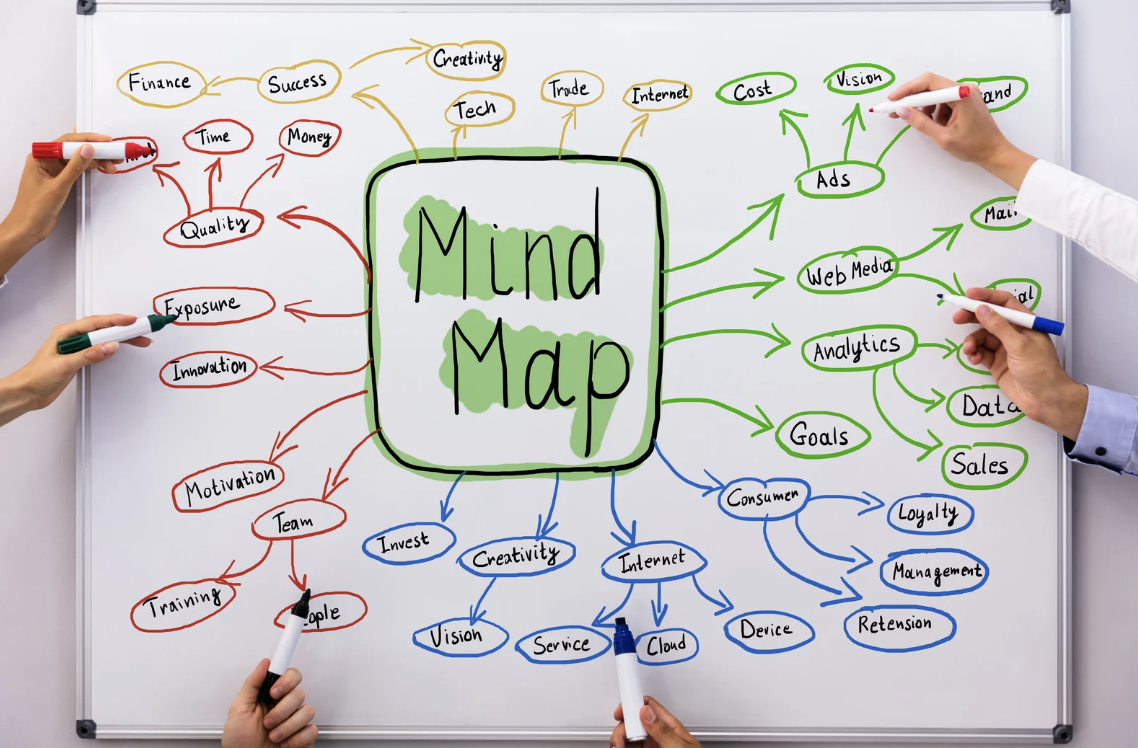
Writing an article: Topic → Intro → Sections → Conclusion
Project planning: Objectives → Timeline → Tasks → Owners
Life goals: Finance, Health, Career, Relationships, Learning
Online: Canva, Miro, MindMeister, XMind, Figma FigJam
Offline / Hand-drawn: Notebook, colored pens, A4/A3 paper

Avoid overwhelming details
Use short keywords for quick recall
Use colors to categorize information
Apply your Mind Maps — don’t just make them look nice
Update them as ideas evolve
Mind Mapping transforms scattered thoughts into a clear one-page visual overview, helping you think systematically, prioritize tasks, and develop ideas more quickly. Whether for studying, working, or life planning, Mind Maps give you a clear direction and greater confidence in decision-making. Best of all, you can start right away whether by hand or with online tools.
Explore skill-building courses, career knowledge, and professional work techniques on Jobcadu, along with tools that help you plan your career path with confidence.



.png&w=3840&q=75)

