

Having years of experience used to be enough to make a senior candidate stand out.
You had the job titles.
You had years of experience.
You had managed teams, delivered projects, and built industry knowledge.
But in 2026, experience alone doesn't necessarily tell recruiters what you can bring to a business.
As AI changes how work gets done, employers are increasingly looking for something beyond technical expertise or a long list of responsibilities.
They want to know: Can you lead? Can you make good decisions? Can you create a business impact? Can you adapt when the job changes?
This shift is already visible in labour-market data.
PwC's 2026 Global AI Jobs Barometer, which analysed more than one billion job advertisements across six continents, found that the skills required for the most AI-exposed jobs are changing more than twice as fast as those required for the least AI-exposed roles.
The report also found that new tasks in AI-exposed roles are 2.5 times more likely to rely on skills such as empathy, judgement and creativity.
In other words, AI isn't simply changing the tools people use.
It's changing what makes someone's experience valuable.
So, what are recruiters really looking for from senior candidates in 2026?

Being a senior candidate doesn't necessarily mean you need to have managed 20 people.
Leadership can also mean taking ownership, influencing decisions, mentoring others, or moving a project forward when there isn't an obvious answer.
Recruiters want to see evidence that you can:
Make decisions
Take ownership
Guide others
Handle difficult situations
Develop people
Influence stakeholders
Take responsibility for outcomes
Instead of simply writing:
“Managed a marketing team of 8.”
Show what your leadership actually changed.
For example:
“Led a cross-functional team of 8 across marketing, sales and product to launch a new customer acquisition strategy.”
Senior candidates are expected to understand more than their own responsibilities.
They need to understand how their work contributes to the business.
That's why recruiters may look beyond:
“What did you do?”
and ask:
“What happened because you did it?”
Compare:
“Managed digital marketing campaigns.”
with:
“Led digital campaigns that increased qualified leads by 32% over six months.”
The second example communicates business impact.
Depending on your role, impact could include:
Revenue growth
Cost reduction
Increased efficiency
Customer acquisition
Retention
Productivity
Conversion rates
Project delivery
Risk reduction
Team performance
Not every achievement needs to have a financial number attached. The important thing is to connect your work to a meaningful outcome.
As you become more senior, your value isn't only in completing tasks. It's increasingly about understanding what should be done and why.
Strategic thinking can involve:
Identifying opportunities
Anticipating risks
Connecting different business priorities
Making decisions with incomplete information
Prioritising limited resources
Thinking about long-term consequences
Turning business goals into actionable plans
For example, instead of saying:
“Created the company's social media strategy.”
You could explain:
“Developed a social media strategy aligned with customer acquisition goals, shifting content investment toward channels generating the highest-quality leads.”
AI literacy is becoming increasingly relevant across different types of roles. That doesn't mean every senior professional needs to become a machine-learning expert.
Instead, recruiters may increasingly value people who understand:
Where AI can improve their work
How to use AI tools responsibly
How to evaluate AI-generated information
Where human judgement is still necessary
How AI can change workflows
How to combine AI with existing expertise
PwC's 2026 research found that AI-exposed roles are experiencing particularly rapid changes in required skills, while human capabilities such as judgement, creativity and leadership are becoming more important.
This creates an important distinction: AI literacy isn't simply knowing how to use ChatGPT.
It's understanding when, where and why AI should be used and when human judgement needs to take over.
For senior professionals, that distinction can be particularly important because you're often expected to make decisions, not simply complete tasks.
One of the biggest advantages of seniority is experience. But experience can become less valuable if someone is unwilling to update how they work.
Technology changes.
Customer expectations change.
Business models change.
Job responsibilities change.
PwC's 2026 data suggests that skills are changing particularly quickly in roles most exposed to AI.
For senior professionals, adaptability can mean:
Learning new tools
Taking on unfamiliar responsibilities
Updating outdated processes
Moving into new areas of the business
Experimenting with new approaches
Learning from mistakes
Staying curious about industry changes
Your years of experience still matter. But recruiters may also want evidence that you know how to use that experience in a changing environment.
At senior level, work rarely happens inside one department.
A marketing leader may need to work with:
Sales
Product
Finance
HR
Operations
Technology
Leadership teams
A senior professional who understands how different functions connect can help move projects forward more effectively.
On your resume, don't only describe your own department.
Show the stakeholders you worked with and what you achieved together.
For example:
“Partnered with Product, Sales and Customer Success teams to redesign the customer onboarding journey, reducing time-to-activation by 20%.”
This demonstrates more than collaboration. It shows that you can connect people, priorities and outcomes.
Senior professionals often deal with complexity.
You may need to explain technical information to non-technical stakeholders, present recommendations to executives, negotiate priorities, or communicate difficult decisions to your team.
Strong communication therefore isn't simply:
“I'm a good communicator.”
Your resume should show how you use communication to create an outcome.
For example:
Presented strategic recommendations to senior leadership
Negotiated priorities across multiple departments
Led stakeholder workshops
Presented business cases to executive teams
Communicated organisational changes across regional teams
Developed executive reports to support decision-making
The goal is to show communication in action.
For senior candidates, learning shouldn't stop when you become an expert.
In fact, the more experienced you become, the more important it can be to demonstrate that your expertise is evolving.
Continuous learning could include:
Professional certifications
Industry courses
AI or technology training
Leadership development
Conferences and workshops
New responsibilities
Cross-functional projects
Mentoring
Self-directed learning
But don't turn your resume into a list of every course you've ever taken. Focus on learning that is relevant to where your career is going.
For example:
“Completed AI strategy programme and implemented generative AI workflows across the content development process, reducing production time by 30%.”

The biggest mistake senior candidates can make is writing a resume that focuses too heavily on responsibilities.
Your resume should help recruiters understand three things:
What were you responsible for?
What decisions, strategies or actions did you take?
What was the outcome?
A simple formula you can use is:
Action + Context + Impact
For example:
Instead of:
Managed regional marketing campaigns across Southeast Asia.
Try:
Led regional marketing campaigns across 5 Southeast Asian markets, coordinating local teams and agencies to increase qualified leads by 28%.
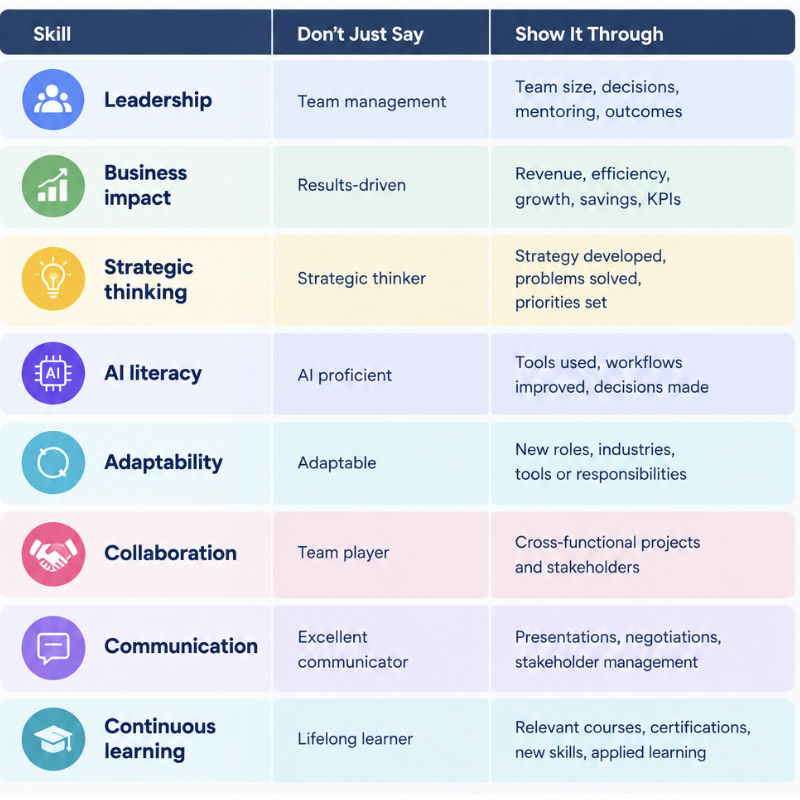
Here's how you can translate the skills recruiters may be looking for into resume evidence:
A senior resume shouldn't read like a longer version of a junior resume.
As your career progresses, the emphasis should increasingly move from:
Tasks → Responsibilities → Decisions → Impact → Leadership
You don't need to describe every task you've ever completed.
Instead, highlight the experiences that demonstrate:
The problems you've solved
The decisions you've made
The people you've influenced
The complexity you've handled
The business outcomes you've created
The ways you've adapted to change
Because seniority isn't simply about how long you've been working.
It's about the level of problems you can solve and the value you can create.
Final thought
The senior job market isn't only asking:
“How many years of experience do you have?”
It's increasingly asking:
“What can you do with that experience?”
If you're updating your resume for your next career move, start by looking beyond your job titles.
Identify the decisions you've made, the problems you've solved, the people you've influenced, the results you've created, and the skills you've developed along the way.
Then turn those experiences into evidence.
Because a strong senior resume doesn't simply tell recruiters where you've been.
It shows them the value you can bring to where you're going next.
Explore Jobcadu's Resume Builder to build a professional resume that brings your experience, achievements, skills and career story together in a clear, recruiter-friendly format.
And if you're not sure which skills to highlight or where your experience can take you next, explore Jobcadu's Career Toolkit for practical career resources and self-assessment tools to help you understand your strengths, development areas and career direction.
No sections detected in this article.


