

Jobcadu

Starting a new job can be exciting. A promotion can feel rewarding. Changing careers can open the door to new possibilities.
But these moments can also bring an unexpected feeling:
“What if I'm not actually qualified for this?”
Perhaps you have just started a new role and feel like everyone else understands more than you do. Maybe you have been promoted into a leadership position and suddenly wonder whether you are ready to manage other people.
Or perhaps you have changed industries and worry that your previous experience no longer counts.
These thoughts are common during major career transitions. Even highly capable and experienced professionals can experience imposter syndrome—the feeling that they are not as capable as others believe and may eventually be “found out.”
The good news is that self-doubt does not necessarily mean that you are unqualified.
Sometimes, it simply means that you are doing something new.
Career transitions often place us outside our comfort zones. When you have worked in the same role for several years, you become familiar with the responsibilities, systems, colleagues, and expectations. You know what you are doing because you have had time to build knowledge and confidence.
A career transition can suddenly change that.
You might become:
A new employee in an unfamiliar company
A manager for the first time
A professional entering a completely new industry
Someone taking on responsibilities you have never handled before
A specialist moving into a leadership role
Suddenly, you may no longer feel like the most knowledgeable person in the room.
This can lead to comparisons with colleagues who have more experience in that specific environment. You may focus on everything you do not know while forgetting the skills and experience that helped you get there in the first place.
This is one of the reasons career transitions can create imposter syndrome.
One of the most effective ways to manage imposter syndrome is to examine the thoughts behind it.
Imagine that you have recently started a new leadership position. You might think:
“I don't know everything. Maybe I wasn't ready for this promotion.”
But consider another interpretation:
“I don't know everything yet because I am still learning.”
These two thoughts describe the same situation, but they create very different responses.
The first assumes that a lack of immediate knowledge is evidence of failure.
The second recognises that learning is a normal part of growth.
A new role is supposed to involve a learning process.
You are not expected to understand every system, solve every problem, or have all the answers on your first day.
Instead of asking: “Am I already good enough?”
Try asking:
What can I learn from this situation?
Which skills do I already have that I can apply here?
What knowledge do I need to develop next?
Who can I learn from?
How can I improve over time?
This approach is sometimes called cognitive restructuring—the process of identifying an unhelpful thought and replacing it with a more balanced and realistic perspective.
For example:
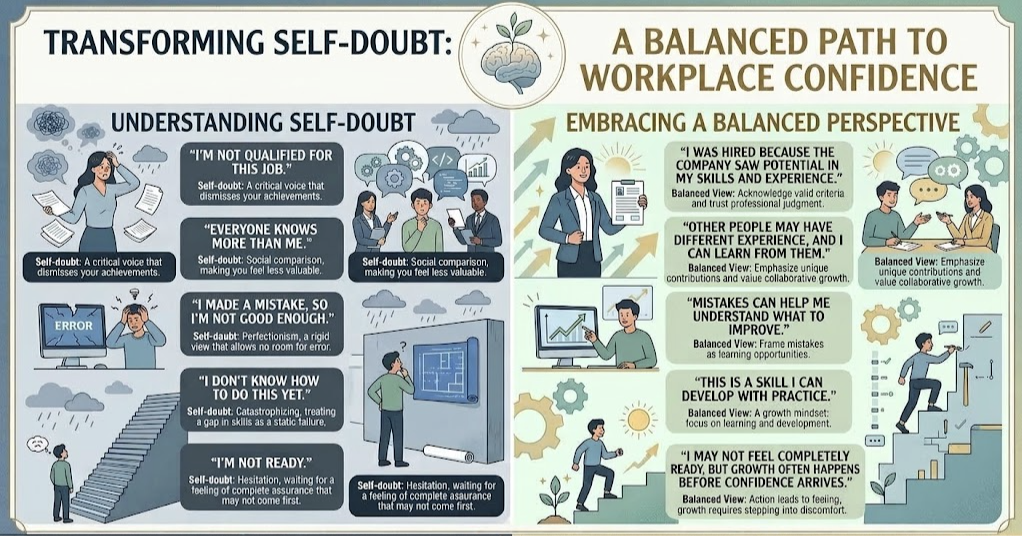
The goal is not to convince yourself that you are perfect.
It is to recognise that being inexperienced in one situation does not mean you are incapable.
When we experience imposter syndrome, our minds can become very good at remembering mistakes and very bad at remembering achievements.
You may remember the presentation that did not go perfectly but forget the five projects you successfully completed before it.
This is why creating a personal wins repository can be useful.
A Wins Repository is simply a document, note, or digital folder where you regularly record your professional achievements.
Your Wins Repository could contain:
Successful projects you completed
Positive feedback from managers or colleagues
Problems you helped solve
Difficult situations you handled
Business results you contributed to
Skills you learned
Goals you achieved
Customer or client feedback
Promotions or new responsibilities
Challenges you overcame
Confidence is not always about repeatedly telling yourself that you are talented.
Sometimes, confidence comes from looking at real evidence.
When self-doubt appears, your Wins Repository can remind you of questions such as:
What have I successfully handled before?
What problems have I solved?
How have I grown over the past year?
What positive feedback have I received?
What challenges once felt difficult but now feel manageable?
You may discover that you are more capable than you currently feel.
One of the biggest mistakes professionals make during career transitions is confusing newness with incompetence.
Imagine joining a new company.
You may not understand:
The company's culture
Internal systems
Team communication styles
Industry terminology
Customer expectations
Business processes
This does not mean you lack professional ability. It means you are new to the environment.
Similarly, a first-time manager may not immediately know how to handle every difficult conversation or leadership challenge.
That does not mean they should never have been promoted.
Leadership is also a skill that develops through experience.
When you feel uncertain, try asking:
“Am I actually incapable, or am I simply inexperienced in this particular situation?”
The answer can make a significant difference.
You may have years of transferable experience that you are forgetting to recognise.
For example:
A teacher moving into corporate training already understands communication and learning.
A salesperson moving into business development may already have strong relationship-building skills.
A marketer moving into a management role may already understand strategy and stakeholder communication.
An operations professional moving into project management may already have experience with planning and problem-solving.
Your career transition may involve learning new skills, but it does not mean you are starting from zero.
Professional comparison can become particularly intense when starting a new role.
You may look at a colleague and think: “They speak confidently in every meeting.”
But you may not see the ten years of experience behind that confidence.
You may compare your first month in a leadership position with someone who has been managing teams for years.
This type of comparison ignores an important fact:
Every professional was once a beginner.
Instead of comparing yourself with the most experienced person around you, consider measuring your progress against your previous self.
Ask:
What do I understand now that I did not understand three months ago?
Which challenges can I handle more confidently?
What new skills have I developed?
Where have I made progress?
Career development is rarely about becoming perfect overnight. It is about making consistent progress.
You do not have to navigate a career transition alone. One of the most valuable resources during a period of professional change can be another person who provides perspective.
This might be a mentor, manager, industry professional, or career coach.
A mentor can often share insights based on their own professional experience.
They may help you:
Understand industry expectations
Learn from their career experiences
Navigate workplace challenges
Build professional relationships
Develop new skills
Gain a more realistic perspective on your career
Sometimes, simply hearing that another successful professional also experienced self-doubt can be reassuring.
A career coach can provide structured support focused on your individual goals and challenges.
For example, a coach may help you:
Identify your professional strengths
Clarify your career direction
Prepare for a new leadership role
Build confidence during a career transition
Develop strategies for professional challenges
Create an action plan for your next career step
The purpose is not for someone else to make career decisions for you.
Instead, the right guidance can help you better understand your situation, identify your options, and move forward with greater clarity.
Sometimes, confidence grows when you have the opportunity to discuss your challenges with someone who can provide an outside perspective.
Many people believe confidence must come before action.
They think:
“Once I feel confident, I will speak up in meetings.”
“Once I feel ready, I will apply for the promotion.”
“Once I stop feeling nervous, I will take on a bigger project.”
Start with small actions, such as:
Sharing one idea during a meeting
Asking a question when you need clarification
Volunteering for a new responsibility
Having a conversation with someone in your industry
Learning one new professional skill
Asking for feedback on your performance
These small experiences can gradually build evidence that you are capable of navigating new situations.
When imposter syndrome becomes intense, take a moment to consider a simple question:
Why are you here?
If you were hired for a role, promoted, or given a new opportunity, someone saw potential in you.
Of course, employers and managers are not always perfect. However, opportunities are rarely given without any reason.
Your skills, experience, attitude, potential, or previous achievements may have contributed to the decision.
You do not need to prove your entire professional worth every single day.
Instead, focus on learning, contributing, and growing.
If you are currently experiencing self-doubt during a career transition, try this five-step approach:
Write down the specific thought that is creating self-doubt.
For example: “I don't have enough experience to succeed in this role.”
Ask yourself: What evidence supports this thought, and what evidence challenges it?
Try creating a more realistic perspective: “There are areas I still need to learn, but I also have experience and transferable skills that I can use.”
Look at the projects, challenges, and achievements that demonstrate your professional capabilities.
This might involve learning something new, asking for feedback, speaking with a mentor, or taking on a manageable challenge.
Career transitions can be uncomfortable because they require us to leave familiar environments and develop new abilities.
Self-doubt may appear when you start a new role, change industries, or move into leadership.
But feeling uncertain does not automatically mean you made the wrong decision.
Sometimes, uncertainty is simply a sign that you are entering a new stage of growth.
Instead of asking whether you are already the perfect person for the role, focus on becoming the person you want to grow into.
You do not need to know everything today. You only need to remain willing to learn.
You don't have to figure out every career challenge alone.
Whether you are starting a new role, preparing for a leadership position, changing careers, or simply feeling uncertain about your next professional step, speaking with someone can help you gain a clearer perspective.
Connect with a certified career coach through Jobcadu and explore a 1-on-1 coaching session designed to support your professional development, career goals, and next steps.
Your next career chapter may feel unfamiliar but that doesn't mean you don't belong there.
Book a 1-on-1 session with a Jobcadu certified coach and take the next step in your career with greater clarity and confidence.
No sections detected in this article.


