

Have you ever finished a full day of work feeling exhausted, only to realize that your most important task is still unfinished?
You answered emails, attended meetings, responded to last-minute requests, updated reports, and helped your teammates solve unexpected problems. You were busy from morning to evening. But when you look at what you actually accomplished, it feels like you made very little progress on the work that matters most.
If this sounds familiar, the problem might not be your time management. It might be how you're prioritizing your work.
In today's workplace, professionals are expected to manage multiple projects, respond quickly, adapt to changing expectations, and deliver results under pressure. When everything feels urgent, it's easy to confuse being constantly available with being genuinely productive.
The solution isn't necessarily to work longer hours. It's to make better decisions about where your time, energy, and attention should go.
In this article, we'll explore how to distinguish urgency from importance, identify high-impact tasks, prioritize competing deadlines, communicate with your manager, and build a simple weekly review system you can reuse.

One of the biggest productivity traps is assuming that the task demanding your attention right now must be the task that deserves it most.
But urgency and importance are two different things.
Urgent tasks require attention soon, often because of a deadline, an immediate request, or a problem that needs resolving.
Important tasks contribute meaningfully to your goals, team priorities, business outcomes, or long-term development.
Sometimes a task is both urgent and important. Other times, the two don't overlap.
For example, responding to a message that needs a quick confirmation might feel urgent because someone is waiting for your reply. Meanwhile, preparing a strategic proposal for next month's business review might be more important, even if the deadline is several days away.
The problem begins when urgent tasks repeatedly push important work aside.
Over time, you may spend your entire day reacting to requests without making meaningful progress on projects that improve performance, solve underlying problems, or help you grow professionally.
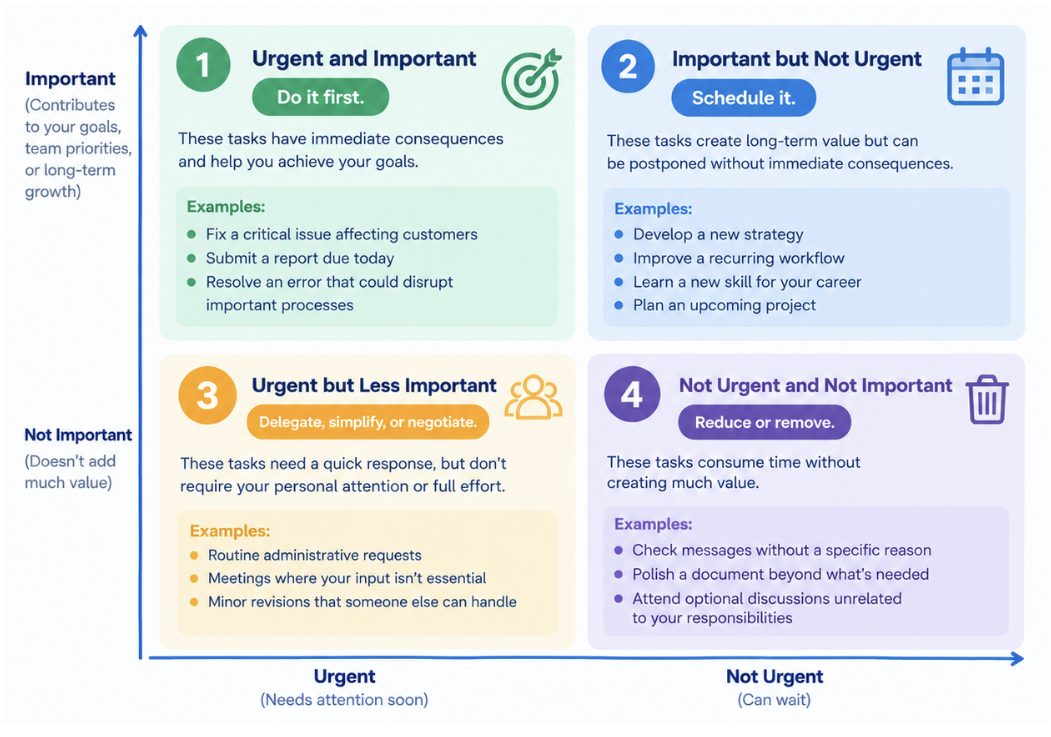
A simple way to evaluate your workload is to divide tasks into four categories.
1. Urgent and important: Do it first.
These tasks have immediate consequences and require your attention.
Examples:
Resolving a critical issue affecting customers.
Delivering a report due today that a team needs to make a decision.
Fixing an error that could disrupt an important business process.
2. Important but not urgent: Schedule it.
These tasks create long-term value but are easy to postpone because they don't demand immediate attention.
Examples:
Developing a new strategy.
Improving a recurring workflow.
Learning a skill relevant to your next career step.
Planning an upcoming project.
3. Urgent but less important: Delegate, simplify, or negotiate.
These tasks may need a quick response, but they don't necessarily require your personal attention or the amount of effort you're currently giving them.
Examples:
Routine administrative requests.
Meetings where your input isn't essential.
Minor revisions that another team member can handle.
4. Neither urgent nor important: Reduce or remove.
These tasks consume time without contributing much value.
Examples:
Repeatedly checking messages without a specific reason.
Polishing a document beyond what the situation requires.
Attending optional discussions that don't relate to your responsibilities.
The goal isn't to ignore urgent requests. It's to stop urgency from becoming your only way of deciding what to do next.
Once you understand the difference between urgency and importance, the next step is deciding which tasks deserve your effort.
A task can keep you occupied without meaningfully improving the outcome you're responsible for.
For example, spending two hours formatting a presentation may feel productive. But if the audience primarily needs a clear recommendation supported by accurate data, refining the recommendation could create far more value than adjusting the slide design.
To identify high-impact work, ask yourself these four questions.
Start by connecting your work to a larger objective.
Does this task help the business generate revenue, improve customer experience, reduce costs, meet a critical requirement, or complete a strategic project?
If the connection isn't clear, consider whether the task is necessary or whether its scope can be reduced.
This doesn't mean every task must have a direct financial impact. Supporting your colleagues, maintaining accurate records, and preventing operational problems can also create significant value.

Consider the consequences of delaying the task.
Will a customer be affected? Will another team be blocked? Will you miss a contractual deadline? Or will the task simply move to tomorrow without creating a meaningful problem?
Understanding the cost of delay helps you distinguish genuine urgency from the pressure to respond immediately.
Some tasks are important because other people cannot move forward until they are completed.
For example, a designer may need approved content before finishing campaign materials, while a project manager may need stakeholder decisions before finalizing the project timeline.
These tasks have dependencies. Even if they don't take long to complete, delaying them could slow down several other activities.
Not every task deserves the same level of effort.
If a task has limited impact, ask whether a simpler approach would be sufficient. Could you use a template, automate a repetitive step, delegate part of the work, or deliver a smaller version that meets the actual requirement?
The aim is not to cut corners. It's to match your effort to the value and risk of the outcome.
A useful rule: Before starting a task, identify its purpose, its consequences, and what successful completion should look like.

When several tasks compete for your attention, relying on instinct alone can be difficult. A simple scoring framework can help you make more consistent decisions.
Evaluate each task using three factors.
How much does this task contribute to an important business goal, customer outcome, team deliverable, or risk reduction?
3 points: High impact; directly supports a critical outcome.
2 points: Moderate impact; supports an important team or operational objective.
1 point: Low impact; limited consequences if delayed.
How soon must the task be completed, considering the real deadline and the consequences of missing it?
3 points: Due today or has an immediate, consequential deadline.
2 points: Due soon and requires planned work to complete on time.
1 point: Flexible deadline with no significant immediate consequences.
How many other tasks or people are waiting for this task to be completed?
3 points: Blocks a critical deliverable or several people.
2 points: Affects another task or teammate's progress.
1 point: Can be completed independently without blocking other work.
Add the three scores to create a simple prioritization score.
Priority score = Impact + Deadline + Dependencies
The maximum score is 9. Higher scores can indicate tasks that deserve earlier attention.
However, this score is a decision aid, not an automatic rule. A low-scoring task with a legal, safety, customer, or other critical deadline may still need immediate attention. Use professional judgment and confirm any non-negotiable requirements.
Imagine you're a marketing executive with these responsibilities:
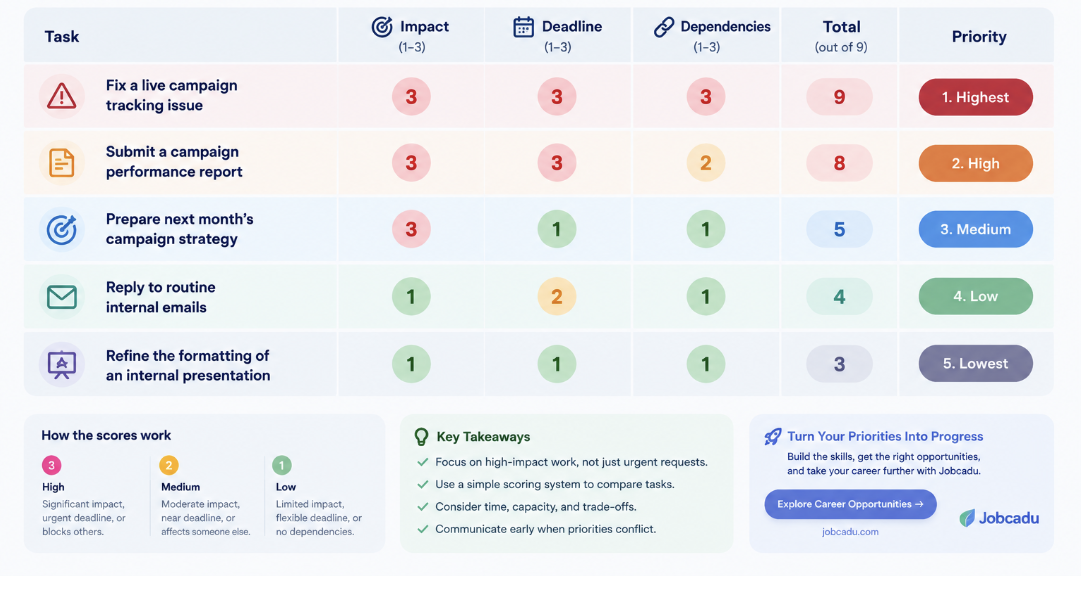
In this example, the live tracking issue comes first because it could affect campaign performance and block other work. The performance report follows because it has a consequential deadline.
The campaign strategy remains important, even though it scores lower on immediate urgency. Instead of letting it disappear beneath daily requests, schedule a dedicated block of time to work on it.
Routine emails and presentation formatting can be handled later, simplified, or reduced where appropriate.
Notice that the objective isn't to complete every task in the order listed. It's to make deliberate trade-offs based on what matters most.
A high priority doesn't automatically mean a task can be completed immediately.
Estimate how long each task will take, consider the meetings and responsibilities already on your calendar, and leave some room for unexpected issues.
If your top priorities already exceed your available working hours, the problem is no longer simply prioritization. You may need to renegotiate deadlines, reduce scope, or ask for support.
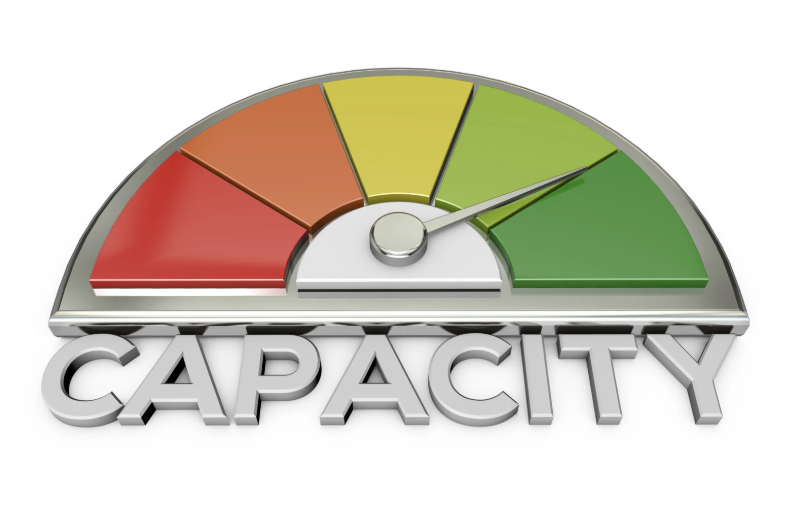
One of the most difficult parts of prioritization is communicating that you cannot do everything at once.
You might worry that asking for clarification will make you seem unproductive, inflexible, or unable to handle responsibility. As a result, you agree to every request and try to make everything fit into the same workday.
But when priorities conflict, silently accepting every deadline can create bigger problems later.
Effective prioritization includes communicating trade-offs before they become missed commitments.
Instead of simply saying you're too busy, show your manager what you're working on, the expected deadlines, and which deliverables require the most time.
For example:
"I'm currently finalizing the monthly performance report, preparing the campaign proposal, and resolving the tracking issue. The report is due this afternoon, and the tracking issue is affecting the accuracy of our campaign data."
This gives your manager context for making a decision.
When a new task arrives, explain what its priority would mean for your existing commitments.
For example:
"I can take on the new presentation today. To make room for it, I would need to move the campaign proposal to tomorrow. Would you prefer me to make that adjustment, or should I keep the proposal on schedule?"
This approach demonstrates ownership rather than simply refusing additional work.

Where possible, propose alternatives.
You could:
Deliver a shorter version first and expand it later.
Complete the most critical section before the deadline.
Delegate a suitable component to another team member.
Move a lower-impact task to the next available workday.
Request an adjusted deadline based on the actual workload.
Offering options helps turn a capacity problem into a practical discussion.
After priorities have been agreed upon, summarize the revised deadlines and responsibilities in writing.
This creates a shared understanding of what will be delivered, when it will be delivered, and what has been deprioritized.
Remember: Prioritization isn't just about managing your own time. It's also about helping your team make informed decisions about limited time and resources.
What the World Economic Forum Says About Prioritization Skills
Prioritization may look like a personal productivity habit, but it also reflects broader workplace skills.
The World Economic Forum's Future of Jobs Report 2025 identifies analytical thinking as the most frequently cited core skill among employers surveyed, with 69% considering it essential for their workforce. Resilience, flexibility, and agility follow at 67%.
The report also highlights the growing importance of analytical thinking and adaptability as work and skill requirements continue to evolve.
These findings don't mean that a particular prioritization method is proven to improve performance. Rather, they provide a useful reason to develop the underlying skills.
Analytical thinking helps you:
Evaluate which tasks contribute most to your goals.
Compare the consequences of different choices.
Identify dependencies, risks, and potential bottlenecks.
Use evidence rather than treating every request as equally important.
Adaptability helps you:
Reassess priorities when new information appears.
Adjust plans when deadlines or business needs change.
Communicate trade-offs when circumstances shift.
Stay focused on outcomes without becoming attached to an outdated plan.
The practical prioritization framework in this article is one way to apply these skills to everyday work.
You don't need a perfect schedule that never changes. You need a clear way to decide what matters now, what can wait, and what needs to change when circumstances change.
Prioritization becomes easier when you stop making every decision from scratch.
A short weekly review can help you identify important work before incoming messages and last-minute requests take over your schedule.
Set aside 15–20 minutes at the beginning of the week, then spend a few minutes reviewing your priorities each day.
Write down the tasks, projects, meetings, and deadlines you already know about.
Don't worry about organizing everything perfectly at first. The goal is to get your commitments out of your head and into one place.
Ask yourself: If I could make meaningful progress on only three things this week, which outcomes would matter most?
Focus on results rather than activities.
For example, instead of writing "work on campaign," write "finalize the campaign plan and obtain stakeholder approval."
Identify which tasks are due soon, which ones block other people, and which ones require input or approval before you can proceed.
Schedule those dependencies early enough to avoid unnecessary delays.
Put focused work on your calendar instead of assuming you'll get to it when everything else is finished.
Also leave some capacity for unexpected requests. A plan that uses every available minute can fall apart as soon as one thing changes.
At the end of the week, ask yourself what was completed, what changed, what was delayed, and what you learned.
Use that information to make next week's plan more realistic.

Weekly review
List all important tasks and deadlines.
Identify the three outcomes that matter most.
Score tasks by impact, deadline, and dependencies.
Schedule focused time for high-impact work.
Identify tasks to delegate, simplify, or postpone.
Flag conflicting deadlines and discuss them early.
Leave room for unexpected work.
Daily check-in
What is the most important outcome I need to move forward today?
Is anything time-sensitive or blocking another person?
Has a new request changed my existing priorities?
Do I need to communicate a trade-off or request support?
You can use this checklist in a notebook, a spreadsheet, a digital planner, or your team's project management tool. The best system is one you'll actually maintain.
Being busy doesn't necessarily mean you're making progress.
When every task feels urgent, it's easy to spend your day responding to immediate demands while important work continues to move further down the list.
The solution is to pause, evaluate the impact of your tasks, consider deadlines and dependencies, and communicate openly when your workload exceeds your capacity.
Start with three simple habits:
Prioritize outcomes, not just activities. Focus on the work that makes a meaningful difference.
Make deliberate trade-offs. Recognize that choosing one priority often means adjusting another.
Review your priorities regularly. Stay flexible as new information and business needs emerge.
You don't have to finish everything to have a productive day. You need to make meaningful progress on the right things.

Strong prioritization skills can help you work more effectively, demonstrate your value, and prepare for greater responsibilities. But career growth also means understanding your strengths, identifying skill gaps, and finding opportunities that match your goals.
With Jobcadu, you can explore job opportunities, discover learning resources, and build a stronger resume that highlights your skills and achievements.
No sections detected in this article.


