

Do you notice the tiny details other people miss?
Maybe you can tell when someone’s mood changes before they say anything. You notice a slight shift in the tone of a Slack message. You replay a conversation because you’re wondering whether you said something wrong. Or perhaps a busy office, constant notifications, and multiple conversations happening at once can leave you mentally exhausted.
If this sounds familiar, you may have a highly sensitive way of processing your environment.
And no, it doesn’t automatically mean you’re “too emotional” or “overthinking everything.”
In the workplace, sensitivity can come with valuable abilities from noticing risks early to understanding people, communicating thoughtfully, and solving problems others may overlook.
The goal isn’t to become less sensitive.
It’s learning how to use your sensitivity without letting it use up all your energy.

Some people naturally pay close attention to details including details that aren't explicitly communicated.
You might notice:
A teammate suddenly becoming quieter during a meeting
A change in someone's tone in Slack or email
A small mistake in a report before it becomes a bigger problem
When a client seems uncomfortable even though they say everything is fine
Tension between team members
Patterns that others haven't noticed yet
This level of awareness can be useful.
For example, a manager who notices that a normally engaged employee has become unusually quiet may check in before the issue grows.
A communicator who notices how different audiences react can adjust their message before misunderstanding happens.
A problem solver who spots small inconsistencies may catch a problem before it affects the entire project.
Your attention to detail isn't automatically overthinking. Sometimes, it's information.
The challenge is learning which information requires action and which information you can simply let pass.
Sensitivity can be a workplace strength
Being sensitive doesn't mean you're fragile.
It can mean that you process information deeply, pay attention to context, and consider how your actions affect other people.
These qualities can be particularly useful in several areas of work.
Good management isn't only about assigning tasks.
Managers also need to understand people, recognize changes in team dynamics, listen carefully, and create an environment where people feel comfortable communicating.
Someone who naturally notices subtle changes may be more likely to catch problems early.
Whether you're working in marketing, HR, customer service, PR, sales, or content, communication requires more than choosing the right words.
You also need to understand: What does this person actually need to hear?
Sensitivity can help you think about tone, context, audience, and emotional impact.
Problems don't always announce themselves.
Sometimes they're hidden inside a small inconsistency, an unusual customer response, or a process that suddenly feels less efficient.
Being highly observant can help you connect these small signals and investigate what is happening.
Sensitivity can also help you understand different working styles.
You may naturally think:
“How will this affect the rest of the team?”
That perspective can be valuable when collaborating across different personalities, roles, and expectations.

There is a difference between awareness and overthinking
This is where things can become exhausting.
Noticing something is useful.
Feeling responsible for every possible interpretation of it is not.
For example:
Awareness: “My manager's message was shorter than usual. I'll check whether they need anything from me.”
Overthinking: “My manager used a period instead of an exclamation mark. Are they unhappy with me? Did I make a mistake? Are they going to talk to HR?”
The first response observes information.
The second creates a story around information without enough evidence.
A useful question to ask yourself is:
This simple question can help separate what you actually know from what your brain is predicting.
Not every slack message needs an emotional investigation
Modern workplaces create a unique challenge for sensitive people.
A short message can feel loaded with meaning because digital communication removes many of the signals we normally use to understand people.
Compare:
“Can you update this?”
with:
“Can you update this?”
The words are exactly the same.
But your brain might interpret the second message differently depending on your mood, relationship with the person, or what happened earlier that day.
Before assuming something is wrong, consider other possibilities:
They're busy.
They're answering quickly between meetings.
English isn't their first language.
They're dealing with another problem.
They simply communicate directly.
The message means exactly what it says.
Don't make a permanent conclusion from a temporary message.
If something genuinely matters, ask for clarification rather than spending hours interpreting punctuation.

Protect your nervous system at work
Sensitivity isn't only about emotions.
Your environment can affect how much mental energy you have available.
A loud office, constant notifications, back-to-back meetings, crowded group chats, and frequent interruptions can create information overload.
You don't necessarily need to eliminate all stimulation.
Instead, create small boundaries around it.
Mute non-urgent notifications: Not every message requires an immediate response.
Create focus blocks: Give yourself periods where you're not constantly switching between Slack, email, meetings, and tasks.
Use headphones when appropriate: They can help reduce background noise and create a clearer boundary around focused work.
Step away from the screen: A short walk, quiet break, or even a few minutes away from notifications can help reset your attention.
Avoid checking messages continuously: Constantly monitoring communication can make your brain feel like it's always “on.”
Create a transition ritual: At the end of the workday, write down unfinished tasks and the next action you'll take tomorrow.
This can help your brain stop carrying work into your personal time.
Learn to ask: “is this mine to solve?”
Sensitive people can sometimes absorb other people's emotions.
Someone is frustrated → you feel responsible.
Someone is stressed → you start worrying.
A teammate is quiet → you wonder whether something is wrong.
A client is unhappy → you keep thinking about it after work.
But being aware of other people's emotions doesn't mean you're responsible for managing all of them.
Try asking:
“Is this something I need to act on, or something I simply noticed?”
Turn sensitivity into a professional skill
Instead of thinking:
“I need to stop being so sensitive.”
Try:
“How can I use this ability more intentionally?”
For example:
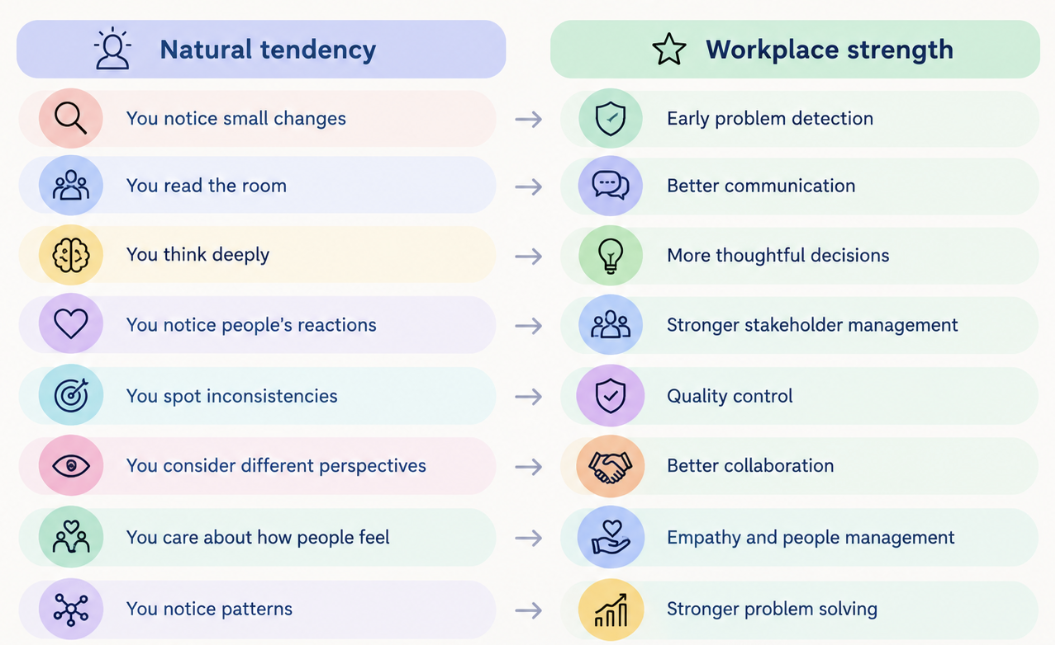
The goal isn't to turn every sensitive trait into productivity.
You don't have to justify your personality by making it useful.
But when your natural tendencies align with your work, they can become genuine professional strengths.
Find a work environment that doesn't constantly drain you
Sometimes the problem isn't that you're “too sensitive.” Sometimes the environment simply isn't a good fit.
Think about the conditions in which you work best.
Do you prefer:
Quiet spaces or busy environments?
Deep work or constant collaboration?
Written communication or frequent meetings?
Clear expectations or highly flexible roles?
Smaller teams or large organizations?
Predictable schedules or fast-changing priorities?
Remote, hybrid, or office-based work?
There isn't one correct working style.
Understanding your own preferences can help you make better career decisions — from choosing a role to evaluating a company culture.
Because career fit isn't only about:
“Can I do this job?”
It can also be:
“Can I do this job sustainably?”
Your sensitivity doesn't have to disappear
Being sensitive at work can sometimes feel like a disadvantage, especially in environments that reward constant speed, confidence, and loud communication.
But sensitivity can also mean that you:
notice details
listen carefully
understand context
recognize patterns
think before reacting
care about the impact of your decisions
notice problems early
understand different perspectives
These aren't weaknesses.
They are capabilities that become stronger when you learn how to manage your attention, boundaries, and energy.
You don't need to become the loudest person in the room.
You don't need to stop caring.
And you don't need to ignore every detail you notice.
You just need to learn which signals deserve your attention and which ones you can let go.

The next time you catch yourself thinking:
“Why am I overthinking this?”
Pause and ask:
1. What do I actually know? Separate facts from assumptions.
2. Is there something I need to do? If yes, take one clear action.
3. Is this my responsibility? You can notice someone's emotions without carrying them.
4. Is my environment draining me? Look at your workload, communication patterns, and workspace.
5. Does this role fit the way I work best? Career growth isn't only about skills. It's also about fit.
Your sensitivity can be part of your career strength
The goal isn't to turn yourself into someone who never worries, never notices details, or never gets affected by their surroundings.
It's to understand yourself well enough to know when your sensitivity is helping you and when you need to protect your energy.
Your ability to notice more can become an advantage when paired with self-awareness, boundaries, and the right environment.
Know yourself. Understand how you work. Then find opportunities where your strengths can actually be used.
Discover career insights, understand your strengths and working style, explore opportunities, and build a career that fits who you are and how you work.
Explore more career resources on Jobcadu and find opportunities that fit your strengths.
No sections detected in this article.


