

Sometimes, the problem isn't a lack of ability. You may be dealing with a skill gap, a role that doesn't fit you, or simply a body and mind that haven't had enough time to recover.
When you're exhausted for long enough, even tasks you're normally good at can suddenly feel difficult.
So before you start thinking, “Maybe I'm just not good enough for this job,” it may be worth asking a different question:
“What is actually causing me to struggle right now?”

Not every difficult period at work has the same cause.
You might genuinely need more knowledge, practice, or training.
You may notice:
You struggle with a task you've never done before.
You repeatedly make the same technical mistakes.
You understand what needs to be done but don't know how to do it yet.
Feedback from your manager points to a specific area for improvement.
You feel more confident when someone teaches or guides you through the process.
A skill gap isn't a failure. It means there's something specific you can learn.
Instead of thinking, “I'm bad at this,” try asking:
“What skill am I missing, and how can I build it?”
Sometimes you have the skills to perform a job but don't enjoy the way the work is structured.
For example, you might:
Prefer creative work but spend most of your time on repetitive tasks.
Enjoy working independently but constantly need to coordinate with others.
Prefer clear structure but work in an environment where priorities change every day.
Enjoy strategy but spend most of your time executing instructions.
Have strong communication skills but dislike a role that requires constant presentations.
In this situation, the question isn't necessarily “Am I capable?”
It might be:
“Does this role allow me to use my strengths in a way that works for me?”
A mismatch doesn't automatically mean the company or role is bad. It may simply mean that your strengths, preferences, and the role's demands aren't aligned.

This is where things can become confusing.
When you're physically and mentally exhausted, your performance can change.
You may notice things like:
Insomnia or disrupted sleep
Sunday dread that starts before the workweek even begins
Persistent fatigue, even after resting
Brain fog or difficulty concentrating
Taking much longer to complete tasks
Becoming unusually irritable or emotionally drained
Feeling overwhelmed by tasks that previously felt manageable
Losing motivation for work you normally enjoy
One bad day doesn't necessarily mean you're burnt out.
But if exhaustion continues and starts affecting your work, sleep, mood, or everyday life, it's worth taking it seriously rather than simply blaming yourself.
And if symptoms are persistent, severe, or affecting your health, consider speaking with a qualified healthcare professional.
When you're struggling at work, try separating the problem into three questions.
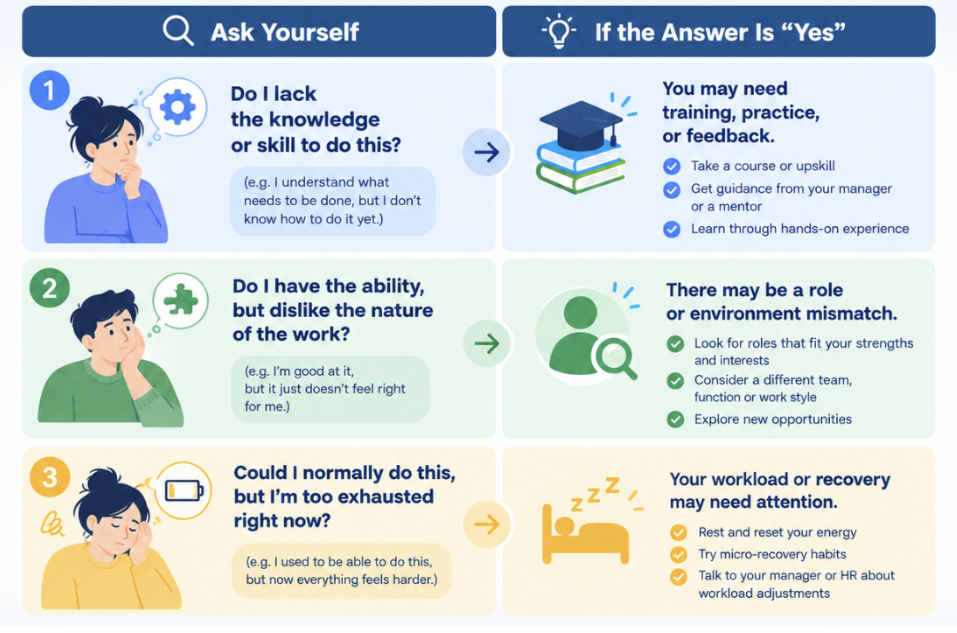 The 15-minute recovery test
When you're mentally drained, taking a break doesn't always mean opening TikTok, scrolling Instagram, or checking another screen.
Sometimes that's not really recovery.
Try a true 15-minute screen break instead.
Put your laptop and phone away if possible.
Walk outside, get some water, stretch, or sit somewhere different.
Ask yourself:
“Do I still feel completely unable to do this, or does it feel slightly more manageable?”
This isn't a test for burnout or a substitute for proper rest. It's simply a small way to notice whether your brain needs a few minutes of recovery or whether there's a bigger problem with your workload or role.
It's easy to respond to struggling at work by working even more.
You stay late.
You check messages after hours.
You skip breaks.
You take work home.
You tell yourself:
“I just need to get better.”
But if the underlying problem is an unsustainable workload, adding more hours may not solve it.
Instead, look at the workload itself.
Ask:
What tasks are taking up most of my time?
Which deadlines are genuinely urgent?
What can be deprioritized?
Are there tasks that could be delegated?
Am I constantly switching between too many priorities?
Are expectations clear?
Is the current workload temporary or becoming the normal standard?
You don't have to wait until you're completely overwhelmed.
A conversation can be useful when workload or expectations are becoming difficult to manage.
Instead of saying:
“I can't handle my job anymore.”
You could make the conversation more specific:
“I currently have several high-priority projects running at the same time. I'd like to discuss which priorities should come first so I can focus on delivering them well.”
Or:
“I've noticed that the current workload is affecting how efficiently I can complete my work. Could we review the priorities and deadlines together?”
The goal isn't necessarily to complain. It's to make the problem visible and discuss possible adjustments.

If you're having a particularly difficult period at work, give yourself some space before making a major career decision.
Ask:
If yes, exhaustion may be influencing how you're evaluating your job.
Those are two different problems.
Your current performance may not represent your full ability.
If yes, you may need development rather than a complete career change.

This can help separate burnout from role dissatisfaction.
Career growth isn't always a straight line. There will be periods when you're learning, making mistakes, feeling confident, feeling lost, and sometimes simply trying to get through the week.
So the next time you think:
“Maybe I'm just bad at my job.”
Pause.
It might be a skill gap.
It might be a role mismatch.
It might be an unhealthy workload.
Or you might simply be very, very tired.
Understanding which one you're dealing with gives you a much better starting point than blaming yourself.
Your career isn't only about finding the next job.
It's also about understanding your strengths, skills, working preferences, and the direction you want to grow in.
Explore Jobcadu's Career Toolkit to better understand your career strengths and development areas, and use Jobcadu’s Resume Builder when you're ready to turn that experience into your next career opportunity.
Your career growth starts with understanding yourself.
No sections detected in this article.


