

For a long time, career success was measured by familiar milestones: a higher salary, a better job title, a promotion, or a position at a well-known company.
But the world of work is changing.
Technology is evolving, AI is reshaping how work gets done, and employers are rethinking what makes someone valuable to an organization. The skills that helped you succeed in your first job may not be enough to keep you competitive throughout your career.
This doesn't mean salary is no longer important. Financial stability remains a major part of career decisions. However, your salary is only one part of your career value. Your skills, professional reputation, ability to adapt, and willingness to keep learning can also influence the opportunities available to you in the future.
Think of these qualities as your career currency: the assets you build over time that can help you access better opportunities, navigate career transitions, and create long-term professional growth.
So, what makes someone valuable in today's job market beyond their current paycheck?

A job title tells people where you work and what position you hold. But it doesn't always explain what you can actually do.
Two people with the same title may have very different capabilities. One Marketing Executive may know how to create social media content, while another can analyze campaign performance, automate reporting, and use AI tools to improve productivity.
Their titles may be similar, but the value they bring to a team can be very different.
This is why building relevant, transferable skills matters. Rather than relying entirely on your current role or years of experience, focus on capabilities you can apply across different projects, teams, and industries.
For example:
A content creator who understands SEO, analytics, and AI-assisted workflows can contribute beyond content production.
An HR professional who can analyze recruitment data may help improve hiring decisions.
A project coordinator who understands automation and stakeholder management can take on more complex responsibilities.
A customer service professional who can identify recurring customer issues through data may contribute to product and process improvements.
The goal isn't to collect as many skills as possible. It's to develop skills that solve real problems and create value.
Ask yourself: If your current job title disappeared tomorrow, what could you still offer an employer?
Your answer can reveal which parts of your career capital are already strong and which areas deserve more attention.
Traditionally, employers often used degrees, previous job titles, years of experience, and company backgrounds as shortcuts for evaluating candidates.
These signals can still matter. However, many employers are also placing greater emphasis on what candidates can demonstrate they know and do.
This approach is known as skills-based hiring.
Instead of focusing exclusively on where you studied or worked, employers may look for evidence of practical capabilities through work samples, portfolios, technical assessments, case studies, certifications, or relevant projects.
For job seekers, this creates both an opportunity and a challenge.
The opportunity is that you may be able to demonstrate your potential even if you don't have a prestigious degree, a recognizable company on your resume, or years of experience in the exact role.
The challenge is that simply claiming a skill is no longer enough. You need to show how you've applied it.
Here are a few ways to make your skills more visible:
Build a portfolio: Show examples of your work and explain the problem you solved.
Document your achievements: Describe how your work improved a process, supported a team, or contributed to a business goal.
Complete relevant projects: Apply your knowledge to realistic problems, even if they come from personal learning or university assignments.
Demonstrate practical knowledge: Use certifications or assessments to support your experience where appropriate.
Connect skills to outcomes: Explain not just what you did, but why it mattered.
For example, writing “Proficient in Excel” provides limited information. Describing how you used Excel to automate a recurring report, reduce manual work, or identify an important trend gives an employer a clearer picture of your capabilities.
Your resume should do more than list qualifications. It should provide evidence of what you can contribute.

Skills help you do the work. Your professional reputation influences whether people trust you with the opportunity.
Think about the colleagues, managers, or clients you've enjoyed working with. Chances are, you remember more than their technical abilities. You also remember whether they kept their promises, communicated clearly, handled pressure, and took responsibility when things went wrong.
These qualities shape professional reputation.
A strong reputation can lead to recommendations, referrals, repeat clients, collaboration opportunities, and greater trust when new responsibilities become available.
You don't need to be famous in your industry or have thousands of LinkedIn followers to build one. Your reputation develops through consistent actions, often in small moments that people remember.
For example:
Delivering work when you say you will.
Communicating early when a deadline is at risk.
Giving credit to colleagues who contributed.
Taking responsibility instead of shifting blame.
Sharing useful knowledge with your team.
Responding constructively to feedback.
Treating people respectfully, regardless of their position.
Your online presence can also support your professional reputation. A clear LinkedIn profile, thoughtful posts, useful project examples, and recommendations from people who have worked with you can help others understand what you do and how you approach your work.
However, your online profile should reflect your actual capabilities. A polished personal brand cannot replace reliability, integrity, or meaningful contributions.
Your reputation is built by what people consistently experience when they work with you.
Over time, that trust can become one of the most valuable assets in your career.
The skills required for a role can change as technology, customer expectations, and business priorities evolve.
A process that works today may become inefficient tomorrow. A tool you rely on may be replaced by something better. A company may restructure, or an industry may shift in a new direction.
You cannot control every change in the job market. But you can develop the ability to respond to change effectively.
Adaptability doesn't mean saying yes to every new trend or constantly changing career direction. It means recognizing when circumstances have changed, understanding what those changes require, and adjusting your approach without losing sight of your goals.
An adaptable professional might:
Learn a new tool when an existing workflow becomes outdated.
Apply existing skills to a different industry.
Adjust priorities when business needs change.
Seek feedback and improve an approach that isn't working.
Take on unfamiliar responsibilities when appropriate.
Recognize when it's time to develop new skills or explore another career path.
For example, a marketer who has relied on manual reporting may need to learn analytics tools and AI-assisted workflows. A traditional administrative professional may benefit from learning automation. A data analyst may need to improve their communication skills as AI makes some technical tasks easier to perform.
In each case, the goal isn't to abandon existing expertise. It's to build on it.
The most adaptable professionals understand that their current way of working is a starting point, not a permanent limit.
Knowing what you can do today is important. Knowing how quickly you can develop new capabilities may be just as valuable.
This is where learning velocity comes in.
Learning velocity refers to how effectively you can acquire new knowledge, turn it into practical skills, and apply what you've learned to real situations.
It isn't simply about finishing courses quickly or collecting certificates. The real test is whether your learning changes how you work.
Consider two professionals who want to learn data analytics.
One completes several online courses but rarely practices what they've learned. The other studies the fundamentals, works with sample datasets, builds a dashboard, receives feedback, and improves the project.
Both have invested time in learning. But the second person has also created evidence of practical ability.
You can improve your learning velocity by following a simple cycle:
Identify a gap: Find a skill that could improve your current work or support your next career step.
Learn the fundamentals: Use courses, tutorials, books, or guidance from experienced professionals.
Apply what you've learned: Build something, solve a problem, or use the skill in your daily work.
Get feedback: Ask others to review your work and identify areas for improvement.
Refine and repeat: Use what you've learned to improve your next attempt.
For example, if you want to become a stronger project manager, you could learn a project management tool, apply it to a real workflow, review whether it improves team coordination, and adjust your approach based on the results.
This creates a stronger learning habit than simply moving from one course to another.
The value of learning isn't just what you know. It's what you can do differently because you learned it.

AI is changing how people research, write, analyze information, create content, automate tasks, and solve problems.
You don't necessarily need to become an AI engineer to remain relevant. But understanding how to use AI effectively is becoming useful across an increasing range of roles.
AI literacy involves more than knowing which tools are popular. It includes understanding how to use them appropriately, evaluate their outputs, recognize their limitations, and take responsibility for the final result.
Depending on your role, this could mean:
Using AI to brainstorm ideas and improve early drafts.
Analyzing information more efficiently while checking the accuracy of the findings.
Automating repetitive tasks to make time for higher-value work.
Using AI to explore data or generate initial code, then testing the results.
Improving workflows while protecting confidential or sensitive information.
Recognizing when human judgment, context, or specialist expertise is essential.
The key is to combine AI capabilities with your own professional knowledge.
For instance, an AI tool may help generate a marketing report, but a marketer still needs to understand the audience, interpret performance, and recommend what the business should do next.
Similarly, AI may help summarize information for a project manager, but it cannot automatically replace the need to manage stakeholder expectations, resolve conflicts, and make informed decisions in context.
As AI tools become more accessible, the differentiator may increasingly be how well you combine technical tools, critical thinking, communication, and domain expertise.
Rather than asking, “Will AI replace my job?” consider a more actionable question:
“Which parts of my work can AI help me improve, and which human capabilities should I strengthen?”
That question gives you a practical starting point for developing your skills and preparing for future opportunities.
Career capital can sound abstract, but you can make it more concrete by reviewing the assets you're building throughout your professional life.
Instead of measuring your career only by salary or job title, consider these five areas.
What can you do, and how relevant are those capabilities to the roles you want?
Consider your technical skills, transferable skills, industry knowledge, and ability to solve meaningful problems.
Questions to ask:
Which skills can I demonstrate with real examples?
What capabilities are becoming more important in my target field?
Which skill gap should I prioritize next?
Do people trust you to deliver quality work and work well with others?
Look at feedback, recommendations, repeat collaborations, referrals, and the responsibilities people are willing to entrust to you.
Questions to ask:
What do colleagues and managers consistently appreciate about working with me?
Do I follow through on commitments?
What would people confidently recommend me for?
How well can you respond when your responsibilities, tools, or working environment change?
Consider examples of learning a new system, adjusting to a different team, solving an unfamiliar problem, or applying your expertise in a new context.
Questions to ask:
When was the last time I successfully adapted to a significant change?
Which parts of my work rely too heavily on one tool or process?
How could I make my skills more transferable?
How consistently do you turn new knowledge into practical capability?
Review the courses you've completed, projects you've built, feedback you've applied, and skills you've developed through practice.
Questions to ask:
What have I learned in the past three to six months?
What have I actually applied at work?
Can I point to a tangible result from that learning?
How prepared are you to pursue your next opportunity?
This includes the strength of your professional profile, the quality of your portfolio, your network, and your understanding of the roles available in your field.
Questions to ask:
Does my resume reflect the value I can bring?
Does my professional profile communicate my strengths clearly?
Do I have examples of work that demonstrate my capabilities?
Am I building relationships that support professional growth?
You can use the following scorecard as a personal reflection tool. Rate each area from 1 to 5, where 1 means you have significant room to develop and 5 means you have strong evidence of your capabilities.
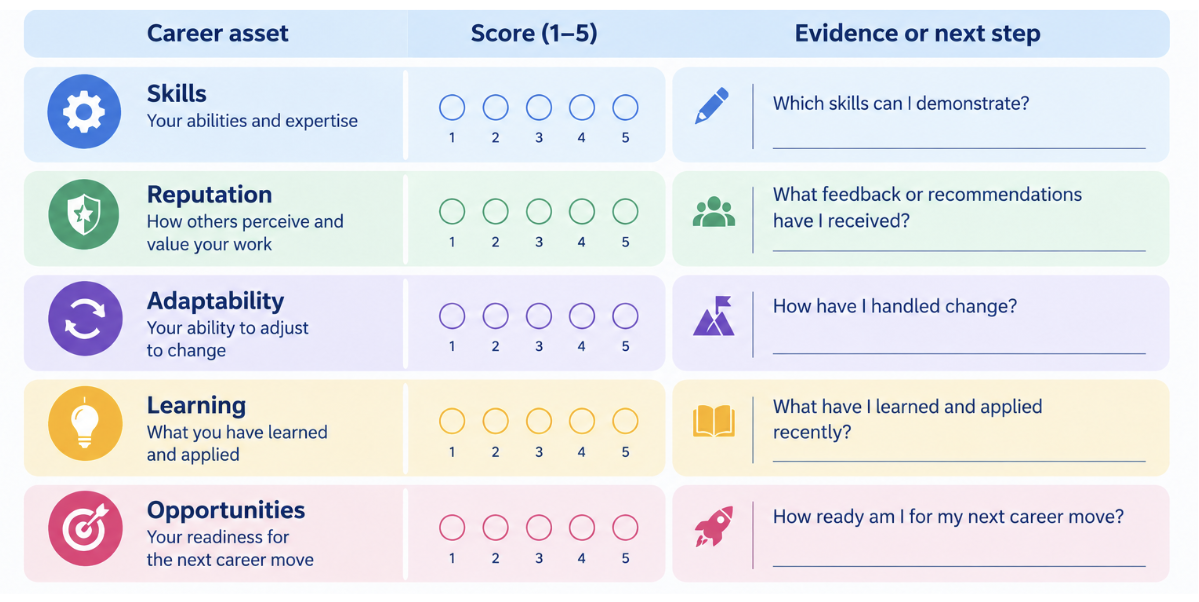
This is not a scientifically validated career assessment or a score employers use. It's a practical way to identify your strengths, notice gaps, and decide where to invest your time next.
You don't need to improve every area at once. Choose one or two priorities that align with your current career goals, then review your progress every few months.
You don't have to wait for a promotion, a new job, or an annual performance review to start building career capital.
You can begin with a few practical steps:
Audit your skills. Review the requirements for roles you may want in the future. Identify which skills you already have and which ones need further development.
Turn your work into evidence. Keep a record of projects, achievements, challenges you've solved, and feedback you've received. This will help you recognize your growth and communicate your value when applying for opportunities.
Invest in targeted learning. Choose courses that address a specific skill gap or support a clear career goal. Apply what you learn through projects or real work instead of collecting certificates without a plan.
Strengthen your professional profile. Make sure your resume and LinkedIn profile reflect your current skills, relevant experience, and achievements. Add portfolio links or project examples when appropriate.
Review your progress regularly. Ask yourself what you've learned, what value you've created, and what opportunities you want to be ready for next.
These steps may not lead to an immediate salary increase. But over time, they can help you become better prepared to pursue new roles, negotiate opportunities, and navigate changes in your career.

Your career growth shouldn't depend on your job title alone. It should reflect the skills you develop, the value you create, and how prepared you are for what's next.
Jobcadu's Career Toolkits, Courses, and Profile features can help you turn career development into a more practical process.
Career Toolkits: Review your career direction, identify areas for improvement, and plan your next steps.
Courses: Develop relevant skills and strengthen your capabilities as work requirements evolve.
Pro-Profile: Present your professional background, skills, and experience in a way that helps others understand what you bring to the table.
You don't need to build your entire future in one day. Start by identifying one skill to develop, one achievement to document, or one area of your professional profile to improve.
Because in a changing job market, your most valuable career assets aren't limited to what you earn today. They're also what you know, what people trust you to do, and how ready you are to learn what comes next.
No sections detected in this article.


