

Starting a business used to sound like something reserved for people with a big idea, significant capital, or years of business experience.
Today, the path can look very different.
A designer can start selling digital products online. A marketer can build a consulting business. A developer can create a software product with a small team. A creator can turn an audience into a community or business. Even someone with a full-time job can start testing a business idea on the side.
Technology has made entrepreneurship more accessible but accessibility doesn't mean it is easy.

Digital tools, AI, social media, and global platforms have lowered some of the barriers to starting a business. At the same time, entrepreneurs face intense competition, financial uncertainty, changing customer expectations, and the pressure of doing more with fewer resources.
So what does entrepreneurship really look like today?
And is it something you have to commit to full-time?
Entrepreneurship is often associated with starting a company and becoming a founder.
But modern entrepreneurship can take many forms.
You could be:
A freelancer building a client-based business
A consultant selling your expertise
A creator developing a personal brand
A founder building a startup
A small-business owner serving a specific market
A professional selling digital products or courses
A full-time employee developing a side business
The common thread is creating value by identifying a problem or opportunity and finding a way to solve it.
This means entrepreneurship doesn't necessarily have to begin with a company.
It can begin with a skill, an idea, or a problem you want to solve.

Several changes have made it easier for individuals and small teams to experiment with business ideas.
You don't necessarily need a physical store to reach customers anymore.
Social media, e-commerce platforms, websites, online marketplaces, and digital payment systems allow businesses to find and serve customers without building everything from scratch.
For example, someone with a skill in graphic design could potentially find clients online, build a portfolio, sell templates, and eventually develop a larger creative business.
The important shift is that access to customers is no longer limited to your immediate location.
Artificial intelligence is changing how businesses approach everyday work.
Entrepreneurs can use AI tools to support activities such as:
Market and customer research
Brainstorming
Content creation
Data analysis
Administrative tasks
Customer support
Workflow automation
Product development
This can make certain tasks faster and allow small teams to experiment with ideas without immediately hiring large teams.
But AI doesn't remove the need for human skills.
Entrepreneurs still need to decide what problem is worth solving, who the customer is, what the business should prioritize, and whether the information produced by AI actually makes sense.
Entrepreneurship can create opportunities that are difficult to find within a traditional job structure.
Your current skills may be more valuable than you realize.
A marketer could turn their knowledge into consulting services.
A photographer could build a specialized photography business.
A developer could create a digital product.
A teacher could develop an online course.
A finance professional could provide specialized advisory services.
The key question becomes:
“What problem can my skills help someone solve?”
This is where your skill stack becomes important.
You don't necessarily need to know everything.
You need to understand what you're good at, what people need, and which skills you need to develop next.

Career paths don't always have to follow a straight line.
Instead of:
Graduate → Get a job → Get promoted → Stay in one career
someone might follow:
Job → Side project → Freelance → Business → New career direction
Entrepreneurship can therefore become something you gradually explore rather than an immediate decision to leave your current job.
Many business opportunities begin with an everyday frustration.
Think about problems you encounter in your own work or life:
Is a process unnecessarily complicated?
Are people struggling to find information?
Is there a service people want but can't easily access?
Are existing products too expensive or difficult to use?
Is there a specific group whose needs aren't being addressed?
You don't need to invent something completely new. Sometimes, the opportunity is to make an existing experience simpler, faster, more accessible, or more useful.
Running even a small business can expose you to areas you may never encounter in a traditional job.
You might learn about:
Sales
Pricing
Negotiation
Marketing
Customer research
Financial management
Leadership
Operations
Strategy
Problem-solving
These skills can also benefit you if you eventually return to or continue within traditional employment.
Entrepreneurship isn't only about building a business. It can also be a way of building yourself.

The flexibility and opportunity can be attractive, but entrepreneurship also comes with responsibilities that shouldn't be overlooked.
Digital platforms make it easier to start a business.
But they also make it easier for other people to do the same thing.
This means entrepreneurs may face:
More competitors
Lower barriers to entry
Difficulty standing out
Constant changes in customer expectations
Pressure to build a recognizable value proposition
Having a good idea isn't always enough.
You need to understand why someone would choose your solution instead of the alternatives.
In a traditional organization, different people usually handle different functions.
As an entrepreneur, especially in the beginning, you might be responsible for almost everything.
One day you're doing marketing. The next day you're handling sales.
Then you're checking finances, answering customers, fixing a website, planning the next product, and wondering why there aren't enough hours in the day.
Being good at your main skill doesn't automatically make you good at running every part of a business.
That's why continuous learning becomes so important.
A traditional job usually provides a more predictable salary.
Entrepreneurial income can be much less predictable.
You may experience:
Fluctuating revenue
Unexpected expenses
Slow periods
Upfront costs
Delayed payments
Uncertainty about future income
Before making a major career decision, it's important to understand your personal financial situation and how much uncertainty you can realistically manage.

One of the biggest misconceptions about entrepreneurship is that being your own boss automatically means having more freedom.
Sometimes it means the opposite.
When your business depends on you, it can become difficult to switch off.
You might:
Check business messages late at night
Work through weekends
Think about your business during personal time
Feel guilty when you're not being productive
Take on every task because “it's my business”
Over time, this can create exhaustion.
Building something you care about doesn't mean you need to be available every hour of the day.
A sustainable business also needs a sustainable person behind it.
Entrepreneurs rarely have all the answers.
You may not know:
Which customer group will respond best
Which product will succeed
How much people are willing to pay
When to hire
When to change direction
Which idea deserves more investment
Waiting until you have complete certainty can prevent you from moving forward.
Instead, entrepreneurship often requires learning through small experiments, customer feedback, and real-world evidence.
You don't always need to know the entire path.
Sometimes you only need enough information to decide what to test next.

There's no single answer that works for everyone.
Instead of asking:
“Should I quit my job and start a business?”
start with smaller questions.
Entrepreneurship often involves creating your own structure rather than following an established one.
Not knowing exactly what happens next is a normal part of building something new.
You may start because of one skill and quickly discover that you need five more.
Understanding your financial runway can help you make decisions based on reality rather than pressure.

Sometimes what you need isn't entrepreneurship.
It might be a different role, company, industry, or working environment.
You don't necessarily have to make entrepreneurship an all-or-nothing decision.
One of the most practical ways to explore entrepreneurship is to treat it as an experiment.
Look for something people genuinely struggle with.
What can you already do that could help solve the problem?
Talk to potential customers. Create a simple version. Offer a small service. See what people actually respond to.
Maybe you discover that you need stronger skills in sales, finance, marketing, technology, or leadership. That's useful information.
Use what you learn to decide whether the idea deserves more time, resources, or commitment.
This approach changes entrepreneurship from:
“I have to quit everything and take a huge risk.”
into:
“I can explore whether this opportunity actually fits me.”
Entrepreneurship isn't automatically better than having a job.
They're simply different ways of structuring a career.
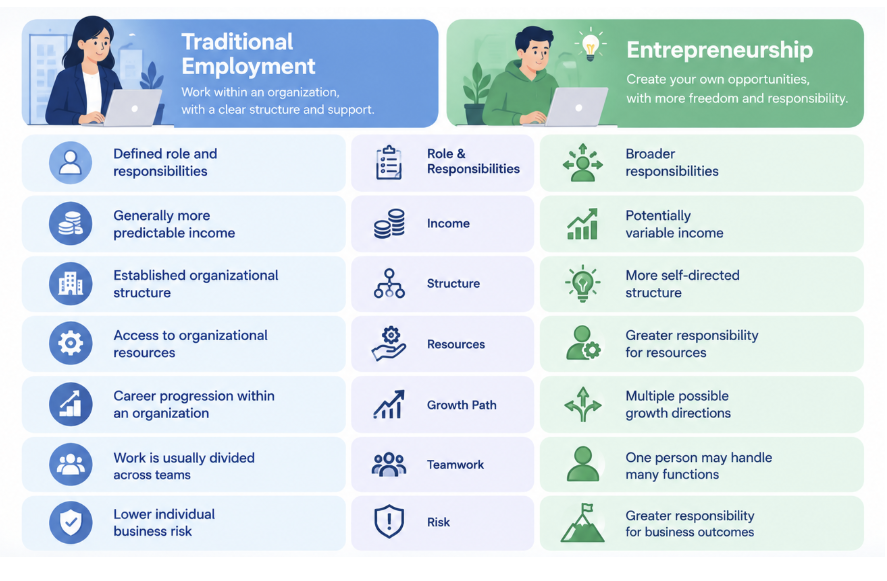
The right path depends on your goals, financial situation, preferred working style, skills, and tolerance for uncertainty.
And your answer can change over time.
The entrepreneur of the future may not look like the traditional image of a founder sitting in a large office with a huge team.
They might be:
A designer selling digital products
A marketer running a specialized consultancy
A developer building a small SaaS business
A creator building a niche community
A professional offering coaching or education
A freelancer working with clients around the world
A full-time employee building a business on the side
AI and digital platforms may continue to make small-scale entrepreneurship more accessible.
But technology won't eliminate the fundamentals.
Successful businesses still need to understand people, problems, value, trust, and execution.

Entrepreneurship isn't simply about becoming a founder. It's about taking ownership of opportunities, developing skills, solving problems, and creating value.
You don't need to have everything figured out before you start. You can begin by understanding:
What am I good at?
What problems do I care about solving?
What skills am I missing?
What kind of work and life do I want to build?
The answers can help you decide whether entrepreneurship belongs in your career now, later, alongside your current job, or perhaps not at all.
And that's okay.
Your career doesn't have to follow one predefined path.
Whether you're thinking about starting a business, building a side project, changing careers, or growing in your current role, the first step is understanding your skills, strengths, and development gaps.
Explore Jobcadu's Career Toolkit to discover more about your career strengths, working preferences, and areas for development.
When you're ready to turn your experience into your next opportunity, Jobcadu’s Resume Builder can help you build a resume that shows not only what you've done but the skills and value you bring.
No sections detected in this article.


