

AI isn’t simply taking jobs away. It’s changing what employers need, how jobs are done, and which skills help candidates stand out.
From marketing and finance to customer service, administration, and technology, artificial intelligence is becoming part of everyday work. Tasks that once took hours can now be completed faster with AI assistance, while new expectations are emerging around digital skills, critical thinking, and adaptability.
According to PwC’s 2026 Global AI Jobs Barometer, which analyzed more than one billion online job advertisements across six continents, skills required for the most AI-exposed jobs are changing more than twice as fast as those in the least AI-exposed jobs. The report also highlights growing demand for human capabilities such as judgment, creativity, and leadership. These changes raise important questions for anyone planning their career.
Will AI change your current role? Which skills should you develop? And how can you remain relevant in a job market that continues to evolve?
The answer starts with understanding how AI is changing work—not just whether it can replace it.

When people talk about AI and employment, the conversation often focuses on one question: Will AI take my job?
But the impact is more complex than that.
AI can automate certain tasks without necessarily eliminating an entire occupation. For example, a marketer might use AI to generate content ideas, analyze customer data, or organize campaign research. An accountant might use AI-assisted tools to process information, while a customer service representative might work alongside a chatbot that handles routine inquiries.
In these situations, the job may remain, but the way it is performed changes.
Employees may spend less time on repetitive tasks and more time reviewing information, making decisions, solving problems, and communicating with others.
At the same time, some roles and tasks may decline, while new responsibilities and opportunities emerge. The effects vary by industry, occupation, organization, and how AI is implemented.
This means preparing for the future isn't only about protecting your current position. It's also about understanding how your responsibilities may evolve.
Instead of asking only, “Will AI take my job?”, consider asking:
“How could AI change my job, and what skills will help me adapt?”
AI can influence many industries, particularly tasks involving repetitive processes, large amounts of information, or predictable workflows.
Here are some examples of how it may change everyday work.
Administrative work
Automating data entry and routine documentation
Organizing information and summarizing documents
Assisting with scheduling and task coordination

Marketing
Generating content ideas and first drafts
Supporting audience research and campaign analysis
Personalizing content and organizing marketing data
Finance
Assisting with data analysis and reporting
Identifying patterns in financial information
Supporting forecasting and routine processes

Customer service
Handling frequently asked questions through chatbots
Drafting responses to common inquiries
Organizing customer feedback and support requests
Technology
Assisting with code generation and documentation
Supporting software testing and debugging
Helping developers investigate technical problems
Creative work
Supporting brainstorming and early concepts
Generating or editing visual assets
Adapting content for different formats and audiences

These examples don't mean every task can be fully automated or that every organization uses AI in the same way. Accuracy, complexity, privacy, and human oversight still matter.
The important distinction is that AI often changes the tasks within a job, even when the occupation itself remains.
Understanding which parts of your work are changing can help you identify where to develop new skills and where your existing expertise remains valuable.
As technology changes how work is performed, the combination of skills needed to perform that work can change too.
The World Economic Forum's Future of Jobs Report 2025 identifies AI and big data among the skills expected to grow in importance, alongside human capabilities such as analytical thinking, resilience, flexibility, and collaboration. Its findings are based on a survey of more than 1,000 employers representing economies around the world. .
Rather than focusing exclusively on technical knowledge, professionals can prepare by developing two complementary skill sets.
Depending on your role, these may include:
AI literacy: Understanding how AI works in practical situations and recognizing its limitations.
Data analysis: Interpreting information to identify patterns and support decisions.
Digital tools: Using software relevant to your industry.
Automation: Recognizing opportunities to improve repetitive workflows.
AI-assisted workflows: Using AI to support research, writing, analysis, or other role-specific tasks.

These remain important when work requires context, judgment, and interaction with people.
Critical thinking: Evaluating information rather than accepting every output at face value.
Communication: Explaining ideas clearly and adapting messages to different audiences.
Creativity: Developing original ideas and finding new approaches to problems.
Problem-solving: Understanding the underlying issue before choosing a solution.
Leadership: Helping people work toward shared goals.
Judgment: Making informed decisions when information is incomplete.
Adaptability: Adjusting to new tools, responsibilities, and working methods.
Collaboration: Working effectively with people across teams and disciplines.
The goal isn't to master every skill on the list. It's to identify the combination that fits your career direction.
The advantage comes from combining relevant technology skills with the human abilities needed to apply them effectively.
One common misconception is that preparing for an AI-driven workplace means becoming a programmer or AI engineer.
Not necessarily.
For many professionals, AI literacy means understanding how to use AI appropriately within their own field.
This includes knowing:
What AI can and cannot do
Which tasks it can help you complete
How to check AI-generated information for errors
How to recognize biased, misleading, or incomplete outputs
How to protect confidential and sensitive information
When human judgment is necessary
When an AI tool may not be suitable for a particular task
Consider a content creator.
They don't necessarily need to build an AI model. Instead, they might use AI to organize research, brainstorm campaign ideas, summarize audience feedback, or explore different content angles.
However, they still need to understand the audience, recognize inaccurate information, maintain the brand's voice, and decide which ideas are worth pursuing.
Similarly, a project manager might use AI to summarize meeting notes, but still needs to manage priorities, communicate with stakeholders, and resolve conflicts.
You don't necessarily need to build AI. You need to understand how AI can change your work.
Start with the tools and tasks most relevant to your role rather than trying to learn every new platform that appears.

If AI can generate ideas, summarize information, and analyze data, what can professionals bring to the table?
The answer often lies in how they interpret and apply that information.
AI can help a manager identify patterns in team performance. But the manager still needs to understand the circumstances behind those patterns, communicate with employees, resolve disagreements, and make decisions that account for both business goals and people.
AI can generate dozens of marketing concepts. But a marketer must still understand the target audience, assess cultural context, maintain brand consistency, and decide which idea best serves the campaign.
AI can help organize information for a business decision. But someone must still evaluate the risks, question the assumptions, and take responsibility for the outcome.
This is why skills such as judgment, critical thinking, communication, leadership, and creative problem-solving deserve attention.
PwC's 2026 AI Jobs Barometer also reports that new tasks in the most AI-exposed jobs are increasingly associated with capabilities such as empathy, judgment, and creativity. This does not mean these skills are immune to technological change; rather, they remain important as work evolves.
AI affects professionals differently depending on their experience, responsibilities, and industry. Your next steps should reflect where you are in your career.
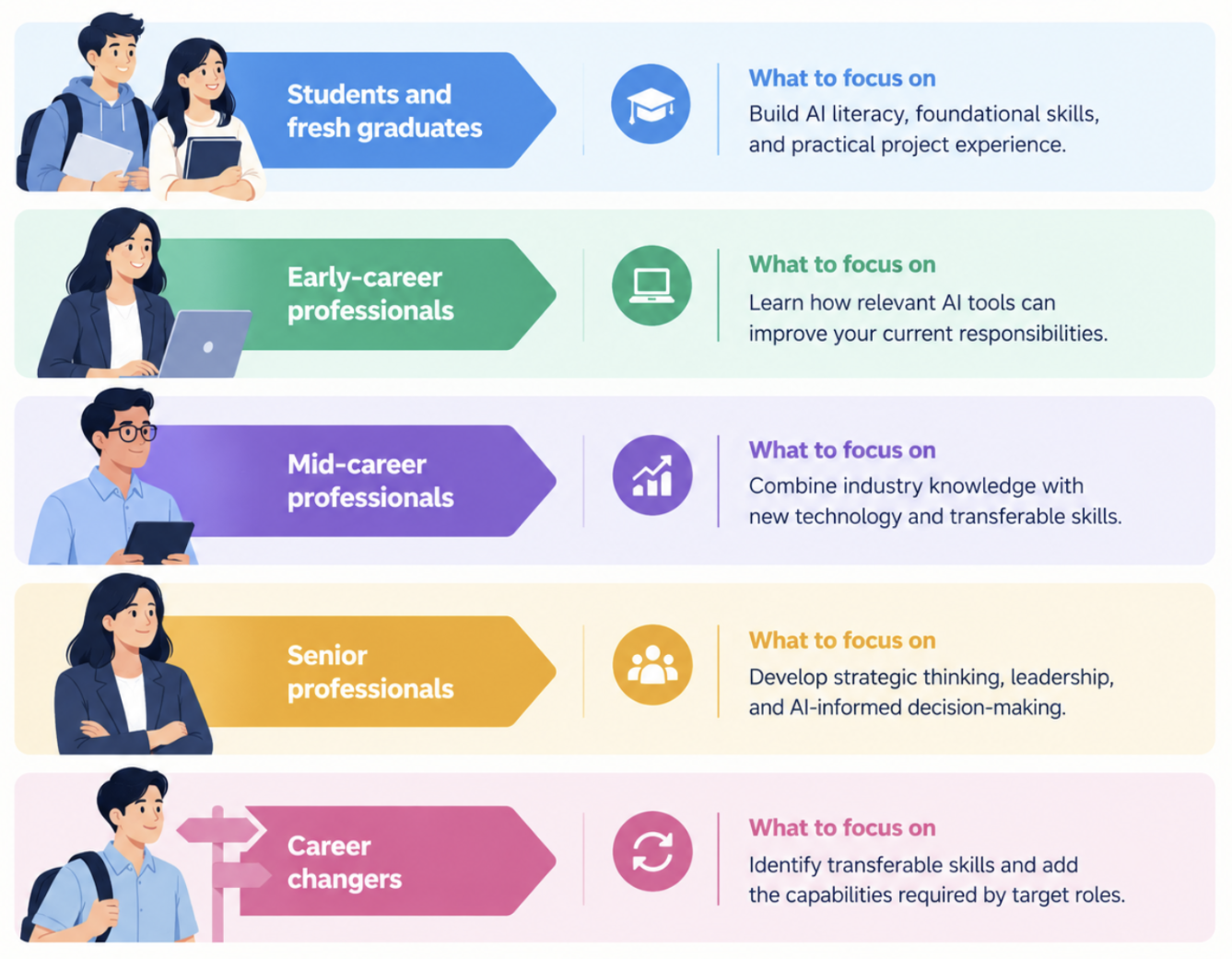
You don't need to know every AI tool before entering the workplace.
Focus on understanding your chosen industry, communicating clearly, solving problems, and learning how technology is used in your target roles.
Use internships, personal projects, and practical assignments to demonstrate what you can do.
Look at your daily responsibilities and identify opportunities to improve your work.
Can you use AI to organize research, reduce repetitive tasks, or prepare a first draft more efficiently?
Learn to evaluate the results, not just generate them. Understanding when a tool helps—and when it doesn't—is part of developing professional judgment.
Your existing experience is an asset.
You may already understand customers, business processes, industry challenges, and stakeholder relationships. Learning relevant AI or digital skills can help you apply that knowledge in new ways.
Rather than assuming you need to start over, identify which parts of your expertise remain useful and how new capabilities could strengthen them.
Senior roles often involve decisions that affect teams, budgets, customers, and business direction.
Develop your understanding of how AI can support decisions, improve processes, and change team responsibilities. Leadership, communication, risk awareness, and change management can help you navigate those shifts.
Changing careers doesn't mean every previous skill becomes irrelevant.
Experience in customer service may transfer to account management. Project coordination may support a move into operations. Content development may provide a foundation for digital marketing or communications.
The next step is to identify the additional skills your target role requires and build evidence that you can apply them.

You don't need to learn every new AI tool or completely reinvent your career overnight. Start with a practical plan.
Write down the skills you use in your current job or studies.
Consider your:
Technical and digital skills
Industry knowledge
Communication and collaboration skills
Problem-solving abilities
Leadership or project management experience
Include achievements and responsibilities that demonstrate these skills. You may already have capabilities that can transfer to other roles.
Review your daily or weekly workflow.
Ask yourself:
Which tasks are repetitive?
Which tasks involve processing large amounts of information?
Which tasks could potentially be completed more efficiently with AI?
Which tasks require human judgment, relationship-building, or accountability?
What new responsibilities might emerge as the work changes?
This exercise can help you identify learning opportunities without assuming your entire job will disappear.

Choose one or two tools that address a real need.
A marketer might explore AI-assisted research or analytics. An administrative professional might investigate document processing or workflow automation. A project manager might explore tools for summarizing information and tracking tasks.
Set a specific learning goal and test the tool on an appropriate task, following your organization's policies on privacy and approved software.
Technology skills can become outdated as tools change. Human skills can help you adapt across different situations and roles.
Practice explaining complex ideas, asking better questions, evaluating evidence, giving constructive feedback, and working with people who have different perspectives.
These abilities can make your use of AI more thoughtful and effective.
Completing a course is a useful starting point, but applying what you've learned helps demonstrate your capabilities.
For example, you could:
Build a portfolio project using an AI-assisted workflow.
Document how you improved a process.
Compare the quality of a task before and after introducing a tool.
Present a case study explaining your approach and results.
Describe what you learned, including the limitations you encountered.
Where possible, measure the outcome honestly. Don't claim a percentage improvement unless you have evidence to support it.
The objective is to show that you can turn knowledge into practical value.

As AI becomes more common in the workplace, simply writing “AI proficient” on your resume may not tell recruiters much.
Employers need context: Which tools did you use? What did you accomplish? What changed because of your work?
Compare these examples.
Instead of:
“Used AI tools to create content.”
Try:
“Used AI-assisted research and content workflows to streamline content production while maintaining brand guidelines and editorial review.”
If you have measured results, you can make the achievement more specific:
“Implemented an AI-assisted content workflow that reduced average production time by 30% while maintaining the team's quality review process.”
Use a quantified result only if it reflects your actual work and can be supported.
You can apply the same approach to other roles.
Instead of:
“Familiar with AI and data analytics.”
Try:
“Used AI-assisted analysis to identify customer behavior patterns and inform campaign planning.”
A strong resume should explain:
Tools used: Which relevant technologies did you apply?
Problems solved: What challenge were you addressing?
Processes improved: What became more efficient or effective?
Decisions supported: How did your work inform an action?
Results achieved: What changed, and how do you know?
Human judgment involved: How did you check, interpret, or improve the output?
For experienced professionals, this is especially important. Your resume should communicate not only what you were responsible for, but also how you used your expertise to create value.
You don't need to mention AI in every bullet point. Focus on the capabilities and outcomes that are relevant to the position you're applying for.
Job titles can provide useful information about a person's experience, but they don't always tell the full story of what someone can do.
Two people with the same title may have different strengths. One might specialize in data analysis, another in stakeholder management, and another in improving workflows with AI.
As roles evolve, it becomes useful to communicate your capabilities alongside your job history.
Ask yourself:
What problems can I solve?
Which skills can I transfer to another role?
What results have I achieved?
How do I learn and adapt to new tools?
How can I demonstrate these capabilities to an employer?
For job seekers, this means looking beyond titles when exploring opportunities. Read job descriptions carefully and identify the skills, responsibilities, and outcomes employers actually expect.
For career changers, it means connecting previous experience to the needs of a new role.
For experienced professionals, it means showing how your knowledge and judgment contribute to business outcomes.
Your job title tells part of your story. Your skills and achievements help complete it.
Understanding how work is changing is one step. Turning that understanding into a career plan is another.
Jobcadu brings together career development resources to help you explore your strengths, identify areas for growth, prepare your resume, and discover relevant opportunities.
Understand your skills, interests, and career direction. Use that self-awareness to explore roles that align with your goals and identify capabilities you may want to develop.
Compare your current capabilities with the skills required for your target career. Use the gaps you identify to guide your learning, focusing on relevant courses and practical development rather than trying to learn everything at once.
Turn your responsibilities and achievements into clearer resume content. Highlight relevant skills, describe your impact, and use AI-assisted guidance to improve your resume while keeping your experience accurate and authentic.
Use your skills and career direction as a starting point for discovering job opportunities that may fit your profile and goals.
The tools you need will depend on your career stage, but the process is the same: understand where you are, identify where you want to go, and build a practical path between the two.
AI is reshaping how people work, but preparing for the future doesn't necessarily mean abandoning everything you've learned or starting your career from zero.
It can mean adding new technology skills to your existing experience, strengthening your human capabilities, and learning how to demonstrate the value you bring to an employer.
Start by understanding your current strengths. Identify the skills your target roles require. Then take one practical step toward developing them.
Explore your career path with Jobcadu today.
No sections detected in this article.


