

When looking for a new job, it is easy to focus on the things that are easiest to compare: job title, salary, and company name.
But there is another factor that can significantly shape your career experience: the type of organization you work for.
A Corporate company may offer a highly structured environment and clearly defined career levels. An SME may give you broader responsibilities and more direct access to decision-makers. A start-up can offer speed, flexibility, and the opportunity to build things from scratch. An MNC may provide international exposure, while government organizations can offer stability and structured career systems. Agencies, meanwhile, can expose you to multiple clients, industries, and projects.
None of these workplace types is automatically better than another.
The better question is:
Your priorities may change as your career develops. Early in your career, you may want to learn as much as possible. Later, you may prioritize leadership opportunities, international experience, flexibility, stability, or work-life balance.
A Corporate workplace typically refers to a medium-to-large organization with multiple departments, established processes, and a relatively clear organizational structure.
You may find dedicated teams for HR, Finance, Marketing, Operations, IT, Sales, and other functions, with responsibilities divided across different roles.

Clearly defined roles and responsibilities
Established processes and policies
Multiple teams and stakeholders
Formal communication structures
Standardized workflows
This can make it easier to understand what is expected of you, especially if you prefer having clear guidelines.
However, the larger the organization, the more likely you may need to coordinate with several teams before a project can move forward.
Corporate organizations often have a more defined hierarchy, such as:
Manager → Senior Manager → Director → Executive
Decision-making may therefore involve several levels of approval.
This can feel slower compared with a small company, but it can also provide exposure to formal management structures and organizational processes.
Depending on the organization and role, you may also receive:
Performance bonuses
Annual salary adjustments
Incentives
Allowances
Larger organizations may offer a wider range of benefits, such as:
Health insurance
Provident fund or retirement benefits
Annual leave
Performance bonuses
Learning and development programs
Employee wellness programs
The actual package will vary by company and position.
You may find:
Office-based work
Hybrid arrangements
Remote work for certain roles
Working hours and policies are usually relatively well defined.
Working at an SME (Small and medium-sized enterprise) can feel very different from working at a large corporation.
Because teams are often smaller, employees may have the opportunity to work across different areas of the business.
You might be hired as a Marketing Executive, for example, but also become involved in events, partnerships, content, customer research, or even business development.

Work across different functions
Take ownership of projects
See the bigger picture of the business
Work closely with different teams
Learn through hands-on experience
Your work may be more visible because there are fewer layers between you and the decision-makers.
You may have opportunities to communicate directly with:
Managers
Business owners
Founders
Senior leadership
This can allow you to understand how business decisions are made and how your work contributes to company growth.
Compensation can vary significantly between SMEs.
Some may offer competitive salaries, while others may have more limited budgets.
Because roles can change quickly, your responsibilities may also expand over time. In some cases, this can create opportunities to negotiate based on increased responsibilities and performance.
Benefits depend heavily on the individual company.
Some SMEs may offer:
Health insurance
Flexible working
Performance incentives
Learning opportunities
Additional allowances
Others may have a smaller benefits package than larger organizations.
Depending on the company, you may find:
Office-based work
Hybrid work
Remote work
Flexible working hours
The key is to check the company's actual policy rather than assuming all SMEs work the same way.
A start-up typically operates in an environment where the business is still building, testing, or rapidly expanding its products, services, and market.
That means things can change quickly.
A role that looks one way when you join the company may evolve as the business grows.

Start-up environments can involve:
Fast decision-making
Frequent experimentation
Changing priorities
Cross-functional work
High ownership
Ambiguous situations
You may sometimes be asked:
“We've never done this before. Can you figure it out?”
For some people, this is exciting. For others, the lack of structure can feel stressful.
Start-ups often have relatively flat structures, especially during their early stages.
Employees may work closely with:
Founders
C-level executives
Heads of departments
This can provide significant exposure to strategic decisions and the realities of building a business.
Start-up compensation varies widely depending on:
Company stage
Business model
Funding
Industry
Role
Candidate experience
Some companies may offer additional incentives such as equity or stock options, while others may focus primarily on salary.
Potential benefits may include:
Flexible working
Remote or hybrid arrangements
Learning opportunities
Team activities
Wellness programs
Equity or other incentives
However, benefits differ significantly between start-ups.
Hybrid and remote work can be common in some start-ups, particularly technology companies.
However, flexibility does not necessarily mean fewer working hours. During important launches or periods of rapid growth, employees may need to respond quickly to business priorities.
An MNC (Multinational Corporation) operates across multiple countries and often connects local teams with regional or global headquarters.
For employees, this can create opportunities to work with international teams, projects, systems, and standards.

MNCs may provide exposure to:
International teams
Global projects
Cross-cultural collaboration
Global business processes
International clients
Standardized systems
MNCs often have established organizational structures.
You may work with:
Local Team → Country Leadership → Regional Team → Global Leadership
Not every decision is made locally, so some projects may require alignment with regional or global stakeholders.
Compensation is often relatively structured according to role, level, and experience.
Depending on the organization, packages may include:
Base salary
Annual bonus
Performance incentives
Allowances
Long-term incentives for certain positions
MNCs may provide comprehensive benefits such as:
Health insurance
Retirement or provident fund
Paid leave
Learning and development
Employee wellness programs
International training opportunities
Again, benefits depend on the company, country, and role.
You may encounter:
Office-based work
Hybrid work
Remote arrangements
Flexible schedules
One additional consideration is time zones.
Working with international teams may mean joining meetings outside traditional local working hours.
Government organizations operate differently from most private-sector companies.
They typically work within established regulations, procedures, and public-sector systems, with responsibilities connected to public services and national or community needs.

Established procedures
Regulations
Compliance
Public responsibility
Long-term planning
For people who prefer predictable systems and clearly defined processes, this environment can be attractive.
Government organizations generally have formal hierarchies and clearly defined positions.
Decision-making may involve multiple levels and established procedures.
This can make the process more structured, although it may also mean that decisions take longer than they would in a flat organization.
Compensation usually follows established salary structures or scales based on the type of organization, position, qualifications, and employment status.
Career progression may also follow defined criteria.
Depending on the organization and employment status, benefits may include:
Healthcare benefits
Leave entitlements
Retirement-related benefits
Other established employee benefits
It is important to check the specific conditions of the position because government employment structures can differ.
Working hours and procedures are generally well defined.
Office-based work is common, although some departments or roles may offer hybrid or flexible arrangements.
An Agency works on behalf of clients rather than focusing on a single company's internal business.
Examples include:
Advertising agencies
Digital agencies
PR agencies
Creative agencies
Recruitment agencies
Consulting agencies
This means your work may change depending on the client and project.

Agency life can involve:
Multiple projects
Multiple clients
Different industries
Tight deadlines
Frequent presentations
Rapid feedback
Team-based collaboration
For example, a digital marketing professional might work on a beauty brand this month, a technology company next month, and a financial services client after that.
Agency structures are often organized around teams, accounts, or projects.
You may work with:
Account Managers
Project Managers
Creative Leads
Functional Specialists
Department Heads
Strong communication and collaboration are often essential.
Salary depends on:
Agency size
Industry
Role
Experience
Specialization
Some agencies may also provide project-based or performance-related incentives.
Benefits vary significantly, but may include:
Health insurance
Flexible working
Team activities
Learning opportunities
Professional development
Depending on the agency and role, you may work:
In the office
Hybrid
Remotely
At client locations
Some roles may also require client meetings or events.
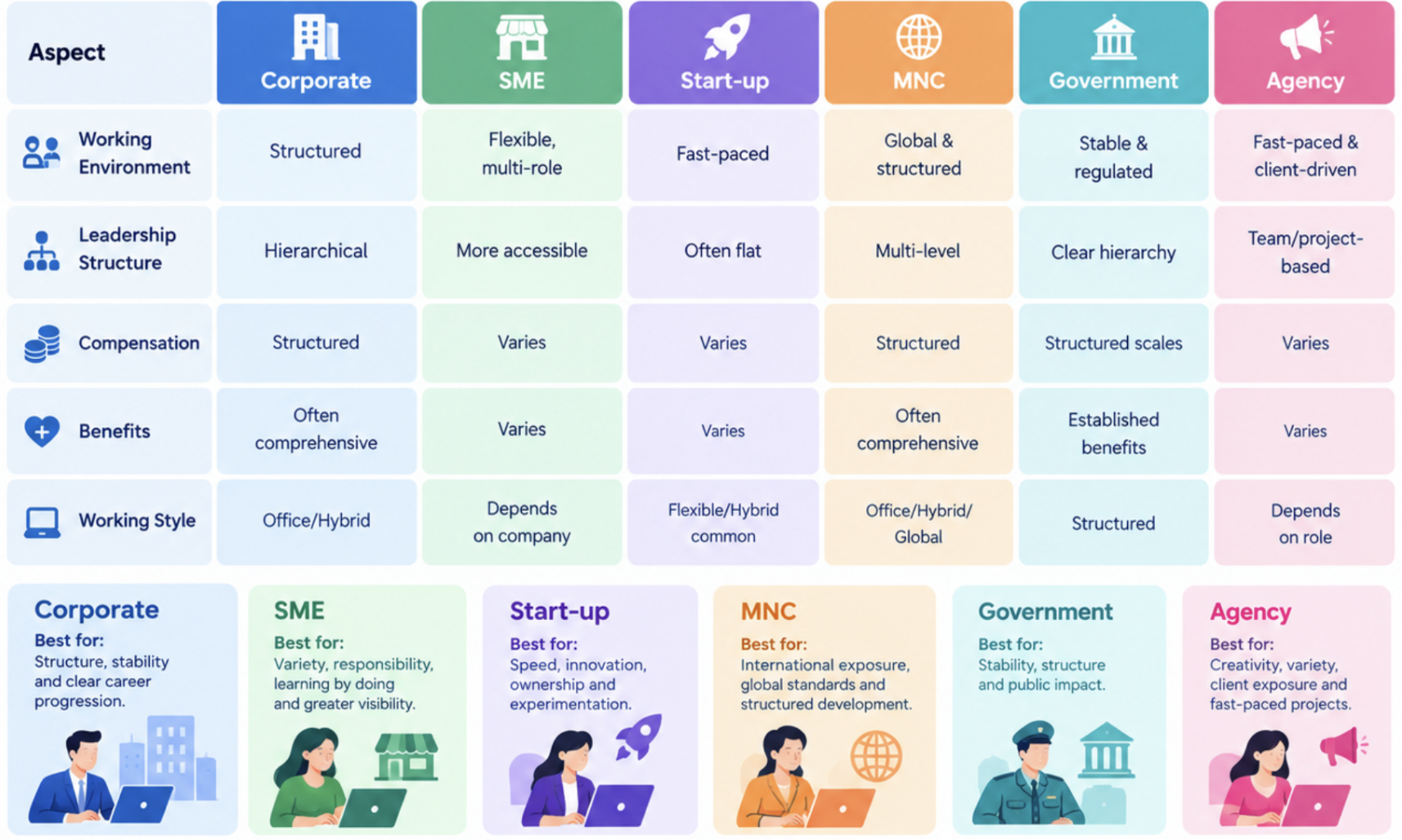
A well-managed SME may have better benefits than a large corporation. A start-up may have a more structured culture than expected. An MNC team may operate very differently from another team within the same company.
Instead of asking “Which type of company is the best?”, ask:
“What do I need from my workplace at this stage of my career?”
Clear structures
Stability
Defined responsibilities
A more predictable career path
Experience in established organizations
Broader responsibilities
Hands-on learning
Greater visibility
Direct access to leadership
Exposure to different parts of the business
Speed
Innovation
Ownership
Experimentation
The opportunity to build something
International exposure
Global projects
Cross-cultural collaboration
Structured development
Experience with international standards
Stability
Established systems
Public impact
Structured career progression
Variety
Creativity
Multiple clients
Different industries
Fast-paced project experience
A job description can tell you what the company is looking for. An interview can help you understand what the job is actually like.
Before accepting an offer, consider asking:
“What will I actually be responsible for?”
“What does success look like in this position?”
“What could the career progression from this role look like?”
“Are there opportunities for training or professional development?”

“Who will I report to?”
“How does the team typically make decisions?”
“Is this role office-based, hybrid, or remote?”
“What are the expected working hours?”
“How does the bonus or incentive structure work?”
“Are there any additional allowances?”
“What benefits are included in the package?”
“Are there any conditions that apply during the probation period?”
These questions can help you understand the opportunity beyond the job title and salary.

The right job is about more than finding a position with the highest salary or the most recognizable company name.
It is about finding an opportunity that matches your skills, experience, career goals, and preferred way of working.
With Jobcadu, you can explore job opportunities across different companies, industries, and career paths whether you're looking for your first job, considering a career change, or preparing for your next step.
Explore opportunities, understand what employers are looking for, and find a workplace that fits the career you want to build.
No sections detected in this article.


