

For a long time, career platforms were built around one simple goal: help people find a job.
Search for a position. Upload a resume. Apply. Wait for a response.
But today's career journey is rarely that simple.
People are changing careers, learning new skills, building portfolios, working with AI, switching industries, and reconsidering what they want from work. A job seeker may not only be looking for a vacancy—they may also be trying to figure out what career direction makes sense, what skills they are missing, and how to become a stronger candidate.
That means finding a job is only one part of career development.
The bigger question is:
What if a career platform could help you not only find your next job, but also prepare for what comes next?
This is where the idea of a Career Ecosystem comes in.

A list of job openings can tell you what opportunities exist.
But it doesn't always tell you:
Which career direction fits you?
What skills do you already have?
What skills are missing?
How should you present your experience?
What should you learn next?
Who can help you make a better career decision?
A modern career journey may require much more than job listings.
Before searching for jobs, people need to understand what they are actually looking for.
This can include exploring interests, strengths, working preferences, career goals, and possible career paths.
Your current skills can be a starting point for understanding which roles may fit you—and where you may need to grow.

Having experience is one thing. Being able to communicate its value clearly is another.
A strong resume should connect your experience, skills, achievements, and the opportunities you want to pursue.
The skills required for jobs can change over time. Career development therefore doesn't stop after graduation or after getting a job.
Learning can become part of an ongoing career journey.
Sometimes, information isn't enough.
Talking to someone with relevant experience can help you see your situation differently, understand an industry, or make a difficult career decision.

Career decisions can involve uncertainty.
Having tools, information, and guidance in one journey can make it easier to move from “I don't know what to do next” to a more informed decision.
Instead of simply seeing hundreds of vacancies, job seekers increasingly need to identify opportunities that are relevant to their skills, experience, and career direction.
Today, career development often happens across many different platforms.
You might:
Search for jobs → on one platform
Build your resume → somewhere else
Take courses → on another platform
Find a mentor → somewhere else
Research careers → through multiple websites
Ask for career advice → from people in your network
Each tool may be useful on its own. But the experience can become fragmented.
You may learn a new skill on one platform but not know how to communicate it on your resume.
You may build a resume but still be unsure which roles match your strengths.
You may find a job but realize six months later that you need new skills to move forward.
The problem isn't necessarily that there aren't enough career resources.
The problem is that they aren't always connected.

The evolution of career technology can be viewed in three stages:
“Here are jobs you can apply for.”
The focus is primarily on connecting job seekers with vacancies.
“Here are tools to help you find and prepare for opportunities.”
The experience expands to include resumes, career information, assessments, learning resources, and other career tools.
“Let's support your career journey from where you are to where you want to go.”
A Career Ecosystem connects different parts of career development so users can move between discovering, building, connecting, applying, and growing.
The goal isn't simply to add more features. It's to make those parts of the career journey work together.
A degree can show where you studied.
A job title can show what role you held.
But skills can help show what you can actually do.
As industries, technologies, and job requirements change, workers may need to continuously develop their capabilities.
This makes skills increasingly important for both job seekers and employers.
For individuals, this means asking:
What skills do I have today, and what skills will I need for the career I want tomorrow?
This mindset shifts career development from something that happens only when you are looking for a job to something you continuously manage.
Instead of waiting until you need a new job to start learning, you can build skills before the next opportunity appears.
AI is also changing how career platforms can support individuals.
Instead of simply showing information, AI can potentially help connect different parts of the career journey.
For example, AI can help with:
Compare your current skills with the requirements of roles you are interested in.

Match your experience and skills with opportunities that may be relevant to your career direction.
Help you communicate your experience more clearly and identify areas that may need improvement.
Show how your existing skills may transfer to different roles or industries.

Identify areas where additional learning could help you become more prepared for your target career.
But AI should not replace human judgment.
It can help organize information and identify patterns, while people still need to decide what matters to them.
Technology can provide information.
People provide context.
A career decision isn't always something that can be solved by matching keywords or analyzing a resume.
Sometimes you need someone to ask:
“Why do you want to make this career change?”
Or:
“Have you considered what this decision means for your long-term goals?”
Mentors and career professionals can provide perspectives that technology alone may not capture.
They can share experiences, challenge assumptions, provide feedback, and help people make sense of complex career decisions.
This is why the future of career technology doesn't have to be AI vs. humans. It can be AI + human guidance.
Imagine your career journey as five connected stages:
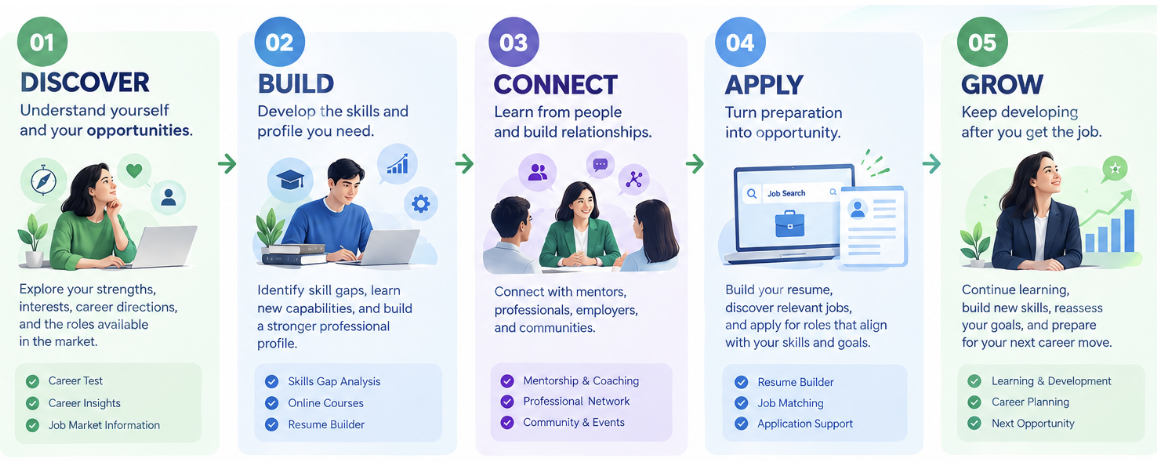
The future of career platforms may move beyond simply answering:
“Where can I find a job?”
and toward helping people answer:
“Where am I going, what do I need to get there, and how can I keep growing?”
A place where job discovery, career exploration, skills development, resumes, mentorship, and professional growth are connected rather than separated across different platforms.
For job seekers, this could mean less time jumping between disconnected tools and more clarity about what to do next.
For employers, it could mean connecting with people based not only on job titles and previous experience, but also on skills, potential, and career direction.
And for career platforms, the opportunity is no longer just to help someone get hired. It is to help them build a career.

Your next career move starts with understanding where you are today and what you need for where you want to go.
With Jobcadu, you can explore different parts of your career journey in one place:
Career Toolkit: Understand your strengths, explore career directions, and gain insights to make more informed career decisions.
Education Portal: Identify the skills you need to develop and discover learning opportunities that can help you move forward.
Resume Builder: Turn your experience and skills into a stronger professional profile, with AI-powered support to improve your resume while keeping your experience authentic.
AI Job Matching: Discover opportunities that align with your skills, experience, and career direction.
Mentors and Coaches: Connect with mentors who can provide real-world perspectives, guidance, and support when you need another point of view.
Explore your career journey with Jobcadu.
No sections detected in this article.


