

After 15+ years in the workforce, you probably have something most job seekers are still trying to build experience.
You have managed projects, solved difficult problems, worked with different teams, handled stakeholders, made mistakes, learned from them, and built expertise that cannot be developed overnight.

So why can finding your next job sometimes feel harder, not easier?
You may find yourself asking:
“Why am I applying to jobs that seem perfect for me but never hearing back?”
“Am I too experienced for some of these positions?”
“Should I apply for senior roles only?”
“Why does my 15-year career not fit neatly into a two-page resume?”
“Should I be networking more instead of applying online?”
The answer may not be that you need to apply to more jobs.
In fact, after 15+ years of experience, applying to everything can be one of the least effective job-search strategies.
Your career has become more complex. Your next move should be more intentional.
Instead of asking:
“How many jobs can I apply for?”
Start asking:
“Which opportunities are actually worth pursuing?”

A professional with 15+ years of experience doesn't approach the job market in the same way as someone with two or three years of experience.
Your challenge is often not a lack of experience. It is how to communicate the right experience.
Over the course of 15+ years, you may have:
Held multiple job titles
Worked across different companies
Changed industries
Managed teams
Led large projects
Developed specialized expertise
Taken on strategic responsibilities
Built an extensive professional network
Accumulated dozens of skills
That's valuable.
But it can also create a problem:
A recruiter doesn't necessarily need to know everything you've accomplished over the past 15 years.
They need to understand:
“Why are you relevant to this particular role?”
Your job search therefore needs to shift from showing everything you've done to showing what matters most for where you want to go next.

When job searching, it can be tempting to think:
“The more applications I send, the greater my chances.”
But more applications don't necessarily mean better opportunities.
Imagine two approaches.
You apply to:
Marketing Director
Marketing Manager
Sales Director
Operations Manager
Product Manager
Business Development Manager
Country Manager
Your reasoning is:
“I have transferable skills, so I'll try everything.”
The problem?
Your professional positioning becomes unclear.
You identify:
Target role: Marketing Director / Head of Marketing
Target industry: Technology / SaaS
Target company: Growth-stage companies
Core strengths: Digital strategy, team leadership, customer acquisition
Now you can build a much stronger story around your experience.
Your resume becomes more focused. Your networking becomes more relevant. Your interview preparation becomes easier. And your time is spent on opportunities that actually support your career direction.
Before searching for jobs, define what you are looking for. This sounds obvious, but experienced professionals sometimes skip this step because they believe their experience gives them more options.
It does—but more options can create more confusion.
Start with five questions.
Do you want to remain an individual contributor?
Move into management?
Take on a regional role?
Move toward an executive position?
Become a specialist?
Move into consulting?

Instead of focusing only on job titles, think about the problems you're good at solving.
For example:
Building growth strategies
Scaling teams
Improving operations
Entering new markets
Transforming digital processes
Reducing costs
Developing talent
This can reveal opportunities beyond your current job title.
Consider:
Startup
Scale-up
Multinational
Enterprise
Family business
Government organization
Non-profit
This question is often overlooked.
Your next career move should not only be about what you want to gain.
It should also consider what you want to avoid.
For example:
Constant travel
Large team management
Highly repetitive work
Unclear responsibilities
Certain industries
Long working hours

Your definition of career success at 25 may be very different from your definition at 40.
Salary may still matter.
But perhaps other factors now matter more:
Autonomy
Flexibility
Leadership
Purpose
Stability
Learning
Work-life balance
Impact
A successful job search begins with understanding what you're actually searching for.
One of the biggest mistakes experienced professionals can make is searching primarily by compensation or job title.
Two jobs with the same title can have completely different responsibilities.
For example:
Marketing Director
At one company, the role might focus on:
Brand strategy
Team leadership
Budget management
At another company, it might be heavily focused on:
Performance marketing
Data analytics
Growth
Customer acquisition
Your experience may be an excellent match for one and a poor match for the other.
That's why you should evaluate opportunities based on role fit, not title alone.
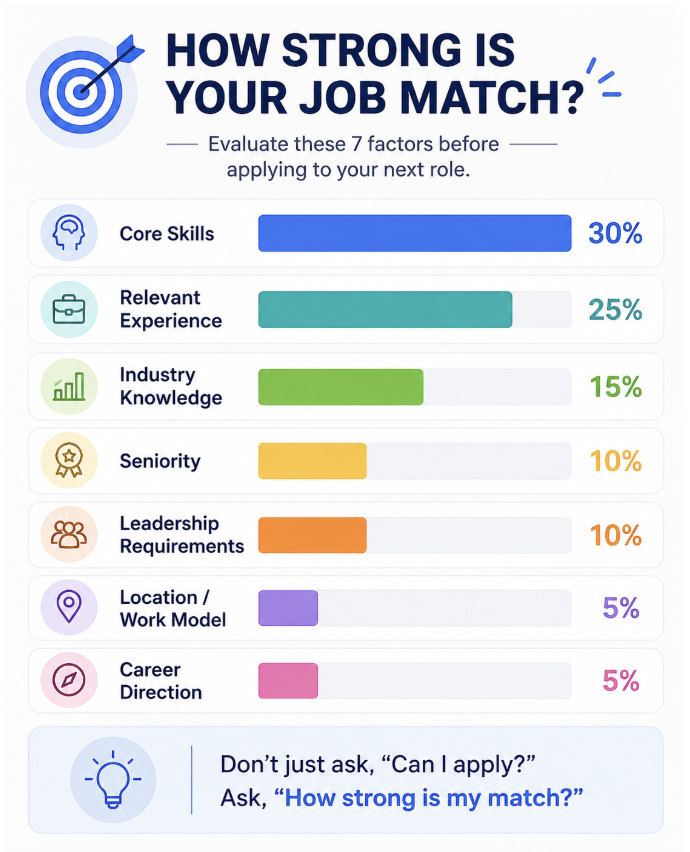
The exact weighting can vary.
The point is to stop thinking:
“Can I apply?”
and start thinking:
“How strong is the match?”
For experienced professionals, networking can become particularly important.
After 15+ years, you may already have connections across:
Former colleagues
Managers
Clients
Partners
Vendors
Industry peers
University networks
Professional communities
Former employees
You may not realize how valuable this network is.
Someone you worked with five years ago may now work at the company you're interested in.
A former manager may know about an opening before it becomes widely advertised.
A former client may know another organization looking for someone with your expertise.
This doesn't mean you should stop applying online.
It means you should stop treating the job search as only an application exercise.
A 15+ year career can create a resume problem: You have too much to say.
You may have:
15 years of achievements
6 companies
8 job titles
40+ skills
Dozens of projects
Multiple certifications
But your resume isn't an autobiography.
Its job is to answer one question:
“Why should this person be considered for this role?”
Suppose you're applying for a: Head of Digital Marketing
The recruiter probably cares more about:
Digital strategy
Growth
Customer acquisition
Team leadership
Budget management
Data
Performance marketing
than about an unrelated project you managed 12 years ago.
Experienced professionals often assume that having an impressive career automatically means their resume will get noticed.
Unfortunately, the screening process doesn't always work that way.
Many organizations use Applicant Tracking Systems (ATS) to help manage and screen applications.
Depending on how the employer configures its system, relevant information such as:
Job titles
Skills
Keywords
Qualifications
Experience
may influence how applications are identified or filtered. This makes keyword alignment important.
For example, if the job description repeatedly mentions:
“Strategic Planning”
“P&L Management”
“Go-to-Market Strategy”
“Cross-functional Leadership”
and your resume uses completely different language even if you have done those things—your relevance may not be immediately obvious.
Don't add keywords you don't actually possess. Instead, translate your experience into terminology that both recruiters and systems can understand.
Your experience becomes valuable when you can demonstrate pattern recognition.
For example:
A junior professional might say:
“I managed a marketing campaign.”
A senior professional might say:
“I've led campaigns across multiple markets and learned that the biggest performance differences often come from audience segmentation and local market behavior. In my previous role, we changed the targeting strategy and improved qualified leads by 28%.”
The senior professional isn't valuable simply because they have more years.
They're valuable because they've seen more situations and learned from them.

Senior professionals should think beyond the resume. Create a collection of evidence that demonstrates your expertise.
This might include:
Major projects
Business results
Case studies
Presentations
Thought leadership
Articles
Speaking engagements
Certifications
Professional recommendations
Portfolio projects
You don't necessarily need to publish confidential company information.
Instead, describe: Challenge → Approach → Outcome → Learning
One of the uncomfortable realities of a 15+ year career is that some of your skills may no longer be as valuable as they once were.
That's not a failure. Every industry evolves.
Marketing moved from traditional media toward digital, data and automation.
Finance increasingly relies on analytics and technology.
HR has become more data-driven and technology-enabled.
Operations increasingly incorporate automation and AI.
Technology itself changes continuously.
The question isn't:
“Are my old skills useless?”
Instead ask:
“Which of my existing skills can be upgraded for today's market?”
For example:
Marketing experience → AI-assisted marketing analytics
Finance experience → Data analytics + AI-enabled forecasting
HR experience → People analytics + HR technology
Operations experience → Automation + process optimization
Your goal isn't necessarily to start over. It's to build on what you already know.

Instead of opening a job board every morning and applying randomly, create a system.
Choose:
1–3 target job families
2–3 industries
Preferred company size
Preferred location
Desired seniority
Minimum requirements
Create a list of companies you'd genuinely want to work for.
For example:
Tier 1 — Dream Companies: 10 companies
Tier 2 — Strong Fit: 20 companies
Tier 3 — Good Alternatives: 30 companies
For every opportunity, evaluate:
Role Fit
☐ Relevant responsibilities
☐ Appropriate seniority
☐ Relevant industry
Skill Fit
☐ Core skills
☐ Technical skills
☐ Leadership skills
Career Fit
☐ Supports long-term direction
☐ Compensation expectations
☐ Work model
☐ Location
For high-match positions:
Tailor your resume
Adjust your professional summary
Prioritize relevant achievements
Match relevant terminology
Research the company
Prepare role-specific interview stories
After 15+ years, your career is no longer simply about getting the next job.
It may be about deciding:
What do I want the next 5–10 years of my career to look like?
Perhaps you want to:
Move into leadership
Become an expert
Change industries
Work internationally
Build a business
Become a consultant
Move into a purpose-driven organization
Have greater flexibility
Work less but create more impact
That means your job search should start with career direction, not job listings.
The right question isn't:
“What job can I get?”
It's:
“What opportunity makes sense for the career and life I want next?”
Identify:
Target roles
Target industries
Target companies
Core strengths
Career priorities
Deal-breakers
Update:
Resume
LinkedIn profile
Professional summary
Skills
Achievements
Portfolio
Make sure your profile reflects where you want to go, not just where you've been.
Reach out to:
Former colleagues
Former managers
Industry contacts
Professional communities
Recruiters
Prioritize: High-Match Opportunities
Then: Stretch Opportunities
Be selective with: Low-Match Opportunities
Track your results and adjust your strategy based on the data.
If you've been working for 15+ years and your job search isn't producing results, don't immediately assume:
“I'm too old.”
or:
“Companies don't want experienced professionals.”
The problem may be much more practical.
Your experience may not be positioned clearly.
Your resume may contain too much information.
You're applying to roles that aren't strong matches.
Your network isn't being activated.
Your skills may need updating.
Your job-search strategy may still look like the strategy you used earlier in your career.
The good news? You don't need to start over.
You need to reposition what you've already built.
Your 15+ years of experience represent thousands of decisions, problems solved, relationships built and lessons learned.
The goal is to make that experience visible, relevant and valuable to the right employer.
With Jobcadu, you can use a more structured approach:
Create an ATS-friendly resume that highlights the experience, skills and achievements most relevant to your target role.
Understand the capabilities you already have and identify areas that may need development.
Use job matching to discover opportunities that better align with your professional profile instead of searching through thousands of unrelated listings.
Once you identify a skills gap, use relevant courses and learning resources to strengthen your profile.
Start with what you've already built and make it work for your next chapter.
No sections detected in this article.


