

Have you ever asked your boss a question and received a two-word reply?
You need detailed instructions to feel confident about a task, but your manager says, “Just handle it.”
Or maybe you like to take your time, think things through, and double-check your work, while your boss wants everything done yesterday.
Working with someone whose communication style is completely different from yours can be exhausting. You might feel confused, pressured, or even wonder whether you're doing something wrong.
But here's the thing: a different working style doesn't automatically mean you're a bad fit.
Sometimes, the challenge isn't a lack of ability or effort. It's that you and your manager approach communication, decisions, and work differently.
Learning how to navigate those differences can make your working relationship smoother and help you become more confident in your career.

Some people feel comfortable figuring things out as they go. Others prefer clear instructions, defined expectations, and a step-by-step plan before getting started.
Neither approach is necessarily wrong. The problem starts when your boss assumes you already understand what they mean.
Imagine this conversation:
You: “Could you clarify what you'd like me to include in the report?”
Your boss: “The usual stuff.”
And now you're left wondering: What exactly is “the usual stuff”?
If this happens regularly, asking more questions isn't always the only solution. You can make it easier for your boss to respond by asking specific, decision-focused questions.
Instead of:
“Can you explain the whole task again?”
Try:
“Just to confirm, should I focus on the sales results, customer insights, and
recommendations?”
Instead of:
“What do you want me to do?”
Try:
“Would you prefer a one-page summary or a detailed report?”
Instead of:
“I don't understand what you mean.”
Try:
“I want to make sure I'm on the right track. My understanding is that the goal is to increase engagement, and I'll start by reviewing the last three campaigns. Is that correct?”
These questions reduce ambiguity while making it easier for your manager to give a quick answer.

When instructions are vague, briefly summarize your understanding before starting.
You can confirm three things:
Goal: What outcome are we trying to achieve?
Priority: What matters most?
Deadline: When does it need to be completed?
For complex tasks, you can also clarify the expected format, available resources, or who needs to review the final work.
This doesn't mean you need to ask your boss about every small decision. The goal is to get enough information to move forward confidently.
Some managers make decisions quickly, expect immediate responses, and prefer to figure things out along the way.
Meanwhile, you might prefer to gather information, consider different options, and check the details before committing.
This difference can create frustration on both sides.
Your boss may think you're overthinking a simple task. You may feel pressured to make decisions before you have enough information.
The solution isn't necessarily to become as fast as your boss. It's to communicate what you need to move forward.

Instead of saying:
“I need more time to think.”
Try:
“I can give you an initial recommendation by 2 PM. I'll check the key data first so we can make a more informed decision.”
This gives your manager a clear timeline and explains why the extra time matters.
You don't always need to have every detail figured out before responding.
Try:
“My initial recommendation is Option A based on what we know so far. I'll verify the cost and potential risks before confirming.”
This shows that you're responsive without pretending to know everything.
Try:
“Given the deadline, I can prioritize the key findings and recommendations first. We can add the supporting details afterward if needed.”
This helps you manage expectations instead of silently rushing through everything.
Remember that speed and accuracy aren't always competing goals. The important thing is knowing which decisions require careful review and which tasks can move forward with a reasonable first draft.
You don't need to change your personality to work well with your boss.
However, learning how someone prefers to receive information can help reduce misunderstandings.
Think of it as adapting your communication—not abandoning who you are.
Here are four common working-style differences and ways to navigate them.
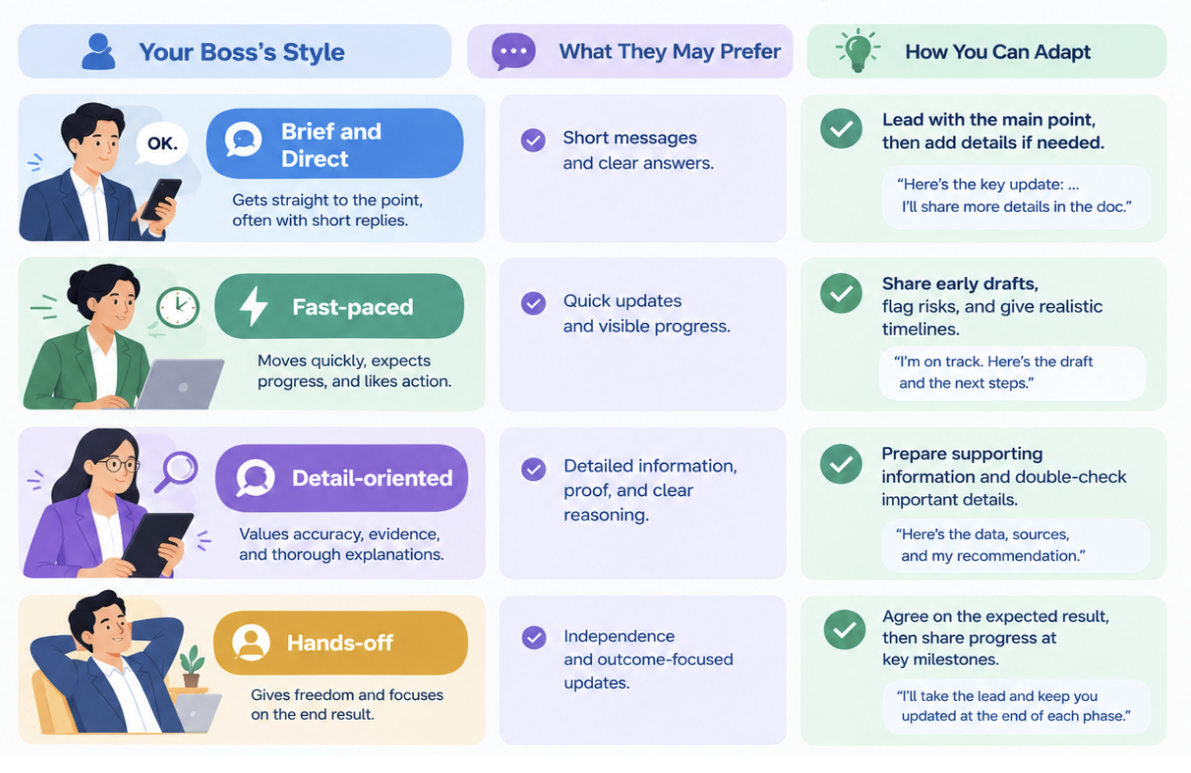
These are practical patterns, not fixed personality types. A manager might prefer short messages for routine tasks but want a detailed explanation for an important decision.
Pay attention to what works in different situations.
For example, if your boss regularly asks, “What's the recommendation?” before discussing the details, start your updates with the recommendation. You can then explain the reasoning behind it.
If your boss frequently asks for progress updates, agree on checkpoints rather than waiting until the task is finished.
Small adjustments can make everyday communication much easier.
One common workplace frustration is assuming that other people should communicate the way we do.
If you like detailed explanations, a brief reply might feel dismissive.
If you prefer independence, frequent questions from your manager might feel like micromanagement.
But the same behavior can mean different things to different people.
A short message may simply mean your manager is busy. A request for frequent updates may reflect the need to coordinate a complicated project. Neither automatically means your boss is unhappy with you.
Instead of immediately interpreting the behavior, look for patterns and ask for clarification when necessary.
For example:
“I work best when I understand the expected outcome before starting. Would it be possible to align on the key requirements at the beginning of each project?”
Or:
“I'd like to keep you updated without interrupting your schedule too often. Would a short progress update every afternoon work for you?”
These conversations turn personal frustrations into practical working agreements.
The goal isn't to decide whose communication style is better. It's to find a way to work together effectively.

Many workplace problems become more difficult because people wait until something goes wrong before discussing how they work together.
You can avoid some of that friction by aligning expectations early.
When starting a new project, clarify:
1. What does success look like?: Ask what the finished result should achieve, rather than focusing only on the tasks involved.
2. How much independence do you have?: Find out which decisions you can make yourself and which require approval.
3. How should you communicate progress?: Agree on whether your manager prefers messages, email, meetings, or updates through a project management tool.
4. When should you raise a problem?: Clarify which issues you should solve independently and which need immediate attention.
5. How will feedback work?: Ask whether your manager prefers feedback throughout the process or after you submit a draft.
You don't need to schedule a formal meeting for every question. These expectations can often be clarified during a project kickoff or a regular check-in.
Once you understand how your manager works, you can spend less energy guessing and more energy doing the work.
Adapting your communication style can help, but it doesn't mean every workplace problem is yours to solve.
There is a difference between working with someone who has a different personality and working in an environment where expectations are consistently unreasonable.
Pay attention if you regularly experience:
Instructions that change without explanation, followed by blame for getting things wrong
Unrealistic deadlines without any discussion of priorities or resources
Feedback that is consistently disrespectful or humiliating
Expectations to be available at all hours without reasonable boundaries
Being held responsible for outcomes without the information or authority needed to deliver them
If these patterns continue, consider documenting important instructions, discussing expectations with your manager, or seeking support from HR or another appropriate workplace contact.
You can try:
“I want to make sure I can consistently deliver the expected results. Recently, the priorities have changed several times during the project. Could we agree on which requirements take priority when timelines are tight?”
Focus on specific situations, their impact on your work, and what would help you move forward.
If the situation involves harassment, discrimination, retaliation, or serious concerns about your well-being, consider seeking appropriate support rather than treating it as a simple communication mismatch.
Adapting is a useful skill. Accepting every unreasonable expectation is not a requirement of being a good employee.

Your career will likely involve working with people who think, communicate, and make decisions differently from you.
Some will be direct. Others will be cautious. Some will want frequent updates, while others will give you considerable independence.
Learning to navigate these differences can strengthen your communication, problem-solving, and collaboration skills.
Start with three simple habits:
Observe: Notice how your manager prefers to receive information and make decisions.
Clarify: Ask focused questions about priorities, expectations, and deadlines.
Adapt intentionally: Adjust your communication where it helps, while maintaining your professional boundaries.
You don't need to become a completely different person to succeed at work.
You just need to understand how to communicate your needs, recognize other people's preferences, and find common ground.
Working with a difficult-to-read boss can teach you a lot about communication, self-awareness, and professional growth. But you don't have to figure out every career challenge on your own.
With Jobcadu, you can explore career-development resources, understand your strengths, and discover ways to build the skills that support your next career move.
Explore the Career Toolkit to reflect on your strengths and working preferences, or connect with mentors & coaches for guidance on navigating workplace challenges and developing your professional confidence.
Because career growth isn't just about doing your job well. It's also about understanding yourself, working effectively with others, and learning how to navigate different workplace environments.
Your boss doesn't have to be just like you for you to work well together.
No sections detected in this article.


