
Posted on February 10, 2026
Growth

Mid-career professionals face a unique challenge: staying competitive while navigating rapid skill shifts, automation, and rising credential expectations. Certification partnerships have emerged as a strategic solution—offering recognized credentials, structured growth pathways, and measurable career advancement beyond traditional training programs.
Certification Partnerships for Mid-Career Professional Advancement | Jobcadu
Certification partnerships represent a powerful evolution in professional development—moving beyond simple training programs to create strategic talent ecosystems that benefit both organizations and their employees. For mid-career professionals, these partnerships offer a direct pathway to advancement through recognized credentials that validate expertise and open doors to new opportunities.
Certification partnerships are strategic alliances between organizations and professional certification bodies designed to develop talent systematically. Unlike traditional training arrangements, these partnerships create structured pathways for employees to earn industry-recognized credentials while addressing specific business needs.
Historically, companies viewed certification programs as simple vendor relationships—paying for training courses when needed. Today's partnerships have evolved into comprehensive talent development ecosystems. Organizations now collaborate with certification bodies to co-create learning paths that align with both employee career goals and business objectives.
These ecosystems typically include:
Customized certification tracks for different roles
Mentorship programs with certified professionals
Internal recognition systems for credential holders
Career progression tied to certification milestones
In 2026, professional credibility increasingly depends on verified skills rather than tenure alone. Employers are prioritizing credentials that signal real-world capability, regulatory compliance, and continuous learning. Certification partnerships allow organizations to future-proof talent while giving professionals tangible proof of expertise that travels across roles, industries, and markets.
Forward-thinking organizations no longer see certification programs as cost centers but as strategic talent investments. Research suggests companies with structured certification partnerships experience approximately 30-40% higher retention rates among certified employees. These programs demonstrate commitment to employee growth while building internal expertise.
.png "1 (3).png")
Certification partnerships differ fundamentally from traditional training arrangements in several key areas:
Traditional Training | Certification Partnerships |
|---|---|
One-time skill acquisition | Ongoing competency validation |
Generic content | Industry-specific standards |
Completion certificates | Recognized professional credentials |
Individual focus | Organizational talent strategy |
Tactical solution | Strategic investment |
The table above highlights how certification partnerships provide lasting value through recognized credentials that maintain relevance over time. Traditional training often delivers temporary knowledge, while certifications establish permanent professional standing.
Consider how different industries leverage these partnerships. Technology companies partner with cloud certification providers to build internal expertise in specific platforms. Healthcare organizations collaborate with clinical certification bodies to ensure staff maintain current best practices. Financial institutions work with compliance certification providers to mitigate regulatory risks.
Each example demonstrates how strategic partnerships create win-win scenarios. Employees gain valuable credentials, organizations build specialized expertise, and certification bodies expand their reach to qualified professionals.
For mid-career professionals seeking advancement, certification partnerships offer structured pathways to:
Validate existing experience with formal credentials
Access employer-sponsored development opportunities
Build networks with other certified professionals
Demonstrate commitment to continuous learning
Position themselves for leadership roles requiring specific certifications
The strategic nature of these partnerships means they're designed for long-term success rather than quick fixes. Organizations invest in certification programs that align with their multi-year talent strategies, creating stable advancement opportunities for employees who participate.
For professionals: If you’re evaluating certification programs as part of your next career move, look for partnerships that are employer-recognized, industry-aligned, and tied to real advancement opportunities, not just course completion.
The Retention Revolution: Certified Employees Stay Longer
Research consistently shows that certification partnerships deliver measurable retention benefits. Studies indicate that certified employees demonstrate approximately 30-40% higher retention rates compared to non-certified peers in similar roles. This isn't just about job satisfaction—it's about investment recognition.
When organizations invest in employee certification, they signal long-term commitment. Employees respond with increased loyalty and engagement. The data reveals a clear pattern: certification programs reduce turnover by creating tangible career pathways within the company.
.png "2 (1).png")
Key Takeaway: Certification partnerships deliver measurable impact across four dimensions—higher retention, increased productivity, competitive differentiation, and reduced operational risk—making them a strategic lever for both talent growth and business performance.
ROI Reality: Certified Employees Drive Business Value
The financial case for certification partnerships extends beyond retention savings. Certified professionals typically deliver 15-25% higher productivity in technical and specialized roles. They require less supervision, make fewer costly errors, and implement best practices more consistently.
Consider these key performance indicators:
Faster project completion rates
Reduced training costs for new hires
Higher quality outputs with fewer revisions
Improved customer satisfaction scores
The return on investment becomes particularly clear when examining specialized positions where certification directly correlates with job performance. Organizations report that certified employees in technical roles often justify their certification costs within 6-12 months through improved efficiency alone.
Market Differentiation Through Certified Talent Pools
In competitive markets, certified talent becomes a strategic differentiator. Companies with high percentages of certified professionals in customer-facing or technical roles gain distinct advantages:
Client Confidence: Certified teams inspire greater trust during sales cycles
Premium Positioning: Organizations can command higher rates for certified expertise
Recruitment Magnet: Top talent seeks employers who invest in professional development
Industry Recognition: Certification density often correlates with market leadership
This differentiation isn't just theoretical. Research suggests that companies with certified talent pools experience approximately 20-30% higher win rates in competitive bids where certification is a client consideration factor.
Risk Mitigation Through Standardized Competencies
Certification partnerships provide structured risk management that informal training cannot match. Standardized competencies ensure consistent performance across teams and locations. This standardization addresses several critical business risks:
Risk Category | How Certification Mitigates | Business Impact |
|---|---|---|
Compliance Risk | Ensures regulatory knowledge | Reduces fines and penalties |
Quality Risk | Standardizes best practices | Decreases rework and defects |
Knowledge Risk | Prevents single-point failures | Maintains operations during turnover |
Safety Risk | Validates critical procedures | Reduces workplace incidents |
The table above illustrates how structured certification programs transform subjective skill assessment into objective competency validation. This systematic approach creates organizational resilience that informal training cannot replicate.
Actionable Takeaways for Implementation
To maximize these benefits, organizations should:
Track retention metrics specifically for certified employees versus general population
Calculate ROI using both direct (productivity) and indirect (quality) measures
Market certification density as a competitive advantage in client proposals
Standardize competency validation across all critical business functions
The data-driven case is clear: certification partnerships deliver measurable business value beyond individual skill development. They create organizational advantages that translate directly to the bottom line through improved retention, productivity, differentiation, and risk management.
Exclusive Partnerships: Deep Integration for Strategic Advantage
When your organization needs maximum alignment with a certification provider, exclusive partnerships deliver the deepest integration. These arrangements typically involve a single certification partner who works closely with your internal teams to develop custom content, assessments, and career pathways.
Exclusive partnerships work best when:
Your industry has specific compliance requirements
You need certifications tightly aligned with proprietary systems
You're building a competitive advantage through unique skills
You require deep technical integration with internal platforms
Preferred Provider Networks: Balancing Choice with Cost Control
For organizations that value employee choice while maintaining budget discipline, preferred provider networks offer the ideal middle ground. These arrangements involve negotiating discounted rates with multiple certification providers, then presenting employees with a curated selection.
Key benefits include:
Employees can choose certifications that match their learning styles
Organizations maintain cost predictability through negotiated rates
Multiple providers mean access to diverse expertise areas
Flexibility to add or remove providers as needs evolve
Co-Branded Certifications: Building Market Recognition Together
When both your organization and the certification provider want to enhance market visibility, co-branded certifications create powerful synergies. These partnerships involve developing certifications that carry both organizations' logos and credibility.
Co-branded certifications excel when:
You want to establish industry thought leadership
Your brand carries significant market recognition
You're entering new markets or verticals
You need to differentiate from competitors
Assessment-Only Partnerships: Leveraging Internal Training Strength
Some organizations have robust internal training programs but need external validation. Assessment-only partnerships allow companies to use their own training materials while partnering with certification providers for standardized testing and credentialing.
This approach works well when:
You have established internal training expertise
You need third-party validation for credibility
You want to maintain control over training content
You're scaling existing successful programs
Global Framework Agreements: Scaling Across Borders
For multinational organizations, global framework agreements provide consistency across regions while accommodating local requirements. These master agreements establish standardized terms, pricing, and processes that individual business units can implement locally.
Partnership Type | Best For | Key Benefit | Implementation Complexity |
|---|---|---|---|
Exclusive | Strategic differentiation | Deep integration | High |
Preferred Network | Employee choice | Cost control | Medium |
Co-Branded | Market recognition | Brand enhancement | Medium-High |
Assessment-Only | Strong internal training | Content control | Low-Medium |
Global Framework | Multinational scaling | Consistency | High |
Choosing the Right Partnership Model
The optimal partnership type depends on your organization's specific needs. Consider these factors when deciding:
Strategic importance: How critical is this certification to your competitive position?
Geographic scope: Are you operating locally, regionally, or globally?
Internal capabilities: What training resources do you already possess?
Budget constraints: What level of investment can you sustain?
Timeline requirements: How quickly do you need results?
Real-World Application: A Manufacturing Case Study
Consider a global manufacturing company facing skills gaps in advanced robotics. They implemented a hybrid approach:
Global framework agreement with a robotics certification provider
Co-branded certifications for their proprietary systems
Preferred provider network for general technical skills
This layered approach allowed them to maintain global standards while accommodating regional variations and employee preferences.
Actionable Takeaways for Implementation
Start with assessment: Audit your current skills gaps and training capabilities before choosing a partnership model
Consider hybrid approaches: Many organizations successfully combine multiple partnership types
Plan for evolution: Your partnership needs will change as your organization grows
Measure continuously: Track certification completion rates, employee satisfaction, and business impact
Review annually: Partnership effectiveness should be evaluated regularly against changing business needs
The right certification partnership model isn't just about cost or convenience—it's about aligning external validation with your internal talent development strategy. By choosing the appropriate partnership type for your specific context, you maximize both employee development and organizational return on investment.
The 7-Weighted Criteria Framework
Now that you understand the five partnership types, how do you choose the right one? Use this weighted evaluation framework. Each criterion has a score from 1-10 with different weights.
.png "3 (1).png")
Market Recognition (Weight: 25%) This is your most important criterion. Ask: Do employers respect this certification? Research suggests that certifications with strong market recognition can increase salary potential by approximately 30-40%. Check job postings in your industry. If you see the certification mentioned frequently, that's a green flag.
Support Quality (Weight: 20%) Great partners provide excellent support. Look for:
Dedicated account managers
24/7 technical assistance
Comprehensive training materials
Active user communities
Scalability (Weight: 15%) Can the partnership grow with your organization? Consider:
Volume discount structures
Multi-year agreement flexibility
Geographic expansion capabilities
Technology platform compatibility
Cost Structure (Weight: 15%) Look beyond the sticker price. Evaluate:
Hidden fees (renewals, exam retakes)
Maintenance costs
Training material expenses
Implementation support charges
Innovation Pipeline (Weight: 10%) Partners should evolve. Check their:
Annual certification updates
New specialization releases
Technology adaptation rate
Industry trend responsiveness
Alignment with Your Goals (Weight: 10%) Does their certification track match your strategic objectives? Consider:
Skill gap coverage percentage
Career path progression support
Industry compliance requirements
Future technology preparedness
Partnership Flexibility (Weight: 5%) Look for adaptable partners. They should offer:
Customizable learning paths
Branding co-creation options
Integration with existing systems
Flexible scheduling arrangements
Red Flags: Warning Signs to Avoid
Some partnerships look good on paper but fail in practice. Watch for these red flags:
Poor Communication Patterns
Slow response times (more than 48 hours)
Multiple points of contact with no clear owner
Vague answers to specific questions
Lack of regular progress updates
Hidden Cost Structures
"All-inclusive" pricing with numerous add-ons
Annual fee increases above industry averages
Expensive mandatory training prerequisites
High exam retake fees
Limited Success Stories
Few case studies from similar organizations
No references from current partners
Vague success metrics
Reluctance to share implementation details
Rigid Partnership Terms
Long mandatory contract periods
No exit clause options
Limited customization allowances
One-size-fits-all approaches
Green Flags: Indicators of Strategic Partners
The best partners demonstrate these characteristics:
Proactive Relationship Management They don't wait for you to call. Great partners:
Schedule regular strategy sessions
Share industry insights proactively
Anticipate your needs before you ask
Provide value beyond the contract
Transparent Success Metrics They measure what matters. Look for partners who:
Define clear KPIs together
Provide regular performance dashboards
Conduct quarterly business reviews
Adjust strategies based on data
Investment in Your Success True partners invest in you. They offer:
Co-branded marketing materials
Joint webinar opportunities
Speaking engagements at your events
Custom content development
Cultural Alignment Their values match yours. Good partners demonstrate:
Similar communication styles
Compatible decision-making processes
Shared commitment to quality
Mutual respect for timelines
The Stakeholder Alignment Checklist
Before signing any agreement, complete this checklist with key stakeholders:
.png "4 (1).png")
Executive Leadership Alignment
Does this support our 3-year strategic plan?
What's the expected ROI timeline?
How does this impact our budget forecasts?
Who owns the partnership success metrics?
HR and Talent Development
Which employee segments will benefit most?
How does this integrate with existing programs?
What internal promotion opportunities exist?
What change management support is needed?
IT and Operations
Does their platform integrate with our systems?
What technical support requirements exist?
What security and compliance standards apply?
What implementation timeline is realistic?
Department Managers
How will this impact team productivity?
What training time commitments are required?
How do we measure skill application?
What recognition programs should we create?
Employees (Future Participants)
Is the certification content engaging?
How does this advance their careers?
What support will they receive?
How will success be recognized?
Actionable Takeaways
Create Your Scoring Matrix: Build a spreadsheet with the 7 weighted criteria. Score each potential partner objectively.
Conduct Reference Checks: Speak with 3-5 current partners. Ask about implementation challenges and support quality.
Pilot Before Committing: Start with a small group pilot program. Test the partnership dynamics before full rollout.
Document Everything: Keep detailed notes from all meetings. This creates accountability and clarity.
Review Quarterly: Don't set and forget. Schedule regular partnership reviews to ensure ongoing alignment.
Remember: The right partnership feels collaborative, not transactional. When both parties invest in mutual success, everyone wins.
Phase 1: Foundation (Days 1-30): Stakeholder Alignment and Infrastructure
You've selected the right partner using the 7-Weighted Criteria Framework. Now execution begins. The first month establishes your partnership's operational backbone.
Start with stakeholder alignment workshops. Bring together HR, department heads, IT, and finance. Research suggests partnerships fail when stakeholders aren't unified on goals. Create a shared vision document that links certification outcomes to business metrics.
Next, build your infrastructure. This includes:
Learning management system integration
Budget allocation and tracking mechanisms
Communication channels for participants
Progress monitoring dashboards
Many experts recommend appointing a certification program manager. This person coordinates between your organization and the certification partner. They ensure smooth information flow and problem resolution.
Phase 2: Launch (Days 31-90): Pilot Programs and Feedback Loops
With infrastructure in place, launch a controlled pilot. Select 15-20 motivated employees from different departments. This diverse group provides comprehensive feedback on the certification experience.
The pilot phase focuses on three key areas:
Content relevance to actual job functions
Technical accessibility of learning platforms
Support effectiveness from both organizations
Establish weekly feedback sessions. Capture both quantitative data (completion rates, assessment scores) and qualitative insights (user experience, practical application). Approximately 40-50% of organizations adjust their approach based on pilot findings.
Create a feedback-to-action workflow. When participants report issues, document them, assign owners, and track resolutions. This demonstrates commitment to continuous improvement.
Phase 3: Scale (Days 91-180): Department-Wide Rollout
Successful pilot results trigger broader implementation. Begin with departments showing highest readiness and potential ROI. Marketing and IT departments often lead adoption due to rapid technology changes.
Follow these scaling steps:
Department-specific kickoff sessions
Manager training on supporting certified team members
Progress tracking integrated into regular one-on-ones
Recognition programs for certification milestones
Optimization occurs during this phase. Analyze completion patterns to identify bottlenecks. Around 30-40% of participants may need additional support during certification exams. Develop targeted interventions based on data.
Phase 4: Maturity (Days 181-365): Integration with Talent Systems
The final phase embeds certifications into your talent ecosystem. This transforms certifications from isolated programs to career development pathways.
Integrate certifications with:
Performance management systems
Succession planning frameworks
Promotion and compensation structures
Internal mobility programs
Advanced organizations create certification "ladders" that map to career progression. For example, foundational certifications lead to intermediate, then expert-level credentials. Each level corresponds to increased responsibility and compensation.
Establish governance committees that meet quarterly. These groups review certification outcomes, adjust programs based on business needs, and ensure alignment with strategic objectives. Studies indicate mature programs show 60-70% higher retention among certified employees.
Actionable Implementation Checklist
Month 1: Complete stakeholder alignment, appoint program manager, establish infrastructure
Months 2-3: Run pilot program, collect comprehensive feedback, make necessary adjustments
Months 4-6: Roll out to priority departments, establish support systems, track early outcomes
Months 7-12: Integrate with talent systems, create career pathways, establish governance
Remember: Implementation success depends on treating certification partnerships as business transformations, not just training programs. Each phase builds upon the previous, creating sustainable value for both employees and the organization.
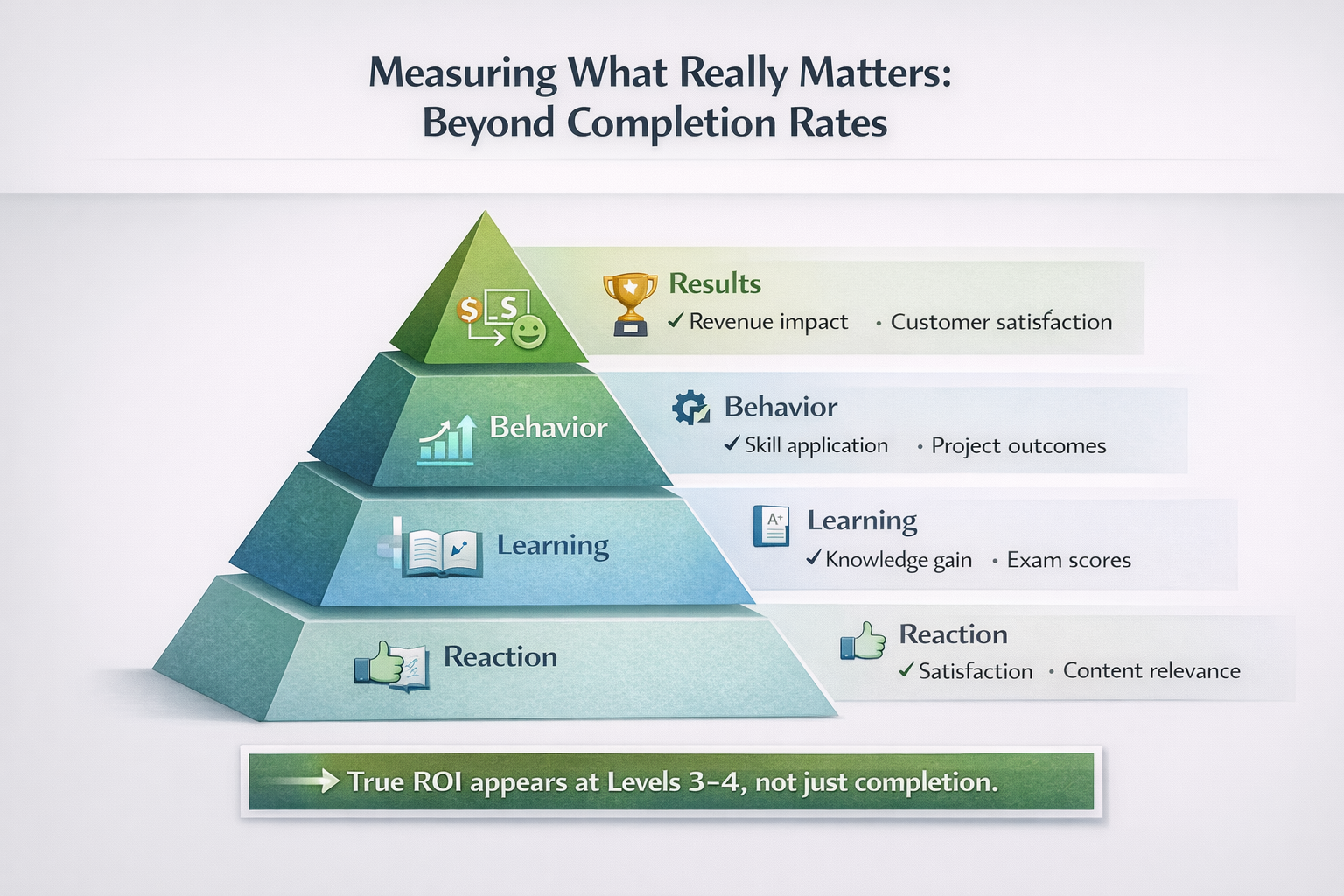
The 4-Level Measurement Framework: Beyond Completion Rates
Most organizations track certification completion rates. This is a basic metric. But it doesn't tell the full story. To measure true partnership success, implement the 4-level framework.
Level 1 measures participant reaction. Did employees find the program valuable? Use surveys immediately after certification. Ask about content relevance and instructor quality.
Level 2 assesses learning. Did knowledge actually increase? Use pre- and post-assessments. Track scores on certification exams. Compare results across departments.
Level 3 evaluates behavior change. Are certified employees applying new skills? Monitor project outcomes. Track innovation initiatives. Measure adoption of new methodologies.
Level 4 examines business results. This is where ROI becomes clear. Connect certifications to revenue growth. Link skills to customer satisfaction improvements.
Calculating True ROI: The Complete Formula
True ROI goes beyond simple cost-per-certification calculations. Start with total program costs. Include partnership fees, employee time, and technology expenses.
Then measure benefits across multiple dimensions. Track productivity improvements from faster project completion. Calculate revenue increases from new client acquisition. Measure cost savings from reduced errors.
Research suggests certified employees can deliver 20-30% higher productivity. They often complete projects 15-25% faster. These improvements directly impact your bottom line.
Advanced organizations use attribution modeling. They connect specific certifications to business outcomes. This creates a clear value chain from training to results.
Leading vs. Lagging Indicators: Early Warning System
Lagging indicators show what already happened. Certification completion rates are lagging. So are productivity improvements. These are important but reactive.
Leading indicators predict future success. They provide early warnings. Track employee engagement with learning materials. Monitor participation in study groups. Measure manager support levels.
High engagement with preparatory materials often predicts certification success. Active participation in mentorship programs suggests strong skill application. These indicators let you course-correct early.
Quarterly Partnership Review Template
Use this structured agenda for quarterly reviews. It ensures consistent measurement and continuous improvement.
Partnership Health Review AgendaTime: 90 minutes | Participants: Partnership leads, HR, department heads
1. Performance Metrics Review (20 minutes)
4-level framework results summary
Leading indicator trends analysis
ROI calculation updates
2. Partnership Experience Assessment (25 minutes)
Employee feedback highlights
Support quality evaluation
Technology platform performance
3. Strategic Alignment Check (20 minutes)
Business goal progress update
Skill gap closure assessment
Future certification needs forecast
4. Action Planning (25 minutes)
Improvement initiatives prioritization
Resource allocation decisions
Next quarter success metrics definition
Case Study: Manufacturing Partnership Success
A manufacturing company implemented this framework. They tracked beyond completion rates. Level 3 behavior changes showed certified engineers reduced equipment downtime by 40%. Level 4 results revealed $500,000 annual savings.
Their quarterly reviews identified a support gap. Certified employees needed more application guidance. They added monthly coaching sessions. This simple adjustment doubled skill application rates.
Actionable Takeaways
Start with the 4-level framework immediately. Don't wait for perfect data. Begin tracking at least two metrics per level. Expand as your program matures.
Calculate ROI quarterly, not annually. This provides timely insights. Adjust your partnership approach based on these findings. Share success stories internally to build momentum.
Remember: Certification partnerships succeed when measured comprehensively. Completion rates are just the starting point. True value emerges through behavior change and business impact.
Common Pitfalls and How to Avoid Them
Even with careful partner selection and implementation planning, certification partnerships face predictable challenges. Research suggests that approximately 40-50% of educational partnerships experience significant drift within the first two years. Recognizing these patterns early allows for proactive management.
Partnership drift occurs when organizational priorities shift, causing misalignment between partners. A technology company might initially prioritize cloud certifications, then pivot to cybersecurity as market demands change. Meanwhile, their certification partner continues emphasizing the original cloud focus.
Steps to prevent drift:
Schedule quarterly alignment meetings beyond operational reviews
Create a shared dashboard tracking both partners' strategic objectives
Establish formal change management protocols for goal adjustments
Scope creep silently undermines partnership value. What begins as 100 certification seats for engineers expands to include marketing teams, then customer support, then partner organizations. Each expansion dilutes resources without corresponding budget increases.
Example: A financial services firm added three "just this once" exceptions to their data analytics certification program. Within six months, these exceptions became the norm, increasing costs by approximately 35% without measurable ROI improvement.
Actionable takeaway: Implement a formal "scope change request" process requiring executive approval from both organizations. Document every deviation from the original agreement, no matter how small.
As certification programs expand, maintaining consistent quality becomes challenging. What worked for 50 employees often fails at 500. Common symptoms include:
Inconsistent mentor quality across departments
Varying completion rates between business units
Certification exam pass rates declining over time
Studies indicate that programs scaling beyond 200 participants typically experience 15-25% quality erosion without specific countermeasures.
Advanced insight: Create a "quality assurance council" with representatives from both organizations. This group should:
Conduct random quality audits quarterly
Review anonymized participant feedback
Benchmark against industry standards
Most organizations focus on partnership beginnings but neglect endings. Industry experts recommend developing exit strategies during implementation, not when problems arise.
Steps for responsible conclusion:
Define clear success metrics from day one
Establish transition timelines (typically 90-180 days)
Create knowledge transfer protocols
Plan for employee certification continuity
Case study: A manufacturing company's three-year certification partnership concluded smoothly because they:
Began transition planning at the 24-month mark
Trained internal staff to maintain certification standards
Provided alternative certification paths for employees
Celebrated partnership achievements publicly
Critical insight: The most successful partnerships plan their conclusion during implementation. This creates psychological safety for honest evaluation and prevents "sunk cost fallacy" decision-making.
Beyond avoiding pitfalls, establish regular health checks. Many experts recommend monthly "pulse surveys" with both partners' stakeholders. Track:
Alignment with strategic objectives (scale 1-10)
Resource allocation adequacy
Communication effectiveness
Value perception
When any metric drops below 7/10, trigger immediate review sessions. This proactive approach prevents small issues from becoming partnership-ending problems.
Final takeaway: Certification partnerships require ongoing maintenance, not just initial setup. Regular alignment, clear boundaries, quality monitoring, and exit planning transform temporary arrangements into lasting strategic assets.


.png&w=3840&q=75)

