Your next career move doesn't have to follow your previous one.
For decades, career success followed a familiar formula: choose an industry, build experience, climb the corporate ladder, and stay on a steady path toward a more senior position.
If you started as a Marketing Executive, you were expected to become a Marketing Manager, then a Marketing Director, and eventually a Chief Marketing Officer. Every move was supposed to bring a higher title, more responsibility, and a bigger salary.
But modern careers don't always work that way.
Today, a marketing professional might transition into product management. A corporate employee might become a freelancer, consultant, or entrepreneur. Someone with ten years of experience might move into an entirely different industry and start building a new career around skills they already have.
These moves aren't necessarily signs of career instability. They can be intentional decisions to find better opportunities, develop new capabilities, or pursue a different definition of success.
The traditional career ladder is giving way to something more flexible: a career built around skills, experiences, and opportunities rather than a single predetermined path.
So, what does this mean for your career, and how can you prepare for a future that may not follow a straight line?

The traditional career ladder is built around upward progression. You gain experience in one role, earn a promotion, and move into a more senior position within the same function or industry.
This model can still work well, especially for careers that require deep specialization or a clearly defined progression. However, it is no longer the only way to grow professionally.
A modern career lattice offers a different perspective. Instead of moving only upward, professionals can move sideways, diagonally, or across industries to build new capabilities and discover opportunities.
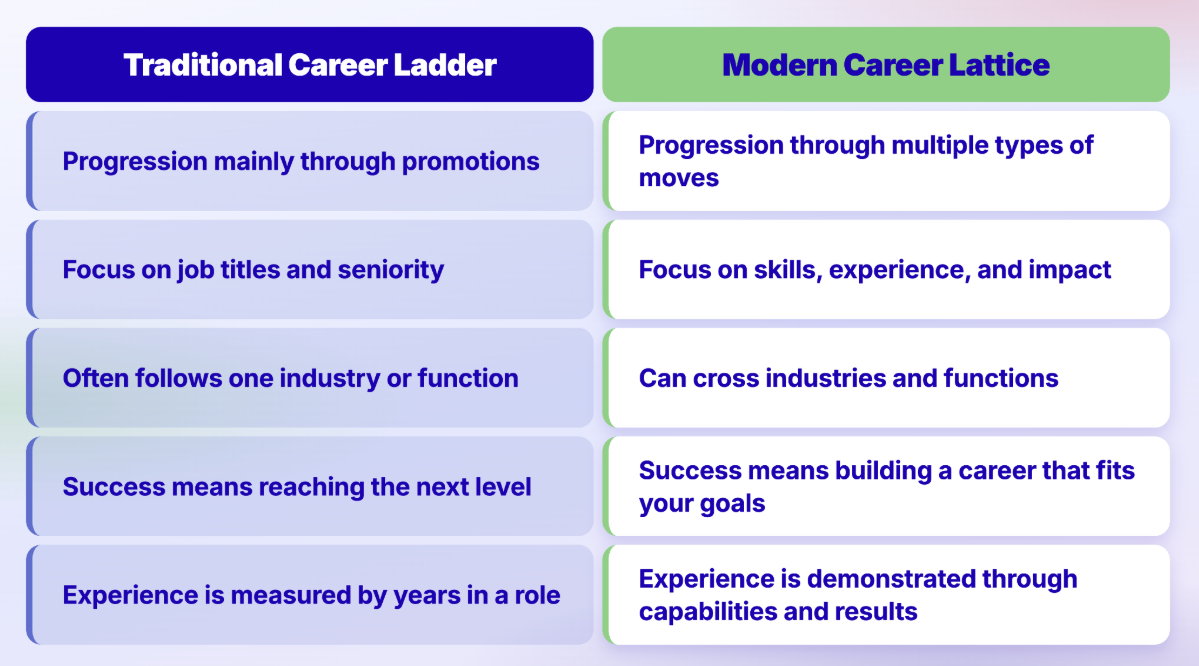
For example, a graphic designer might move into UX/UI design, then product design, and eventually product management. Each transition builds on previous experience while opening up a different set of opportunities.
The important point is that career growth doesn't always mean moving up. Sometimes, moving sideways is what helps you move forward.
A career change can happen for many reasons. Some professionals want better compensation, while others seek more meaningful work, greater flexibility, or opportunities to develop new skills.
Technology is also changing how work gets done. As new tools and business models emerge, some roles evolve while new responsibilities and opportunities appear. Professionals may need to reconsider where their existing capabilities can create the most value.
Here are several reasons someone might choose a nonlinear career path:
Changing priorities: What you wanted from work in your early twenties may differ from what matters to you later in your career.
New opportunities: An emerging industry or role may offer more room to grow than your current field.
Skill development: You may discover that your strongest abilities are relevant to a different function.
Industry transformation: Automation, AI, and changing business needs can reshape the skills employers value.
Burnout or lack of fulfillment: You may want a role that better matches your interests, strengths, or preferred working style.
Personal circumstances: Location, family responsibilities, flexibility, or financial goals may influence your next move.
Changing industries doesn't mean starting from zero. A customer service professional moving into customer success, for example, may already understand customer needs, communication, problem-solving, and relationship management.
The challenge is learning how to connect those existing strengths to the requirements of a new role.
Another shift in modern working life is the growth of portfolio careers.
Rather than relying on a single full-time job to define their professional identity, some people combine several income streams or professional activities. These might include freelance projects, consulting, part-time employment, teaching, content creation, or running a small business.
For example, a marketing professional might work full-time while taking on freelance projects, creating educational content, and teaching digital marketing workshops.
Each activity can develop different skills, expand a professional network, and create additional opportunities.
A portfolio career can offer:
More variety: Work across different projects, clients, or industries.
Broader skills: Develop capabilities beyond your primary job description.
Additional income opportunities: Explore different ways to monetize your expertise.
Greater flexibility: Depending on your arrangements, choose work that fits your priorities.
A wider professional network: Build relationships beyond one organization.
However, portfolio careers also come with challenges. Income can be unpredictable, managing multiple commitments takes time, and freelancers may need to handle administration, marketing, and client relationships themselves.
A portfolio career is not automatically better than traditional employment. It is simply another way to organize your working life.
The key is to build a portfolio intentionally, with a clear understanding of your financial needs, capacity, and long-term goals.

One of the biggest misconceptions about career growth is that every move should come with a better title.
In reality, a lateral move can be valuable even when your job title and salary remain similar. It may help you gain experience in a new function, develop leadership capabilities, or prepare for a future role.
Consider these examples:
Example 1: From Content Creator to Product Marketing
A content creator already understands storytelling, audience behavior, campaign execution, and brand communication. By developing skills in customer research, product positioning, and go-to-market strategy, they may be able to transition into product marketing.
Example 2: From Teacher to Learning and Development Specialist
A teacher has experience explaining complex ideas, designing learning activities, and assessing progress. These capabilities can transfer to corporate training, employee development, or instructional design.
Example 3: From Customer Service to Business Analysis
A customer service professional understands recurring customer problems, service processes, and operational bottlenecks. With additional training in data analysis, process mapping, and reporting, they may be able to move toward business analysis.
Notice that none of these transitions requires the person to discard their previous experience.
Instead, they build on what they already know while developing the skills needed for their next role.
Before rejecting a lateral move because it doesn't look like a promotion, ask yourself:
Will this role help me develop skills I currently lack?
Will I gain experience that is valuable in my target industry?
Will it expand my professional network?
Will it create opportunities for future growth?
Does it move me closer to the kind of work I want to do?
A move can be a strategic investment in your future, even if its immediate rewards aren't obvious.

In a nonlinear career, your job title tells only part of your professional story.
Two people with the same title may have very different capabilities. Meanwhile, professionals from different industries may possess remarkably similar skills.
This is why skills-based career progression matters.
Instead of asking only, "What position have you held?" employers and professionals can also ask, "What can you do, what problems can you solve, and what results can you deliver?"
Imagine two candidates applying for a project management role.
One has previously held the title of Project Manager. The other has worked as an event coordinator, managing schedules, suppliers, budgets, stakeholders, and last-minute changes.
Although their job titles differ, both may have relevant project coordination experience. The second candidate still needs to demonstrate the required capabilities, but their previous title shouldn't automatically disqualify them.
Skills-based progression encourages professionals to look beyond job titles and identify the capabilities they can bring to new opportunities.
These capabilities may include:
Technical skills: Data analysis, coding, design, financial modeling, or digital marketing.
Communication skills: Presenting ideas, writing clearly, negotiating, and managing stakeholders.
Problem-solving skills: Identifying root causes, evaluating options, and developing solutions.
Project management skills: Planning timelines, coordinating resources, and managing deliverables.
Leadership skills: Influencing others, resolving conflicts, and supporting team performance.
Digital and AI skills: Using technology to improve workflows, analyze information, and complete tasks effectively.
The goal isn't to become good at everything. It's to understand which skills you already have, which ones are transferable, and which ones you need to develop for your next move.

Transferable skills are capabilities you can apply across different roles, industries, or working environments.
They are particularly important when you're changing careers because they help employers understand the value of your previous experience.
However, transferable skills aren't identified simply by listing qualities such as "hardworking," "creative," or "a good communicator." You need evidence showing how you used those skills in practice.
Try this four-step approach.
Look beyond your job title and list the tasks you performed regularly.
For example, a Social Media Executive might have:
Planned monthly content calendars.
Coordinated with designers and video editors.
Analyzed engagement metrics.
Managed campaign deadlines.
Presented performance reports to stakeholders.
Translate each responsibility into the capability it demonstrates.
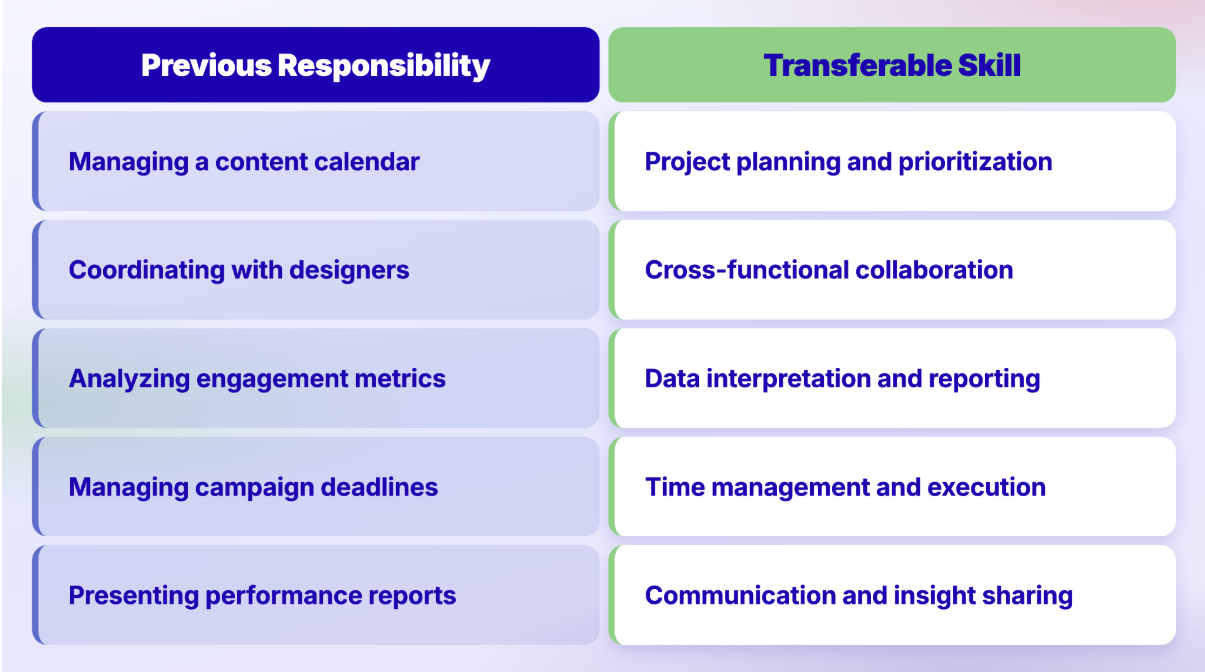
This exercise helps you recognize that your experience may be relevant beyond your current function.
Research job descriptions for the position you want. Look for recurring responsibilities, required capabilities, and expected outcomes.
If you want to move from content creation into project management, for example, you may already have experience with timelines, coordination, resource planning, and deliverables.
You may still need to learn formal project management methods or tools, but you won't necessarily be starting from scratch.
Separate your skills into three categories:
Ready to use: Skills you can already demonstrate with concrete examples.
Need to strengthen: Skills you have used but need to develop further.
Need to learn: Skills or technical knowledge required for your target role that you haven't yet developed.
This gives you a more practical learning plan than simply deciding to "learn something new."
For example, if you're transitioning into data analysis, you might already have communication and problem-solving skills but need to develop SQL, spreadsheet analysis, or data visualization.
You can then prioritize relevant courses, projects, or practical experience to help close those gaps.
Building a Resume for a Nonlinear Career
A nonlinear career can make resume writing more challenging. Your previous titles may not match your target position, your experience may span several industries, and your professional journey may not follow an obvious progression.
The solution isn't to hide your career changes. It's to explain the connections between them.
Your resume should help employers understand three things:
What role are you targeting?
Which relevant skills and experiences do you bring?
Why does your previous experience make you a credible candidate?
Here are five ways to communicate your career story more effectively.
Your summary should connect your previous experience to the role you want.
Instead of writing:
"Marketing professional with experience in social media, content creation, and digital campaigns."
You could write:
"Marketing professional with experience in campaign planning, cross-functional coordination, and performance analysis, seeking to apply these skills to product marketing and go-to-market strategy."
The second version communicates a clearer direction and explains how your existing capabilities relate to your target role.
Include a skills section that reflects the requirements of your target position.
For a transition into project management, relevant skills might include:
Project coordination
Timeline and resource planning
Stakeholder communication
Risk identification
Budget tracking
Reporting and documentation
Only include skills you can support with real experience, training, or projects.
Employers need more than a list of tasks. Show how you used your skills and what you achieved.
Instead of:
"Responsible for coordinating marketing campaigns."
Write:
"Coordinated cross-functional marketing campaigns by managing timelines, aligning deliverables across teams, and tracking performance against campaign objectives."
If you have reliable metrics, include them to make the result more concrete. Never invent numbers to make your experience appear stronger.
If you're moving into a new field, your previous employment may not provide enough evidence of your readiness.
You can strengthen your application with relevant projects, certifications, freelance work, volunteer experience, or practical coursework.
For example, an aspiring data analyst could include a dashboard project using publicly available data. Someone moving into UX design could include a portfolio case study that demonstrates their research and design process.
These examples help bridge the gap between your previous career and your intended direction.
A nonlinear career may give you a broad range of experience, but not every detail belongs in every application.
Prioritize the responsibilities, skills, achievements, and projects that are most relevant to the job description. Keep other experience concise when it doesn't directly support your application.
The objective isn't to make your career look perfectly linear. It's to make your suitability for the role easy to understand.

A more flexible career requires a different way of planning.
Rather than focusing exclusively on promotions or following a fixed timeline, consider what you want to be capable of doing in the next one to three years.
You might want to become better at leading projects, analyzing business performance, managing stakeholders, using AI tools, or making strategic decisions.
Once you define those capabilities, you can identify the roles, projects, and learning opportunities that will help you develop them.
Try asking yourself these five questions:
Direction: What kind of work do I want to do more of?
Strengths: Which skills have I already developed through work, study, or personal projects?
Gaps: What capabilities do I need for my next career move?
Evidence: How can I demonstrate those capabilities to an employer?
Opportunities: Which roles would let me apply my existing skills while developing new ones?
Your next move might be a promotion, a lateral transfer, a career pivot, a freelance project, or a course that prepares you for a new opportunity.
There is no single correct sequence. What matters is making intentional decisions that help you move toward your goals.

A nonlinear career doesn't mean moving without direction. It means having the flexibility to explore different paths while understanding the skills and experience that make you valuable.
Jobcadu's Career Toolkit can help you reflect on your career direction, identify skill gaps, and explore areas for development. With relevant courses, you can work toward building the capabilities your target roles require.
When you're ready to explore new opportunities, Application Tools can help you discover roles to consider based on your profile and qualifications. Use job descriptions to compare your current skills with employer requirements and identify opportunities that align with your next career step.
No sections detected in this article.